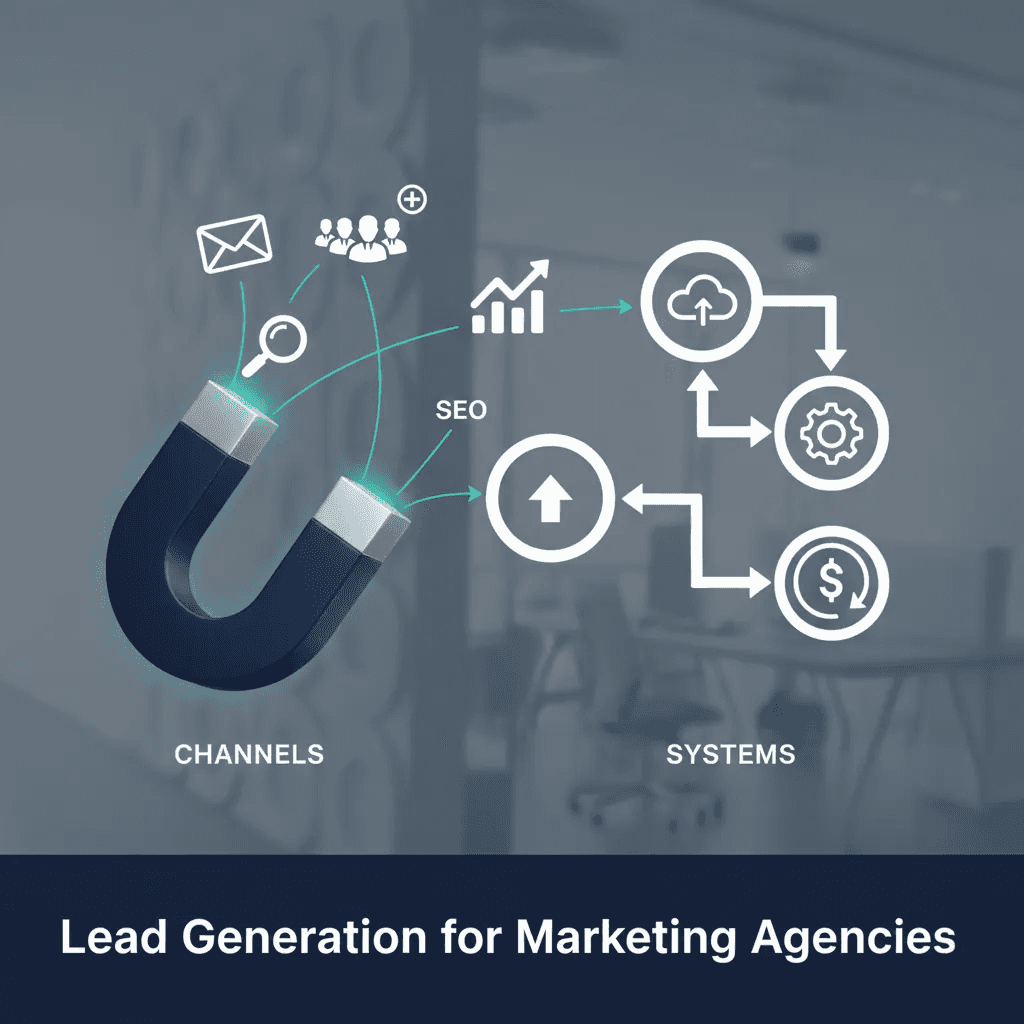
Lead Generation for Marketing Agencies: Systems, Channels, and What Actually Works

If you are searching for lead generation for marketing agencies, you are probably not looking for more tactics. You want a predictable way to create conversations with buyers who can afford your services, need them now, and are a good fit. The hard truth: most agencies do not fail because they lack ideas. They fail because they confuse activity with a system, chase the wrong ICP, and rely on channels that do not match their offer, stage, or capacity.

This page is a practical playbook for building an agency pipeline that holds up under scrutiny: qualification, model selection, channel mechanics, benchmarks, and a decision framework that tells you what to do next (and what to stop doing). It is written for agency owners and operators who want clarity and execution, not theory.

What a qualified lead means for a marketing agency

Lead vs prospect vs opportunity for agencies

In agency land, people use “lead” to mean everything from a website form submission to a booked call to a signed client. That ambiguity makes performance impossible to evaluate. Use these definitions so your team (and your analytics) stop guessing:

  • Lead: A contact that fits basic filters (industry, company size, role) and has shown some signal of interest or relevance (reply, form submission, engaged referral intro).
  • Prospect: A lead that matches your ICP and has a plausible problem you can solve, but has not been qualified for budget, timing, or authority.
  • Opportunity: A prospect with confirmed need, decision authority (or a clear path to it), realistic budget, and an agreed next step (audit review, proposal, second call).

When you measure “leads,” you will get better decisions if you measure opportunities and qualified meetings, not raw contacts. Otherwise you optimize for volume and end up with more spam, more tire-kickers, and worse close rates.

Qualification criteria that matter: budget, authority, need, timeline, fit

Qualification for agencies is not complicated, but it must be explicit. Use a simple grid and score each dimension 0–2:

  • Budget: Can they afford your minimum retainer or project fee without “let me talk to my accountant” energy?
  • Authority: Are you speaking to the decision-maker, or someone who will “send this internally” and disappear?
  • Need: Is there a pain with cost (missed revenue, churn, staffing constraints, CAC spikes) or is this “nice to have”?
  • Timeline: Do they have a deadline (quarter goals, launch, board pressure), or are they browsing?
  • Fit: Do you have proof you can solve this in their context (industry, channel mix, constraints), and do you actually want to?

Agencies that scale get picky. They choose minimum standards and enforce them. The short-term discomfort of disqualifying is the price of a healthy pipeline.

Why most agencies think they have a lead problem but actually have a positioning problem

If your message sounds like every other agency (“we help businesses grow using SEO/ads/social”), you are not doing lead generation. You are doing “please compare me on price.” In competitive markets, buyers filter aggressively. The fastest way to improve lead quality is to sharpen positioning:

  • Specific outcome: What measurable result do you deliver (and for whom)?
  • Specific mechanism: Why do you get that result (process, model, assets, expertise)?
  • Specific proof: Where have you done it (case studies, before/after, references)?

Choose your acquisition model: inbound, outbound, or hybrid

Inbound model: trust-first demand generation and its constraints

Inbound is when buyers find you (search, content, referrals, communities) and enter your world already believing you may be the right fit. Inbound works best when you have:

  • Clear niche or category alignment
  • Strong proof assets (case studies, recognizable logos, strong portfolio)
  • Patience for compounding (SEO, content, partnerships)

The constraint is speed. Inbound usually has a ramp-up period. If you need meetings this month, inbound alone will not save you unless you already have traction.

Outbound model: controlled volume and the cost of attention

Outbound is when you create demand through direct outreach (LinkedIn, cold email, partner introductions). The advantage is control: you can choose who you talk to, when, and in what volume. The cost is attention: you must earn trust quickly with a clear, relevant reason to talk.

Outbound works best when you have:

  • A defined ICP and targeting list
  • A sharp offer that reduces risk (audit, diagnostic, workshop, teardown)
  • Operational discipline to follow up consistently

Hybrid model: sequencing inbound assets with outbound execution

Hybrid is the highest-leverage model for most agencies because it combines control (outbound) with credibility (inbound assets). The sequence looks like this:

  1. Build proof assets: case studies, teardown examples, short explainer pages.
  2. Use outbound to drive attention: outreach that points to proof, not hype.
  3. Convert with pre-qualification: clear next step and filters.

Hybrid prevents the classic outbound trap: booking low-quality calls because your message has no credibility behind it.

When each model wins based on deal size and sales cycle

Match model to reality:

  • Lower deal size, shorter cycle: outbound can work fast, especially with a simple offer and clear ROI.
  • Higher deal size, longer cycle: inbound assets matter more because buyers need proof and reassurance.
  • Complex services: hybrid usually wins because it creates trust before you ask for commitment.

The mistake is choosing a model based on what sounds good instead of what your agency can execute consistently.

Match lead generation to your agency type and offer

SMMA and full-service retainers: what converts and what does not

For SMMA and full-service retainers, your biggest enemy is skepticism. Buyers have seen too many “we run your ads” offers that deliver vanity metrics. What converts is specificity:

  • A clear niche (one industry, one buyer type, one dominant channel)
  • A concrete operating model (how you work, what you do weekly, what the client must provide)
  • Risk reduction (pilot, phased rollout, performance gates, clear cancellation terms)

What typically does not convert: generic pitch decks, vague promises, and “free strategy calls” with no pre-qualification.

SEO agencies: search intent, proof requirements, and longer sales cycles

SEO buyers are often more analytical and slower to commit because results take time and vendor quality varies widely. To generate leads as an SEO agency, you need:

  • Evidence you understand their search landscape (not just generic keyword talk)
  • Process transparency (technical baseline, content plan, links, measurement)
  • Proof tied to outcomes (qualified leads, revenue, pipeline), not rankings alone

SEO lead generation works best when your inbound assets demonstrate expertise and your outbound message points to a relevant teardown or case study. Your sales process also needs to educate without overwhelming.

PPC agencies: trust barriers, audit offers, and fast qualification

PPC is easier to qualify quickly because the pain is immediate: wasted spend, volatile CPA, low conversion rates. The fastest route to meetings is a tight diagnostic offer:

  • Account audit with a defined deliverable (findings + priority fixes)
  • Landing page conversion review tied to ad performance
  • 90-day performance plan with assumptions clearly stated

PPC buyers do not want theory. They want to know what you would do differently next week. You can accelerate trust by showing the checklist you use and the common failure patterns you fix.

Project-based vs retainer offers: pipeline stability trade-offs

Project work is easier to sell (lower commitment) but harder to stabilize (more sales required). Retainers are harder to sell but create predictable revenue. Your lead generation should reflect that:

  • Project-based: optimize for higher volume, faster qualification, standardized scope.
  • Retainer: optimize for higher trust, stronger proof, deeper discovery.

If you sell retainers with a project-style funnel, you will attract mismatched buyers and churn will follow.

Channel deep dives: how marketing agencies get clients

LinkedIn outbound: targeting, messaging angles, and follow-up sequences

LinkedIn outbound works when you treat it like a data problem, not a charisma contest. The essentials:

  • Targeting: choose one ICP slice (industry + role + company size) and one trigger (hiring, new funding, expansion, ad spend signals, recent site relaunch).
  • Messaging angle: lead with relevance and observation, not credentials. A good opener is about their situation.
  • Follow-up: most outcomes come from follow-up 2–5, not message 1.

A simple sequence that avoids spam:

  1. Connection note: 1 sentence with relevance.
  2. Message 1: 2–3 sentences, one insight, one question.
  3. Message 2: share a tiny teardown or example.
  4. Message 3: offer a specific next step (15-min diagnostic) with a clear outcome.

Cold email: list quality, segmentation, and reply-driving offers

Cold email is not dead. Bad cold email is. The differentiator is list quality and segmentation. If you email “marketing@company.com” with a generic pitch, you are competing with spam filters and human distrust.

What works:

  • List quality: accurate role-based contacts and companies that actually match your ICP.
  • Segmentation: separate sequences by industry and trigger so your message can be specific.
  • Offer: a reply-driving next step that is low risk and high clarity (audit, teardown, benchmark comparison).

SEO and content: topics that attract buyers not learners

SEO can generate the best leads because the buyer is already searching for a solution. But most agency blogs attract learners (other marketers) instead of buyers. To attract buyers, create pages around:

  • Problem queries: low lead quality, high CAC, low conversion, churn.
  • Comparison queries: in-house vs agency, PPC agency vs freelancer, SEO vs ads trade-offs.
  • Evaluation queries: pricing, process, timeline, what to expect.

The winning content is not “10 marketing tips.” It is content that helps a buyer decide, reduce risk, and understand what working with an agency actually looks like.

Paid ads: what to advertise for agencies without wasting budget

Paid ads for agencies fail when you advertise the service directly to cold audiences (“Hire our agency”). You have not earned trust yet. What tends to work better:

  • Lead magnet with strong intent: a diagnostic checklist, benchmark report, or teardown offer tied to a real pain.
  • Retargeting: ads to people who already visited your proof pages or case studies.
  • Offer clarity: one promise for the next step, not the whole service menu.

Ads can scale once your funnel converts. If your discovery calls do not close, ads will only buy faster failure.

Partnerships and referrals: building a repeatable referral engine

Referrals are the highest-trust channel, but they are often accidental. Build a referral engine by design:

  • Partner types: dev shops, consultants, niche software vendors, fractional CFOs, recruiters, PR firms.
  • Clear referral target: define the exact client profile you want introductions to.
  • Give partners tools: a one-page explainer, sample intro text, and a case study they can forward.

Partners need to feel safe introducing you. That comes from predictability: your process, your communication, and your delivery must be reliable.

Benchmarks and expectations: what good looks like by channel

Time-to-results by channel and why ramp-up matters

Most disappointment comes from unrealistic timelines. Here is a practical view:

  • LinkedIn outbound: meetings can happen in 2–4 weeks if targeting and follow-up are disciplined.
  • Cold email: 2–6 weeks depending on list quality and offer clarity.
  • Partnerships: 4–12 weeks because relationships take time.
  • SEO and content: often 3–6+ months for meaningful compounding, faster if you already have authority.
  • Paid ads: can be quick, but only if your funnel and sales process already convert.

Ramp-up is normal. The goal is not immediate perfection. It is learning fast without burning trust.

Conversion ranges that separate healthy from broken funnels

Benchmarks vary, but you need ranges to diagnose reality. Use these as directional signals:

  • Outbound to meeting: if you book almost nothing, your targeting or offer is off. If you book many but none qualify, your filters and messaging are off.
  • Meeting to opportunity: you should consistently identify fit and disqualify quickly.
  • Opportunity to close: if close rate is low, your proof, process clarity, pricing structure, or positioning is mismatched.

Do not obsess over a single “best” number. Use conversion rates to identify which part of the pipeline is leaking.

Pipeline math for agencies: leads needed by close rate and deal size

Pipeline math is how you stop guessing. Start with a monthly revenue target and work backwards:

  1. Pick your average deal value (project fee or monthly retainer).
  2. Estimate your close rate from qualified opportunities (be honest).
  3. Calculate opportunities needed: target revenue divided by average deal value, then divided by close rate.

Example: if you want 20k in new monthly retainer revenue, your average retainer is 4k, and you close 25% of qualified opportunities, you need 20k / 4k = 5 new clients. Then 5 / 0.25 = 20 qualified opportunities in the period that drives those closes. Next, determine how many meetings you need to produce those opportunities.

This is why “more leads” is the wrong goal. You want enough qualified opportunities to hit targets.

Capacity planning: how many leads you can handle without churn

Agencies often chase volume beyond delivery capacity. That creates churn, destroys referrals, and breaks your brand. Capacity planning means:

  • Define how many active clients your team can deliver for without quality dropping.
  • Define onboarding bandwidth (how many new clients per month is safe).
  • Align lead gen volume to onboarding capacity.

In other words: closing 10 clients per month is not a win if you can only onboard 3 well. It becomes a reputational problem.

The agency lead generation system: from targeting to booked calls

ICP design for agencies: niches, triggers, and disqualifiers

Your ICP is not “business owners.” A usable ICP includes:

  • Niche: industry + business model + typical constraints.
  • Buyer: role and what they care about (CEOs want growth and risk reduction; marketing managers want execution and internal buy-in).
  • Triggers: events that increase urgency (hiring, expansion, new location, funding, competitor pressure, new product line).
  • Disqualifiers: low budget, no authority, no capacity to implement, unrealistic expectations.

Disqualifiers are not negative. They are your filter against chaos.

Offer packaging: why audits and free work often backfire

Audits can work, but many agencies use them as a crutch because they cannot articulate value clearly. The audit becomes free consulting that attracts people who want ideas, not implementation.

To make an audit work:

  • Define exactly what they get (scope, format, decision output).
  • Make the audit lead to a decision (go or no-go, prioritized roadmap).
  • Set boundaries: you are not redesigning their full strategy for free.

If your audit cannot be delivered consistently and profitably, it is not a lead gen asset. It is a time leak.

Funnel steps: landing page, proof, scheduling, and pre-qualification

Your funnel should reduce cognitive load for the buyer. A clean pipeline funnel usually includes:

  • One primary next step: diagnostic call, teardown, workshop, or assessment.
  • Pre-qualification: short form that filters for budget, goals, timeline, and fit.
  • Scheduling: frictionless booking and clear expectations for the call.

The aim is not to impress. It is to help the right buyer say, “Yes, this is worth my time.”

Sales process alignment: discovery calls, proposals, and follow-up

If you generate meetings but do not close, lead gen is not your bottleneck. Your sales process is. A strong agency sales flow typically looks like:

  1. Discovery: confirm fit, define the real problem, quantify impact, identify constraints.
  2. Diagnosis: show what is happening and why, using evidence.
  3. Plan: outline the approach, timeline, responsibilities, and success metrics.
  4. Proposal: simple options and clear scope boundaries.
  5. Follow-up: structured, time-bound, and helpful (not needy).

Why agency lead generation fails and how to fix it

Weak differentiation: competing on price and generic promises

The market is crowded. If you lead with services instead of outcomes, buyers default to price comparison. Fix by making your promise and mechanism specific. Your prospect should be able to say, “They are the agency that does X for Y using Z.”

Low-quality lists and bad targeting signals

Most outbound fails because the list is wrong. Agencies target companies that are not in-market or do not have the problem they claim to solve. Fix by targeting triggers and signals, not just firmographics. When your audience is more likely to have the problem today, your messaging becomes simpler and your response rate rises.

Messaging that sounds like every other agency

If your message could be sent by 1,000 agencies, it will be ignored. Strong messaging includes:

  • A relevant observation (what you noticed)
  • A believable hypothesis (why it matters)
  • A low-friction question (do you want to see what we found?)

Avoid “we help businesses grow” and replace it with a specific scenario the buyer recognizes.

No proof, no process, and no outcomes: the trust gap

Buyers are not buying marketing services. They are buying reduced uncertainty. Proof closes the trust gap. At minimum, you need:

  • 1–3 strong case studies relevant to the ICP you are targeting
  • A clear process overview (what happens in weeks 1–2, month 1, month 2)
  • A defined measurement plan (what you track and why)

Without proof and process, you can still get leads, but they will be low quality because only desperate or naive buyers take the risk.

Operational leakage: poor onboarding and delivery killing referrals

Lead generation is connected to delivery. If onboarding is chaotic, clients will not refer you, even if results are decent. Fix by making onboarding predictable:

  • Clear kickoff agenda and responsibilities
  • Defined deliverables for the first 30 days
  • Communication cadence and escalation path

Referrals are earned through reliability, not just performance.

Decision framework: pick the right lead generation approach for your stage

Starter agencies: fastest path to first consistent meetings

If you are early-stage, your goal is not to “build a brand.” Your goal is to learn what sells and get consistent meetings with a tight ICP.

  • Pick one niche slice you can speak to confidently.
  • Choose one outbound channel (LinkedIn or cold email) and commit to weekly volume.
  • Create one proof asset: a teardown example or mini case study, even if from a small win.
  • Use a simple, clear offer (diagnostic call with a defined output).

Starter agencies win by focus and repetition, not by building complex funnels.

Scaling agencies: building predictable volume without destroying quality

Scaling agencies usually have some proof and some referrals, but inconsistency. The goal is a repeatable machine:

  • Systemize targeting and list building.
  • Standardize your outreach sequences and follow-up.
  • Add inbound proof pages and retargeting to increase trust.
  • Enforce qualification so sales time is spent on real opportunities.

At this stage, the biggest upgrade is building a pipeline that produces opportunities on schedule, not “whenever someone asks.”

Established agencies: increasing deal size and reducing lead volatility

Established agencies should optimize for deal quality, not just volume. Your priorities:

  • Sharpen positioning to attract higher-LTV clients.
  • Build deeper proof (industry-specific case studies, process documentation).
  • Develop partnerships that send high-quality introductions.
  • Invest in inbound assets that compound (SEO, content, events, community presence).

Volatility drops when your lead sources are diversified and your brand is anchored in a clear niche.

A 30-day execution plan: the minimum viable pipeline build

  1. Week 1: define ICP, triggers, disqualifiers, and minimum deal size; create one proof asset.
  2. Week 2: build a targeted list; write one sequence; set up tracking and a simple CRM workflow.
  3. Week 3: run outreach consistently; refine based on replies; tighten qualification questions.
  4. Week 4: review conversion rates; fix the biggest bottleneck (targeting, offer, proof, follow-up).

The goal is not perfection. It is a working baseline you can improve every week.

Next steps: turn this into an execution plan

Checklist: choose one model, one channel, one offer, one KPI

  • Model: inbound, outbound, or hybrid
  • Channel: LinkedIn, cold email, SEO, ads, partnerships (pick one primary)
  • Offer: diagnostic, teardown, workshop, or assessment (one clear next step)
  • KPI: qualified meetings per week (not messages sent)

Write these four choices down. If you cannot state them in one sentence, your plan is too vague to execute.

Measurement setup: what to track weekly to avoid self-deception

Track the minimum numbers that reveal truth:

  • New contacts reached (by channel)
  • Reply rate (positive vs negative)
  • Meetings booked
  • Meetings qualified (opportunities)
  • Proposals sent
  • Deals closed

Then ask one diagnostic question weekly: “Where is the biggest drop?” Fix that before adding more volume.

Soft CTA: request a pipeline audit or get a template kit

If you want to move faster, a practical next step is to run a pipeline audit on your current system. The goal is to identify the single biggest constraint: targeting, offer, proof, follow-up, or sales process. If you prefer to implement yourself, build a small template kit that includes: an ICP sheet, outreach sequences, qualification questions, and a weekly metrics dashboard.

Frequently asked questions about lead generation for marketing agencies

What is the fastest lead generation method for a marketing agency starting from zero?

The fastest reliable path is focused outbound with tight targeting and a clear, low-friction offer. Choose one ICP slice, build a clean list, run a simple outreach sequence with consistent follow-up, and use a diagnostic call or teardown as the next step. Speed comes from relevance and repetition, not from blasting volume.

How many leads does a marketing agency need per month to grow steadily?

Do not start with “leads.” Start with your revenue target, average deal size, and close rate from qualified opportunities. Work backwards to opportunities needed, then meetings, then outreach volume. Many agencies grow steadily when they can produce a consistent number of qualified opportunities every month, even if the raw lead count is not high.

Does inbound or outbound produce higher quality leads for agencies?

Inbound often produces warmer leads because trust is already partly built, but it takes longer to ramp and depends on authority. Outbound can produce excellent leads when targeting and triggers are strong, but it requires sharper messaging and stronger proof to overcome skepticism. For most agencies, a hybrid approach yields the best blend of speed and quality.

Why do marketing agencies struggle with lead generation even with good services?

Because buyers do not buy “good services.” They buy reduced uncertainty. Agencies struggle when they lack differentiation, rely on generic messaging, do not show proof, and do not have a clear process. The fix is often positioning and system design, not switching channels every month.

What should a marketing agency offer to get more booked calls without discounting?

Offer a clear diagnostic with a defined output: a teardown, benchmark review, audit with prioritized fixes, or a short workshop tied to a measurable pain. The key is that the prospect knows exactly what they will get and why it matters, without you giving away full strategy work for free.

Lead Generation for Marketing Agencies: Systems, Channels, and What Actually Works

If you are searching for lead generation for marketing agencies, you are probably not looking for more tactics. You want a predictable way to create conversations with buyers who can afford your services, need them now, and are a good fit. The hard truth: most agencies do not fail because they lack ideas. They fail because they confuse activity with a system, chase the wrong ICP, and rely on channels that do not match their offer, stage, or capacity.

This page is a practical playbook for building an agency pipeline that holds up under scrutiny: qualification, model selection, channel mechanics, benchmarks, and a decision framework that tells you what to do next (and what to stop doing). It is written for agency owners and operators who want clarity and execution, not theory.

What a qualified lead means for a marketing agency

Lead vs prospect vs opportunity for agencies

In agency land, people use “lead” to mean everything from a website form submission to a booked call to a signed client. That ambiguity makes performance impossible to evaluate. Use these definitions so your team (and your analytics) stop guessing:

  • Lead: A contact that fits basic filters (industry, company size, role) and has shown some signal of interest or relevance (reply, form submission, engaged referral intro).
  • Prospect: A lead that matches your ICP and has a plausible problem you can solve, but has not been qualified for budget, timing, or authority.
  • Opportunity: A prospect with confirmed need, decision authority (or a clear path to it), realistic budget, and an agreed next step (audit review, proposal, second call).

When you measure “leads,” you will get better decisions if you measure opportunities and qualified meetings, not raw contacts. Otherwise you optimize for volume and end up with more spam, more tire-kickers, and worse close rates.

Qualification criteria that matter: budget, authority, need, timeline, fit

Qualification for agencies is not complicated, but it must be explicit. Use a simple grid and score each dimension 0–2:

  • Budget: Can they afford your minimum retainer or project fee without “let me talk to my accountant” energy?
  • Authority: Are you speaking to the decision-maker, or someone who will “send this internally” and disappear?
  • Need: Is there a pain with cost (missed revenue, churn, staffing constraints, CAC spikes) or is this “nice to have”?
  • Timeline: Do they have a deadline (quarter goals, launch, board pressure), or are they browsing?
  • Fit: Do you have proof you can solve this in their context (industry, channel mix, constraints), and do you actually want to?

Agencies that scale get picky. They choose minimum standards and enforce them. The short-term discomfort of disqualifying is the price of a healthy pipeline.

Why most agencies think they have a lead problem but actually have a positioning problem

If your message sounds like every other agency (“we help businesses grow using SEO/ads/social”), you are not doing lead generation. You are doing “please compare me on price.” In competitive markets, buyers filter aggressively. The fastest way to improve lead quality is to sharpen positioning:

  • Specific outcome: What measurable result do you deliver (and for whom)?
  • Specific mechanism: Why do you get that result (process, model, assets, expertise)?
  • Specific proof: Where have you done it (case studies, before/after, references)?

Choose your acquisition model: inbound, outbound, or hybrid

Inbound model: trust-first demand generation and its constraints

Inbound is when buyers find you (search, content, referrals, communities) and enter your world already believing you may be the right fit. Inbound works best when you have:

  • Clear niche or category alignment
  • Strong proof assets (case studies, recognizable logos, strong portfolio)
  • Patience for compounding (SEO, content, partnerships)

The constraint is speed. Inbound usually has a ramp-up period. If you need meetings this month, inbound alone will not save you unless you already have traction.

Outbound model: controlled volume and the cost of attention

Outbound is when you create demand through direct outreach (LinkedIn, cold email, partner introductions). The advantage is control: you can choose who you talk to, when, and in what volume. The cost is attention: you must earn trust quickly with a clear, relevant reason to talk.

Outbound works best when you have:

  • A defined ICP and targeting list
  • A sharp offer that reduces risk (audit, diagnostic, workshop, teardown)
  • Operational discipline to follow up consistently

Hybrid model: sequencing inbound assets with outbound execution

Hybrid is the highest-leverage model for most agencies because it combines control (outbound) with credibility (inbound assets). The sequence looks like this:

  1. Build proof assets: case studies, teardown examples, short explainer pages.
  2. Use outbound to drive attention: outreach that points to proof, not hype.
  3. Convert with pre-qualification: clear next step and filters.

Hybrid prevents the classic outbound trap: booking low-quality calls because your message has no credibility behind it.

When each model wins based on deal size and sales cycle

Match model to reality:

  • Lower deal size, shorter cycle: outbound can work fast, especially with a simple offer and clear ROI.
  • Higher deal size, longer cycle: inbound assets matter more because buyers need proof and reassurance.
  • Complex services: hybrid usually wins because it creates trust before you ask for commitment.

The mistake is choosing a model based on what sounds good instead of what your agency can execute consistently.

Match lead generation to your agency type and offer

SMMA and full-service retainers: what converts and what does not

For SMMA and full-service retainers, your biggest enemy is skepticism. Buyers have seen too many “we run your ads” offers that deliver vanity metrics. What converts is specificity:

  • A clear niche (one industry, one buyer type, one dominant channel)
  • A concrete operating model (how you work, what you do weekly, what the client must provide)
  • Risk reduction (pilot, phased rollout, performance gates, clear cancellation terms)

What typically does not convert: generic pitch decks, vague promises, and “free strategy calls” with no pre-qualification.

SEO agencies: search intent, proof requirements, and longer sales cycles

SEO buyers are often more analytical and slower to commit because results take time and vendor quality varies widely. To generate leads as an SEO agency, you need:

  • Evidence you understand their search landscape (not just generic keyword talk)
  • Process transparency (technical baseline, content plan, links, measurement)
  • Proof tied to outcomes (qualified leads, revenue, pipeline), not rankings alone

SEO lead generation works best when your inbound assets demonstrate expertise and your outbound message points to a relevant teardown or case study. Your sales process also needs to educate without overwhelming.

PPC agencies: trust barriers, audit offers, and fast qualification

PPC is easier to qualify quickly because the pain is immediate: wasted spend, volatile CPA, low conversion rates. The fastest route to meetings is a tight diagnostic offer:

  • Account audit with a defined deliverable (findings + priority fixes)
  • Landing page conversion review tied to ad performance
  • 90-day performance plan with assumptions clearly stated

PPC buyers do not want theory. They want to know what you would do differently next week. You can accelerate trust by showing the checklist you use and the common failure patterns you fix.

Project-based vs retainer offers: pipeline stability trade-offs

Project work is easier to sell (lower commitment) but harder to stabilize (more sales required). Retainers are harder to sell but create predictable revenue. Your lead generation should reflect that:

  • Project-based: optimize for higher volume, faster qualification, standardized scope.
  • Retainer: optimize for higher trust, stronger proof, deeper discovery.

If you sell retainers with a project-style funnel, you will attract mismatched buyers and churn will follow.

Channel deep dives: how marketing agencies get clients

LinkedIn outbound: targeting, messaging angles, and follow-up sequences

LinkedIn outbound works when you treat it like a data problem, not a charisma contest. The essentials:

  • Targeting: choose one ICP slice (industry + role + company size) and one trigger (hiring, new funding, expansion, ad spend signals, recent site relaunch).
  • Messaging angle: lead with relevance and observation, not credentials. A good opener is about their situation.
  • Follow-up: most outcomes come from follow-up 2–5, not message 1.

A simple sequence that avoids spam:

  1. Connection note: 1 sentence with relevance.
  2. Message 1: 2–3 sentences, one insight, one question.
  3. Message 2: share a tiny teardown or example.
  4. Message 3: offer a specific next step (15-min diagnostic) with a clear outcome.

Cold email: list quality, segmentation, and reply-driving offers

Cold email is not dead. Bad cold email is. The differentiator is list quality and segmentation. If you email “marketing@company.com” with a generic pitch, you are competing with spam filters and human distrust.

What works:

  • List quality: accurate role-based contacts and companies that actually match your ICP.
  • Segmentation: separate sequences by industry and trigger so your message can be specific.
  • Offer: a reply-driving next step that is low risk and high clarity (audit, teardown, benchmark comparison).

SEO and content: topics that attract buyers not learners

SEO can generate the best leads because the buyer is already searching for a solution. But most agency blogs attract learners (other marketers) instead of buyers. To attract buyers, create pages around:

  • Problem queries: low lead quality, high CAC, low conversion, churn.
  • Comparison queries: in-house vs agency, PPC agency vs freelancer, SEO vs ads trade-offs.
  • Evaluation queries: pricing, process, timeline, what to expect.

The winning content is not “10 marketing tips.” It is content that helps a buyer decide, reduce risk, and understand what working with an agency actually looks like.

Paid ads: what to advertise for agencies without wasting budget

Paid ads for agencies fail when you advertise the service directly to cold audiences (“Hire our agency”). You have not earned trust yet. What tends to work better:

  • Lead magnet with strong intent: a diagnostic checklist, benchmark report, or teardown offer tied to a real pain.
  • Retargeting: ads to people who already visited your proof pages or case studies.
  • Offer clarity: one promise for the next step, not the whole service menu.

Ads can scale once your funnel converts. If your discovery calls do not close, ads will only buy faster failure.

Partnerships and referrals: building a repeatable referral engine

Referrals are the highest-trust channel, but they are often accidental. Build a referral engine by design:

  • Partner types: dev shops, consultants, niche software vendors, fractional CFOs, recruiters, PR firms.
  • Clear referral target: define the exact client profile you want introductions to.
  • Give partners tools: a one-page explainer, sample intro text, and a case study they can forward.

Partners need to feel safe introducing you. That comes from predictability: your process, your communication, and your delivery must be reliable.

Benchmarks and expectations: what good looks like by channel

Time-to-results by channel and why ramp-up matters

Most disappointment comes from unrealistic timelines. Here is a practical view:

  • LinkedIn outbound: meetings can happen in 2–4 weeks if targeting and follow-up are disciplined.
  • Cold email: 2–6 weeks depending on list quality and offer clarity.
  • Partnerships: 4–12 weeks because relationships take time.
  • SEO and content: often 3–6+ months for meaningful compounding, faster if you already have authority.
  • Paid ads: can be quick, but only if your funnel and sales process already convert.

Ramp-up is normal. The goal is not immediate perfection. It is learning fast without burning trust.

Conversion ranges that separate healthy from broken funnels

Benchmarks vary, but you need ranges to diagnose reality. Use these as directional signals:

  • Outbound to meeting: if you book almost nothing, your targeting or offer is off. If you book many but none qualify, your filters and messaging are off.
  • Meeting to opportunity: you should consistently identify fit and disqualify quickly.
  • Opportunity to close: if close rate is low, your proof, process clarity, pricing structure, or positioning is mismatched.

Do not obsess over a single “best” number. Use conversion rates to identify which part of the pipeline is leaking.

Pipeline math for agencies: leads needed by close rate and deal size

Pipeline math is how you stop guessing. Start with a monthly revenue target and work backwards:

  1. Pick your average deal value (project fee or monthly retainer).
  2. Estimate your close rate from qualified opportunities (be honest).
  3. Calculate opportunities needed: target revenue divided by average deal value, then divided by close rate.

Example: if you want 20k in new monthly retainer revenue, your average retainer is 4k, and you close 25% of qualified opportunities, you need 20k / 4k = 5 new clients. Then 5 / 0.25 = 20 qualified opportunities in the period that drives those closes. Next, determine how many meetings you need to produce those opportunities.

This is why “more leads” is the wrong goal. You want enough qualified opportunities to hit targets.

Capacity planning: how many leads you can handle without churn

Agencies often chase volume beyond delivery capacity. That creates churn, destroys referrals, and breaks your brand. Capacity planning means:

  • Define how many active clients your team can deliver for without quality dropping.
  • Define onboarding bandwidth (how many new clients per month is safe).
  • Align lead gen volume to onboarding capacity.

In other words: closing 10 clients per month is not a win if you can only onboard 3 well. It becomes a reputational problem.

The agency lead generation system: from targeting to booked calls

ICP design for agencies: niches, triggers, and disqualifiers

Your ICP is not “business owners.” A usable ICP includes:

  • Niche: industry + business model + typical constraints.
  • Buyer: role and what they care about (CEOs want growth and risk reduction; marketing managers want execution and internal buy-in).
  • Triggers: events that increase urgency (hiring, expansion, new location, funding, competitor pressure, new product line).
  • Disqualifiers: low budget, no authority, no capacity to implement, unrealistic expectations.

Disqualifiers are not negative. They are your filter against chaos.

Offer packaging: why audits and free work often backfire

Audits can work, but many agencies use them as a crutch because they cannot articulate value clearly. The audit becomes free consulting that attracts people who want ideas, not implementation.

To make an audit work:

  • Define exactly what they get (scope, format, decision output).
  • Make the audit lead to a decision (go or no-go, prioritized roadmap).
  • Set boundaries: you are not redesigning their full strategy for free.

If your audit cannot be delivered consistently and profitably, it is not a lead gen asset. It is a time leak.

Funnel steps: landing page, proof, scheduling, and pre-qualification

Your funnel should reduce cognitive load for the buyer. A clean pipeline funnel usually includes:

  • One primary next step: diagnostic call, teardown, workshop, or assessment.
  • Pre-qualification: short form that filters for budget, goals, timeline, and fit.
  • Scheduling: frictionless booking and clear expectations for the call.

The aim is not to impress. It is to help the right buyer say, “Yes, this is worth my time.”

Sales process alignment: discovery calls, proposals, and follow-up

If you generate meetings but do not close, lead gen is not your bottleneck. Your sales process is. A strong agency sales flow typically looks like:

  1. Discovery: confirm fit, define the real problem, quantify impact, identify constraints.
  2. Diagnosis: show what is happening and why, using evidence.
  3. Plan: outline the approach, timeline, responsibilities, and success metrics.
  4. Proposal: simple options and clear scope boundaries.
  5. Follow-up: structured, time-bound, and helpful (not needy).

Why agency lead generation fails and how to fix it

Weak differentiation: competing on price and generic promises

The market is crowded. If you lead with services instead of outcomes, buyers default to price comparison. Fix by making your promise and mechanism specific. Your prospect should be able to say, “They are the agency that does X for Y using Z.”

Low-quality lists and bad targeting signals

Most outbound fails because the list is wrong. Agencies target companies that are not in-market or do not have the problem they claim to solve. Fix by targeting triggers and signals, not just firmographics. When your audience is more likely to have the problem today, your messaging becomes simpler and your response rate rises.

Messaging that sounds like every other agency

If your message could be sent by 1,000 agencies, it will be ignored. Strong messaging includes:

  • A relevant observation (what you noticed)
  • A believable hypothesis (why it matters)
  • A low-friction question (do you want to see what we found?)

Avoid “we help businesses grow” and replace it with a specific scenario the buyer recognizes.

No proof, no process, and no outcomes: the trust gap

Buyers are not buying marketing services. They are buying reduced uncertainty. Proof closes the trust gap. At minimum, you need:

  • 1–3 strong case studies relevant to the ICP you are targeting
  • A clear process overview (what happens in weeks 1–2, month 1, month 2)
  • A defined measurement plan (what you track and why)

Without proof and process, you can still get leads, but they will be low quality because only desperate or naive buyers take the risk.

Operational leakage: poor onboarding and delivery killing referrals

Lead generation is connected to delivery. If onboarding is chaotic, clients will not refer you, even if results are decent. Fix by making onboarding predictable:

  • Clear kickoff agenda and responsibilities
  • Defined deliverables for the first 30 days
  • Communication cadence and escalation path

Referrals are earned through reliability, not just performance.

Decision framework: pick the right lead generation approach for your stage

Starter agencies: fastest path to first consistent meetings

If you are early-stage, your goal is not to “build a brand.” Your goal is to learn what sells and get consistent meetings with a tight ICP.

  • Pick one niche slice you can speak to confidently.
  • Choose one outbound channel (LinkedIn or cold email) and commit to weekly volume.
  • Create one proof asset: a teardown example or mini case study, even if from a small win.
  • Use a simple, clear offer (diagnostic call with a defined output).

Starter agencies win by focus and repetition, not by building complex funnels.

Scaling agencies: building predictable volume without destroying quality

Scaling agencies usually have some proof and some referrals, but inconsistency. The goal is a repeatable machine:

  • Systemize targeting and list building.
  • Standardize your outreach sequences and follow-up.
  • Add inbound proof pages and retargeting to increase trust.
  • Enforce qualification so sales time is spent on real opportunities.

At this stage, the biggest upgrade is building a pipeline that produces opportunities on schedule, not “whenever someone asks.”

Established agencies: increasing deal size and reducing lead volatility

Established agencies should optimize for deal quality, not just volume. Your priorities:

  • Sharpen positioning to attract higher-LTV clients.
  • Build deeper proof (industry-specific case studies, process documentation).
  • Develop partnerships that send high-quality introductions.
  • Invest in inbound assets that compound (SEO, content, events, community presence).

Volatility drops when your lead sources are diversified and your brand is anchored in a clear niche.

A 30-day execution plan: the minimum viable pipeline build

  1. Week 1: define ICP, triggers, disqualifiers, and minimum deal size; create one proof asset.
  2. Week 2: build a targeted list; write one sequence; set up tracking and a simple CRM workflow.
  3. Week 3: run outreach consistently; refine based on replies; tighten qualification questions.
  4. Week 4: review conversion rates; fix the biggest bottleneck (targeting, offer, proof, follow-up).

The goal is not perfection. It is a working baseline you can improve every week.

Next steps: turn this into an execution plan

Checklist: choose one model, one channel, one offer, one KPI

  • Model: inbound, outbound, or hybrid
  • Channel: LinkedIn, cold email, SEO, ads, partnerships (pick one primary)
  • Offer: diagnostic, teardown, workshop, or assessment (one clear next step)
  • KPI: qualified meetings per week (not messages sent)

Write these four choices down. If you cannot state them in one sentence, your plan is too vague to execute.

Measurement setup: what to track weekly to avoid self-deception

Track the minimum numbers that reveal truth:

  • New contacts reached (by channel)
  • Reply rate (positive vs negative)
  • Meetings booked
  • Meetings qualified (opportunities)
  • Proposals sent
  • Deals closed

Then ask one diagnostic question weekly: “Where is the biggest drop?” Fix that before adding more volume.

Soft CTA: request a pipeline audit or get a template kit

If you want to move faster, a practical next step is to run a pipeline audit on your current system. The goal is to identify the single biggest constraint: targeting, offer, proof, follow-up, or sales process. If you prefer to implement yourself, build a small template kit that includes: an ICP sheet, outreach sequences, qualification questions, and a weekly metrics dashboard.

Frequently asked questions about lead generation for marketing agencies

What is the fastest lead generation method for a marketing agency starting from zero?

The fastest reliable path is focused outbound with tight targeting and a clear, low-friction offer. Choose one ICP slice, build a clean list, run a simple outreach sequence with consistent follow-up, and use a diagnostic call or teardown as the next step. Speed comes from relevance and repetition, not from blasting volume.

How many leads does a marketing agency need per month to grow steadily?

Do not start with “leads.” Start with your revenue target, average deal size, and close rate from qualified opportunities. Work backwards to opportunities needed, then meetings, then outreach volume. Many agencies grow steadily when they can produce a consistent number of qualified opportunities every month, even if the raw lead count is not high.

Does inbound or outbound produce higher quality leads for agencies?

Inbound often produces warmer leads because trust is already partly built, but it takes longer to ramp and depends on authority. Outbound can produce excellent leads when targeting and triggers are strong, but it requires sharper messaging and stronger proof to overcome skepticism. For most agencies, a hybrid approach yields the best blend of speed and quality.

Why do marketing agencies struggle with lead generation even with good services?

Because buyers do not buy “good services.” They buy reduced uncertainty. Agencies struggle when they lack differentiation, rely on generic messaging, do not show proof, and do not have a clear process. The fix is often positioning and system design, not switching channels every month.

What should a marketing agency offer to get more booked calls without discounting?

Offer a clear diagnostic with a defined output: a teardown, benchmark review, audit with prioritized fixes, or a short workshop tied to a measurable pain. The key is that the prospect knows exactly what they will get and why it matters, without you giving away full strategy work for free.

Logo by Rebel Force

B2Bgrowthmachine® is a Rebel Force Label

© All right reserved

Logo by Rebel Force

B2Bgrowthmachine® is a Rebel Force Label

© All right reserved