
AI analysis of data: from data to action
Dec 17, 2025
Every SMB organization in 2025 has plenty of data, but not enough decisions that generate revenue today. Dashboards tell you what happened, AI tells you what will likely happen, but growth only happens when those insights are automatically converted into concrete actions. That is the core of AI analysis of data, from data to action. In this article, we show how a compact, secure approach can operationalize insights in sales, operations, and service, specifically for wholesalers, distributors, B2B suppliers, accounting and legal boutiques, installation companies, and B2B real estate agents.
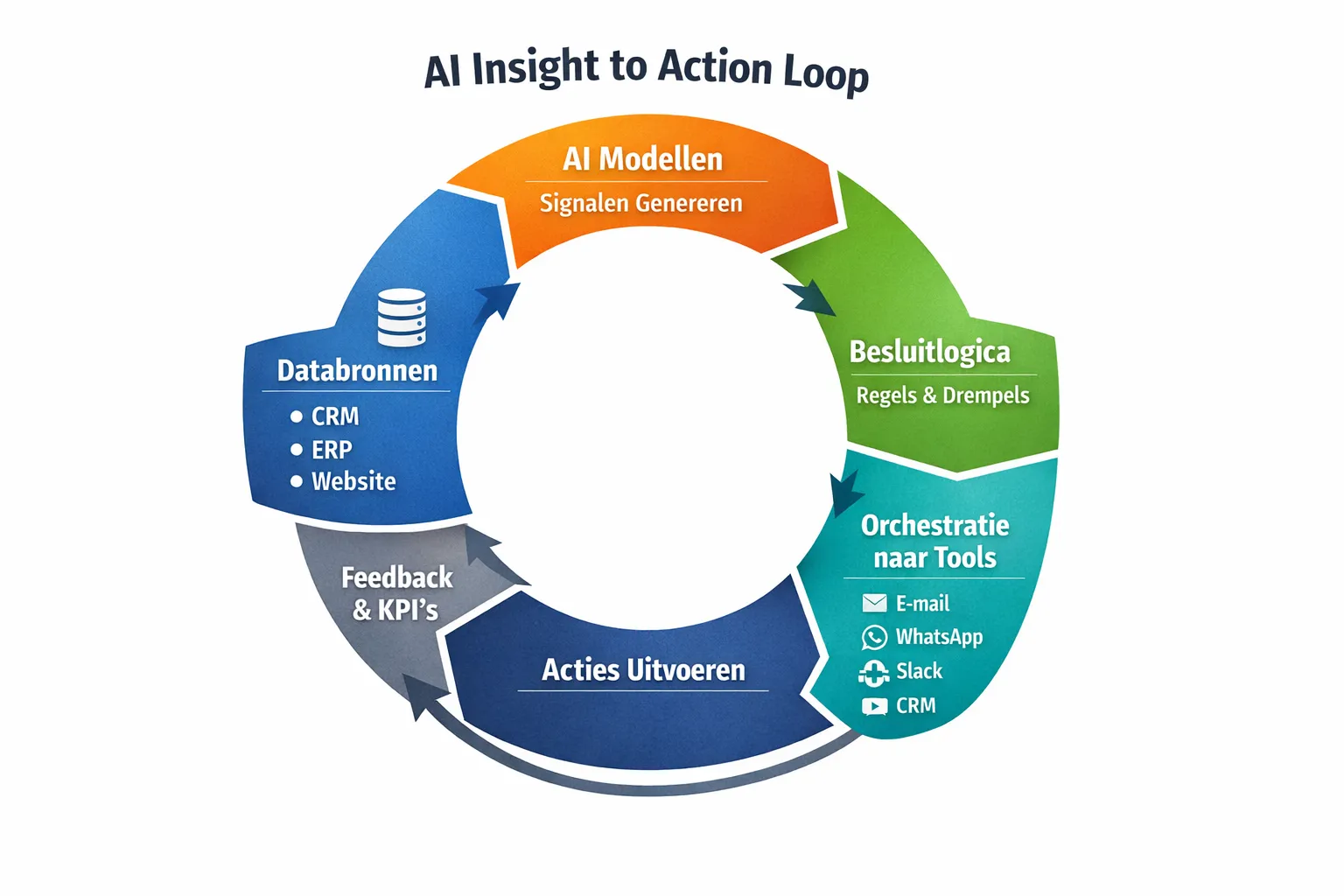
Why AI data analysis only creates value when you enable activation
Insights without activation get ignored. Teams do not have time to manually follow up on every signal, especially with hundreds of leads, quotes, and orders each week.
Activation means an AI signal immediately triggers a task, message, follow-up, quote, or change in the systems where your people work, such as CRM, ERP, email, or WhatsApp.
Results improve when you close the loop. Every action and outcome is logged and fed back into the model, so scores and rules continuously get better.
If you want to go deeper into the data step, see our practical guide on AI for data: faster insights, less manual work. Below, we focus on the action layer, the part where revenue, lower costs, and shorter cycles come from.
The insight-to-action blueprint in 6 steps
Step 1. Start with the decision, not the model
Define one clear decision that saves money or time. Examples: “Schedule a call within 5 minutes when a lead crosses a scoring threshold” or “Automatically start a purchasing proposal when a SKU is at risk of stocking out within 10 days.”
Step 2. Identify the signals that truly matter
Combine data points from CRM, ERP, email, website, support, and IoT. Think intent signals (downloads, replies), transaction behavior, inventory levels, margin, service level, or contract expiry dates.
Step 3. Choose a model your team can understand
Use predictive models or rules plus an LLM for context. Keep scores explainable with features people recognize. Add a confidence threshold, and use a human-in-the-loop when certainty is low.
Step 4. Define decision logic with guardrails
Translate the model output into if-then actions, with limits and exceptions. Examples: only email during office hours, never discount more than 10 percent without human approval, no outreach when there is an open high-priority support ticket.
Step 5. Orchestrate actions in your tool stack
From one workflow, send the right action to CRM, ERP, email, WhatsApp, or Slack. Think task creation, automated quotes, meeting invitations, reorder proposals, or customer-facing status updates.
Step 6. Measure, learn, and refine continuously
Log every action and outcome, compare against a baseline, and A/B test on small cohorts. Raise or lower thresholds based on conversion and error rates. This is the flywheel that drives scalable growth.
Turning data into action, by industry
Wholesalers and distributors
Demand forecasting to purchasing action: AI detects an upcoming spike for SKUs, automatically creates a purchasing proposal, alerts the buyer in Slack, and sends account managers a ready-to-use email to inform customers about lead times or alternatives.
High-risk orders to credit action: Payment risk signals automatically increase the required down payment and inform finance. The sales email automatically adjusts payment terms.
B2B product suppliers
Cross-sell from usage data: Based on consumption and prior behavior, AI proposes a bundle, generates a draft quote in the CRM, and schedules a call task for the right account manager.
Service alerts to SLA action: When sensor data predicts a failure, the system creates a service job and confirms a time slot to the customer.
Accounting and legal boutiques
Time tracking to invoicing action: AI links emails, meetings, and documents to cases and creates a draft timesheet. Finance receives a signal to send the invoice once thresholds are met.
Churn signals to retention action: Unused portals or delayed documents trigger a personalized check-in email from the partner with relevant advice or a meeting suggestion.
Installation and field service companies
Scheduling to technician action: AI prioritizes tickets based on impact and distance, suggests routes in the planning tool, and automatically sends the customer an SMS with an arrival time.
Material risk to procurement action: When a part becomes scarce, AI generates a purchase request with alternative suppliers and informs the project team about impact on the delivery date.
B2B real estate agents
Lead behavior to matching action: AI matches inbound leads with available listings, enriches the lead with Chamber of Commerce and industry data, and immediately sends a proposal with 3 relevant properties plus a link to schedule a viewing.
Contract expiry to renewal action: Three months before the end date, a sequence starts for tenant and landlord, including an automatic draft proposal and a task for the agent.

KPIs that matter when you activate AI insights
Lead-to-meeting rate and speed to first contact.
Quote-to-order cycle time and win rate by segment.
Number of stock-outs, rush orders, and average lead time.
Technician hours utilized per week and first-time fix rate.
DSO, payment behavior, and success of dunning campaigns.
NPS/CSAT and first-contact resolution in support.
Percentage of automated tasks without human intervention and error rate per action.
Start with a realistic baseline. If five salespeople each get back two hours per day through automated follow-up, you save 50 hours per week. At 50 euros per hour, that is about 2,500 euros per week, more than 120,000 euros per year, excluding additional revenue from faster response times.
The technical backbone, kept simple
Data layer: connect CRM, ERP, email, calendar, website, and optionally IoT. Work with event webhooks or a data hub, with as few copies as possible.
Modeling: combine predictive models with LLMs for context and generative output. Use confidence scores so you can enable human-in-the-loop when in doubt.
Decision layer: rules and thresholds the team understands, with clear owners per ruleset.
Orchestration: one workflow engine that triggers actions to email, WhatsApp, Slack, CRM, and ERP. Log every step for audit and recovery.
Observability: dashboards that show both business KPIs and operational health, including retries and exceptions.
Security, compliance, and the EU AI Act in 2025
The EU AI Act requires transparency, risk assessment, and logging. For SMB workflows, this means: register data flows, define usage purposes, document rules, keep human override possible, and log decisions plus performance. Minimize data, pseudonymize where possible, and periodically run a model and bias check. Start small, but build in version control and audit trails from day one so you do not have to rebuild later.
Four fast pilots you can launch in 14 days
Smart lead follow-up in sales: AI enriches new leads, scores intent, automatically drafts a personalized first message, schedules a call task in the CRM, and sends a Slack reminder if no action happens within 2 hours.
Quote accelerator: Detect buying intent in email or portal activity, generate a draft quote with AI, automatically apply a discount within a set bandwidth, and only involve a manager for exceptions.
Stock-out prevention: For the top 100 SKUs, AI calculates a 14-day risk, creates a purchasing proposal, and proactively informs account managers for key accounts.
Accounts receivable flow with empathy: Segment accounts by payment behavior and lifetime value, send personalized reminders, automatically create a call task for high risk, and offer a payment plan when appropriate.
From website insight to conversion in the first 5 minutes
AI can interpret website behavior extremely well, but conversion happens in the first minutes. Set up alerts that push sales to call or email within five minutes when intent is high, and automate calendar links plus next steps. For teams working specifically with SaaS, the thinking behind Fix Your First Five Minutes is a useful reference to improve that critical first contact moment. Combine this with your own lead scoring to move from visitor to paying customer.
How B2B GrowthMachine helps you go from signal to revenue
B2B GrowthMachine provides the activation layer SMB teams need:
Sales workflow automation, from follow-up and outreach to CRM updates, quotes, and pipeline management.
AI assistants as digital colleagues, usable for administration, planning, reporting, and research.
Lead generation and nurturing, with data enrichment, multichannel outreach, and AI lead scoring.
Custom AI agents and integrations, connected to your CRM, ERP, email, WhatsApp, Slack, and accounting.
Continuous optimization and monitoring, so performance improves and risk decreases.
Want to move from data to action without disrupting your organization? Schedule a short advisory call or request a demo. We start small, measure precisely, and scale what works. That way, AI analysis of data becomes not a report, but a growth engine that gives time back every week and accelerates revenue.