
Build an effective AI development team in SMEs
Dec 17, 2025
Smart SMBs in 2025 are not just building AI projects, they are building AI capability. That means a compact, multidisciplinary AI development team that automates sales and operations, integrates safely with your systems, and improves continuously. You do not need an army of data scientists, you do need a sharp scope, clear governance, and a team that delivers results in weeks, not years.

Why every SMB needs an AI development team
Faster from lead to deal, with automated outreach, lead scoring, and quoting.
Less manual work, fewer errors, lower costs through end-to-end workflow automation.
Stronger governance, because AI without clear roles and processes quickly creates risks (GDPR, EU AI Act, brand safety).
AI is changing job scopes. In some sectors, tasks disappear, in others new roles emerge. A recent analysis of AI’s impact on jobs shows for Spain that hundreds of thousands of traditional roles decline, while programming and consulting work grows. The lesson for SMBs is clear, build the internal skills and structure to use AI responsibly, or your competitors will.
The minimum team setup for SMBs
Aim for 3 to 6 people, supplemented with part-time expertise. Start lean and scale once the business case is proven.
AI Lead, Product Owner: connects strategy to execution, prioritizes use cases, safeguards KPIs, point of contact for compliance.
Automation Engineer: builds workflows, agents, and integrations with low-code and, when needed, Python. Delivers stable runbooks.
Data and Integration Specialist: connects CRM, ERP, email, WhatsApp, and accounting, ensures data quality and API security.
Prompt and Content Engineer: develops prompts, RAG knowledge bases, and tone of voice, sets up evaluation sets against hallucinations.
MLOps and QA, part-time: version control for prompts and models, CI/CD for automations, monitoring, and incident response.
Security and Compliance, part-time: DPIAs, vendor assessments, access control, EU AI Act classification, and audit trails.
Rhythm and rituals that work:
Daily 15-minute stand-up with clear blockers and experiments.
Weekly demo to sales, operations, and leadership, including metric review.
“Definition of Done” for each automation: measurable outcome, logging, fallback to a human, security check, runbook.
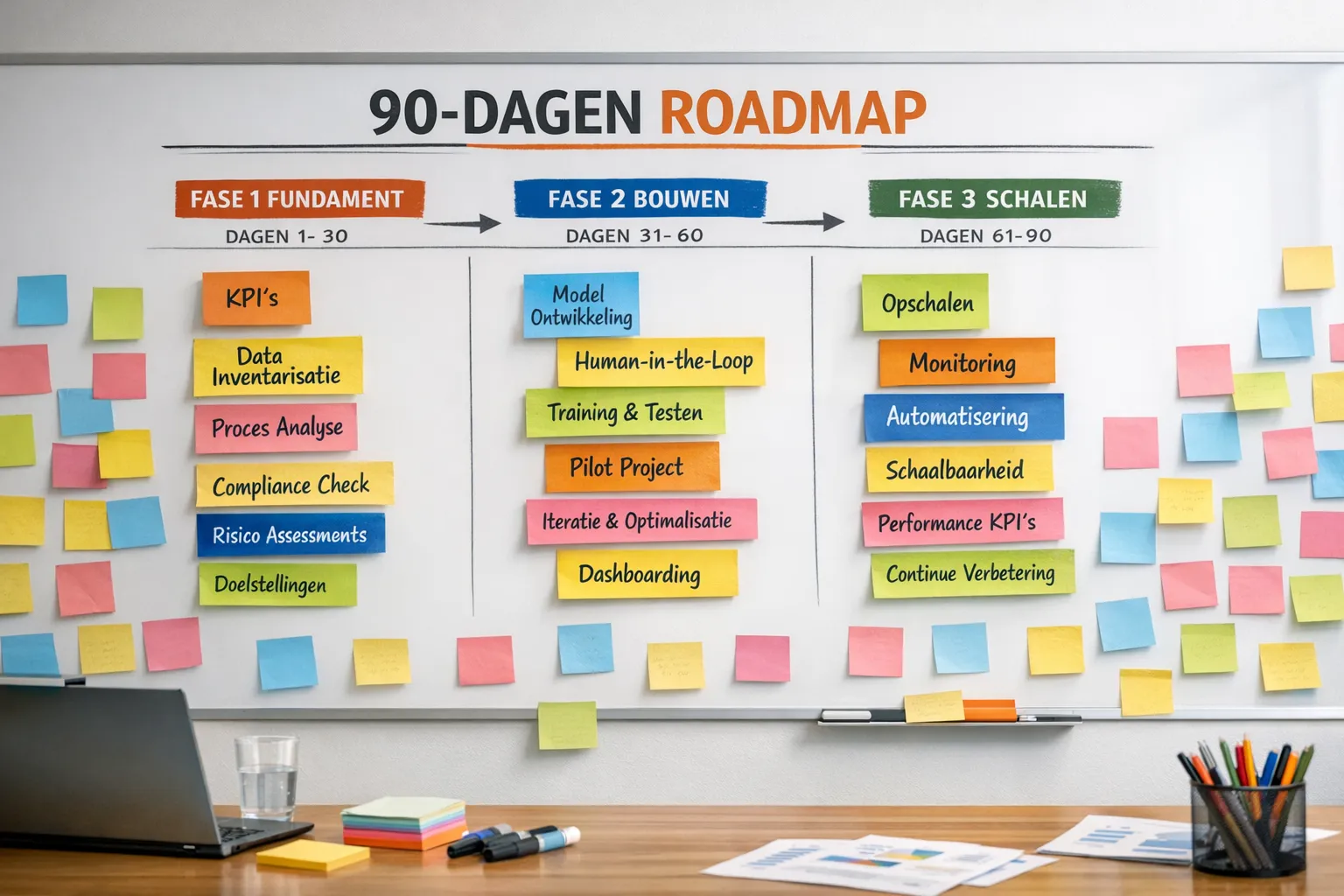
From zero to a winning AI team in 90 days
Phase 1, Foundations and choices, weeks 1 to 3
Define business goals and KPIs, for example faster first response time, more qualified meetings, shorter quote turnaround, less manual work in administration.
Select the top 3 use cases with clear benefits and low risk. Think AI-assisted outreach, automatic CRM updates, document intake and enrichment, quote assistant.
Data inventory and governance: sources, data quality, consent, retention periods, and baseline logging policy.
Phase 2, Build with human-in-the-loop, weeks 4 to 8
Launch the first automation in a limited scope, for example AI-driven lead follow-up with personalized emails and automatic CRM logging.
Human-in-the-loop for critical steps: an employee approves sending, quotes, and pricing advice.
Set up an evaluation harness: test prompts, representative documents, acceptance criteria, and A/B comparisons.
Phase 3, Harden and scale, weeks 9 to 13
Monitoring and incident process: metrics, error budget, retrieval logs, prompt versioning.
Train end users and create an internal AI handbook: tone of voice, dos and don’ts, privacy.
Launch the second and third use case, for example automated quote formatting, invoice processing, or self-service customer Q&A. Gradually increase autonomy and expand guardrails.
The baseline stack for an SMB AI development team
Orchestration and workflows: choose a platform that can connect email, CRM, ERP, WhatsApp, Slack, and accounting and trigger AI tasks, with logging and role-based permissions.
Models and knowledge: typically generative language models plus retrieval augmented generation (RAG) for your own documents and product data. Use regionally hosted models when data requirements are strict.
Integrations: standardized connectors for CRM, ERP, mailboxes, and calendars. API-first prevents vendor lock-in.
Evaluation and monitoring: automated regression tests for prompts and knowledge bases, dashboards for quality, speed, error rates, and adoption.
Security: secrets management, access segmentation, audit logs, data masking, and email or WhatsApp templates with safety checks.
Governance, risk, and the EU AI Act
Classify risk per use case. Many sales and operations automations are low or medium risk, but still require transparency, logging, and human control.
Privacy by design: minimize data, define retention periods, sign data processing agreements with AI and integration vendors, and run DPIAs for sensitive flows.
Guardrails: input filters, policies for prohibited content, fact-checking for critical claims, mandatory human review for commercial offers above a threshold.
Traceability: log prompts, context, model version, output, and approval. This simplifies audits and root-cause analysis.
Upskilling, hiring, and building a learning organization
Not every company can hire every role right away. Combine internal upskilling with targeted external support until the value is proven.
Skills that deliver fast ROI: process design, prompt engineering, data quality, basic APIs, privacy, and change management.
Microlearning and practice: weekly learning goals tied to real tickets, short knowledge sessions, and peer reviews.
Career paths: marketers and sales ops can grow into prompt or automation engineering, IT admins can take on integration and MLOps tasks, legal can own AI governance.
The labor market is shifting toward technical and analytical roles. The analysis of AI’s impact on jobs mentioned earlier emphasizes that reskilling and broad skills like critical thinking, communication, and adaptability make the difference. The same applies to Dutch SMB teams.
What works by sector, practical priorities
Wholesale and distribution: AI lead scoring based on purchasing behavior, automated follow-ups, a quote assistant that uses product and inventory data, and automatic CRM updates.
B2B product suppliers and manufacturers: product configuration and pricing advice, quote generation with technical appendices, installation scheduling with customer communication.
Accountancy and legal boutiques: document intake, classifying and summarizing case files, customer Q&A assistant, automatic file creation in DMS or CRM.
Installation companies with B2B customers: intake and qualification, planning and route optimization, work order to invoice without manual work, status updates via WhatsApp.
Commercial real estate brokers: lead qualification on property fit, personalized outreach, automatic brochure summaries, and meeting scheduling.
For each sector, choose use cases with high impact on cycle time and deal probability, and ensure human-in-the-loop where reputation or contract value is high.
KPIs that truly matter for your AI team
Time-to-first-value: days until the first automation is used by end users.
Adoption: percentage of deals or tickets where the automation was used.
Efficiency: hours of manual work reduced per week and error rate versus baseline.
Growth impact: additional meetings, conversion to quote and to order, median quote cycle time.
Quality and risk: escalations per 100 tasks, number of human interventions, audit and privacy incidents.
Anchor these KPIs in a weekly dashboard. Stop or refactor automations that do not meet thresholds, improve what is close, and scale what performs best.
Common pitfalls, and how to avoid them
Starting too broad. Begin with one pipeline, for example lead to meeting, and deliver visible value.
No governance. Set up a lightweight policy early for logging, privacy, and human review.
Tool sprawl. Choose an orchestration platform that covers most integrations and keep the number of vendors limited.
No evaluation. Build a fixed set of test cases and compare versions, or regressions will creep in.
Over-automation. Let people decide on exceptions, pricing deviations, and legally sensitive cases.
FAQ
How big should an AI development team be in an SMB? Start with 3 to 4 core roles, supplemented with part-time security and QA. Only scale once the business case is clearly positive.
Do I need data scientists to get started? Often not. For workflow and sales automation, an automation engineer, integration specialist, and a strong product owner with domain knowledge are usually enough.
Which use case should I tackle first? Choose a process with high repetition, clear KPIs, and low legal risk, for example lead follow-up or quote creation with human approval.
How do I ensure GDPR compliance and alignment with the EU AI Act? Minimize data, log decisions, run DPIAs for sensitive flows, choose vendors with data processing agreements, and keep human control for material outcomes.
What if my data is messy? Start small with well-scoped sources, add data quality checks in the pipeline, and improve iteratively.
How do I measure ROI? Add up hours saved and incremental revenue, subtract tooling and implementation costs. Report monthly and stop what does not pay off.
Ready to build your AI team and deliver results?
B2B GrowthMachine helps SMBs deliver in weeks what would otherwise take months. With AI-driven sales and operations automation, a practical AI assistant for daily tasks, seamless integrations with CRM, ERP, email, and WhatsApp, custom AI project development, and continuous optimization, you build scalable AI capability inside your organization. Want to think through your first use case or a 90-day approach for your AI development team? Get in touch for a no-obligation strategy session. That is how you make AI a profitable colleague for sales and operations, not a standalone pilot.