
AI for SMEs: practical applications in 2025
Dec 12, 2025
Working smarter instead of harder, that is the essence of AI for SMEs in 2025. Not another hype or a standalone chatbot, but practical automations that generate leads, reduce costs, and prevent errors. In this article you will find proven use cases for SME teams in sales, service, operations, finance, and real estate, plus a 30-day implementation plan and clear compliance tips.

What does AI for SMEs in 2025 really mean?
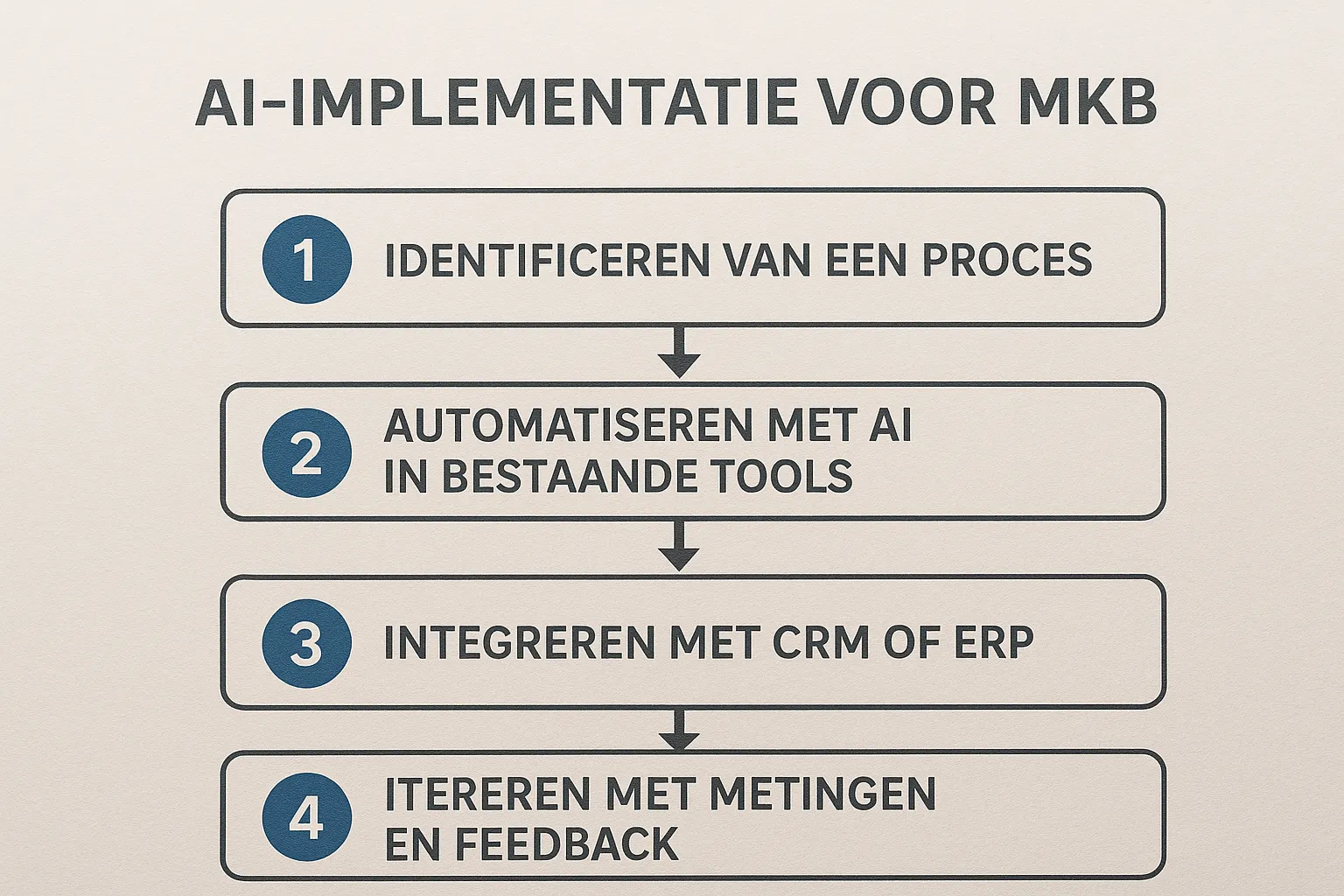
AI for SMEs is about small, targeted automations that run inside your existing systems. Think CRM, ERP, email, WhatsApp, and accounting software. The biggest gains do not come from one big project, but from successive workflow improvements that together create scale advantages. Start small, measure results, then expand.
Further reading for inspiration:
How AI workflow automation is changing for businesses, with examples per process. Read the overview.
Unsure whether to use AI or manual work, including cost and scalability. Compare here.
Practical applications SMEs are using right now
The best 2025 use cases are concrete, measurable, and directly linked to revenue or cost.
Sales and marketing
AI accelerates your funnel and removes friction between marketing and sales.
Smart follow-ups and sequences, automated follow-up and reminder emails based on behavior in CRM, quotes, and website visits.
Generating quotes and product copy, price variants, bundles, and terms based on the customer profile and margin targets.
Lead scoring and data enrichment, enrich prospects with industry, company size, and intent signals, then prioritize by likelihood to win rather than volume.
More tactical ideas and tooling? Check the guide with five core solutions. 5 essential AI tools.
Operations and service
This is often where the biggest unused return sits.
Order processing and inventory, automated order entry from email and PDFs, stock reservation, and delivery times without manual work.
Service scheduling, combine location, SLA, product knowledge, and traffic data for optimal routes and less downtime.
Knowledge retention, an AI assistant that searches manuals, tickets, and notes and delivers the right answer in seconds for technicians or support.
Finance and administration
Fast, low-error, and audit-proof.
Document processing, automatically read, validate, and post invoices, packing slips, and contracts into your system.
Accounts payable and receivable, automated matching, reminders with the right tone per customer type, and prioritization based on risk and cash flow.
Reporting, weekly KPI updates and exception alerts without merging spreadsheets.
Management and reporting
KPI cockpit on real-time data, sales, margin, service SLAs, and inventory turnover in one overview, with alerts when thresholds are exceeded.
Management notes, automatic summaries of pipeline, issues, and risks with concrete action points for the weekly kickoff.
Industry-specific examples for fast ROI
Wholesalers and distributors
Dynamic quote and pricing generation based on current purchasing, inventory, and customer terms. Less waiting time, higher win rates.
Returns and claims processing, AI reads packing slips and photos, proposes a decision, and updates inventory.
Demand forecasting, combine order history and seasonality for smarter purchasing and fewer stockouts.
B2B product suppliers and local manufacturing
BOM and variant configuration, generate bills of materials and product variants based on customer requirements and available parts.
Quality reports, automatically classify photos and measurement data and feed insights back into process improvement.
Shop floor scheduling, AI assigns orders across machines and teams based on due date and utilization.
Installation companies serving businesses
Work order to invoice, AI converts work orders, hours, and materials into a complete invoice with attachments.
Route optimization and SLA, combine urgency, location, and skills, schedule technicians efficiently, and automatically communicate ETA to the customer.
On-site quoting, photos and notes are translated in real time into a clear scope, material needs, and a price proposal.
Accountancy and legal boutiques
Document intake, automatically categorize and summarize annual accounts, payroll files, and contracts, then prepare them for review.
VAT and general ledger classification, AI makes a first proposal based on history and context, the accountant validates.
Contract analysis, extract key clauses and risks, flag deviations, and draft a letter with questions for the client.
B2B commercial real estate brokers
Matching properties and seeker profiles, AI uses text, photos, and transaction history to surface warm matches.
Proposal workflows, automatic draft mandates, attachment checklist, and scheduling after an intake call, including clear follow-up tasks.
Deal room assistant, tag documents, organize the data room, and streamline Q&A so closing becomes faster and less error-prone.
Implement in 30 days, a realistic plan
Week 1, choose one high-volume process with clear KPIs. Map the steps, measure the current lead time and error rates. Collect 20 to 50 example cases.
Week 2, build a clickable prototype with your existing tools. Think CRM workflows, email, SharePoint or Google Drive, and an AI assistant. Integrate at least one system via API or a Zapier-like connector.
Week 3, test with real cases. Let two to three end users work with the new flow. Evaluate accuracy, how often the suggestion is immediately correct, and when it needs a human check.
Week 4, harden and scale. Add validation rules, define exceptions, and set up monitoring. Start with a limited segment of customers or products, then expand weekly.
If you want more context on the broader impact on processes and roles, read the analysis about the future of AI automation. Future of AI automation.
How to calculate the ROI of an AI workflow
Determine time saved per task, for example 12 minutes less per quote.
Multiply by monthly volume, for example 180 quotes per month is 2,160 minutes, which is 36 hours.
Assign an hourly cost, for example 55 euros. Gross savings are 1,980 euros per month. Add error reduction and shorter lead times, which often also generate extra revenue.
Subtract software and implementation costs. Your total ROI is usually visible within weeks if you choose a highly repetitive process.
Governance, privacy, and the EU AI Act in 2025
Using AI can fit perfectly within the rules. For SMEs, transparency and due care matter most.
Transparency, inform customers and employees when they are dealing with an AI assistant and what it is used for.
Data minimization, only process the data needed for the task, pseudonymize where possible.
Human oversight for high-impact decisions, for example credit, price exceptions, or contract terms.
Vendor assessment, check how a provider handles data storage, security, and model updates. Ask for a clear exit plan.
Helpful sources:
Explanation and timeline of the EU AI Act by the European Commission. EU AI Act overview.
Practical framework for risk management, NIST AI Risk Management Framework. NIST AI RMF.
Common pitfalls and how to avoid them
Tool hunting instead of process focus, pick the process first, then the tool.
Poor input data, garbage in means garbage out. Assign ownership to one role that safeguards data quality.
No clear measurement, always start with a baseline and a target, for example lead time minus 30 percent.
Automating without exceptions, define when a human takes over, for example missing data or a low confidence score.
Quick wins you can launch this month
Quote summarizer, automatically generate a draft quote from CRM notes and earlier deals, the sales rep reviews and sends.
Purchase email to order, read emails and PDFs, populate order fields in ERP, and have an employee only validate.
Smart follow-up planner, automatically create CRM tasks if a customer does not respond within 3 days, with an appropriate template text.
Invoice reader, book incoming invoices with a first AI proposal and route exceptions to finance.
Support triage, classify incoming tickets and provide the most likely answer plus a source link from your knowledge base.
If you want more real-world cases and concrete workflows, see how AI simplifies the daily flow. How AI workflow automation transforms.
FAQ
What does AI cost for an SME on average to get started? Entry can be low if you start with one workflow. Expect a few days of implementation and a limited software budget. Focus on a high-volume process, then you will usually earn the investment back quickly.
Do I need a lot of data before AI works? No. Many use cases rely on your existing documents, emails, and CRM data. With 20 to 50 example cases you can already validate a solid prototype.
How do I prevent errors or hallucinations? Set up validation rules and never let AI make high-risk decisions on its own. Work with sources, confidence scores, and human-in-the-loop checks for critical steps.
Does this integrate with my CRM or ERP? Yes. Modern AI workflows connect via APIs with systems like CRM, ERP, email, and chat. Start with one-way automation, then expand to writing back into your core system.
How do I choose the first process? Pick a task that comes back often, has clear rules, and is measurable, for example quotes, invoices, or service scheduling. Avoid extreme custom edge cases as a starting point.
What about privacy and the EU AI Act? Be transparent, collect no more data than necessary, and always have a human review important decisions. Consult the official European Commission overview for the latest status. EU AI Act.
Ready to apply this in your business?
B2B GrowthMachine helps SME teams grow faster with less manual work. We deliver sales workflow automation, an AI assistant for daily tasks, lead generation tools, custom AI project development, seamless integrations with CRM, ERP, and communication channels, continuous optimization, 24/7 AI support, and data-driven insights.
If you want to have your first AI workflow live within 30 days and see real results, get in touch with B2B GrowthMachine.