
AI business process automation for scalable operations
Dec 11, 2025
Scaling often stalls not because you lack leads, but because of fragmented processes, manual work, and system integrations that cannot handle peak load. AI-driven business process automation makes operations agile, predictable, and scalable without adding extra FTEs. According to McKinsey, generative AI can automate activities that take up a significant share of knowledge workers’ time, which directly translates into shorter cycle times and lower costs. In this article, you will learn how to use AI business process automation for scalable operations, with concrete use cases by sector and a 90-day implementation plan.
What is AI business process automation and why now
AI business process automation combines classic workflow automation with modern AI. Where traditional RPA mainly mimics repetitive clicks, AI adds understanding. Think of reading emails and PDFs, making context-based decisions, predicting the next step, and automatically communicating with customers or suppliers. The result is fewer manual handoffs, fewer errors, and processes that grow with demand.
Three developments make this urgent in 2025:
Data is scattered across CRM, ERP, accounting, inboxes, and spreadsheets, AI can connect and interpret these silos.
Customers expect speed, from quote to delivery, with real-time status updates.
Regulation and compliance require traceability and consistent execution, something automated workflows provide by default.
For a deeper dive into workflow automation, you can also read our piece on how AI workflow automation is transforming businesses.
A blueprint for scalable operations
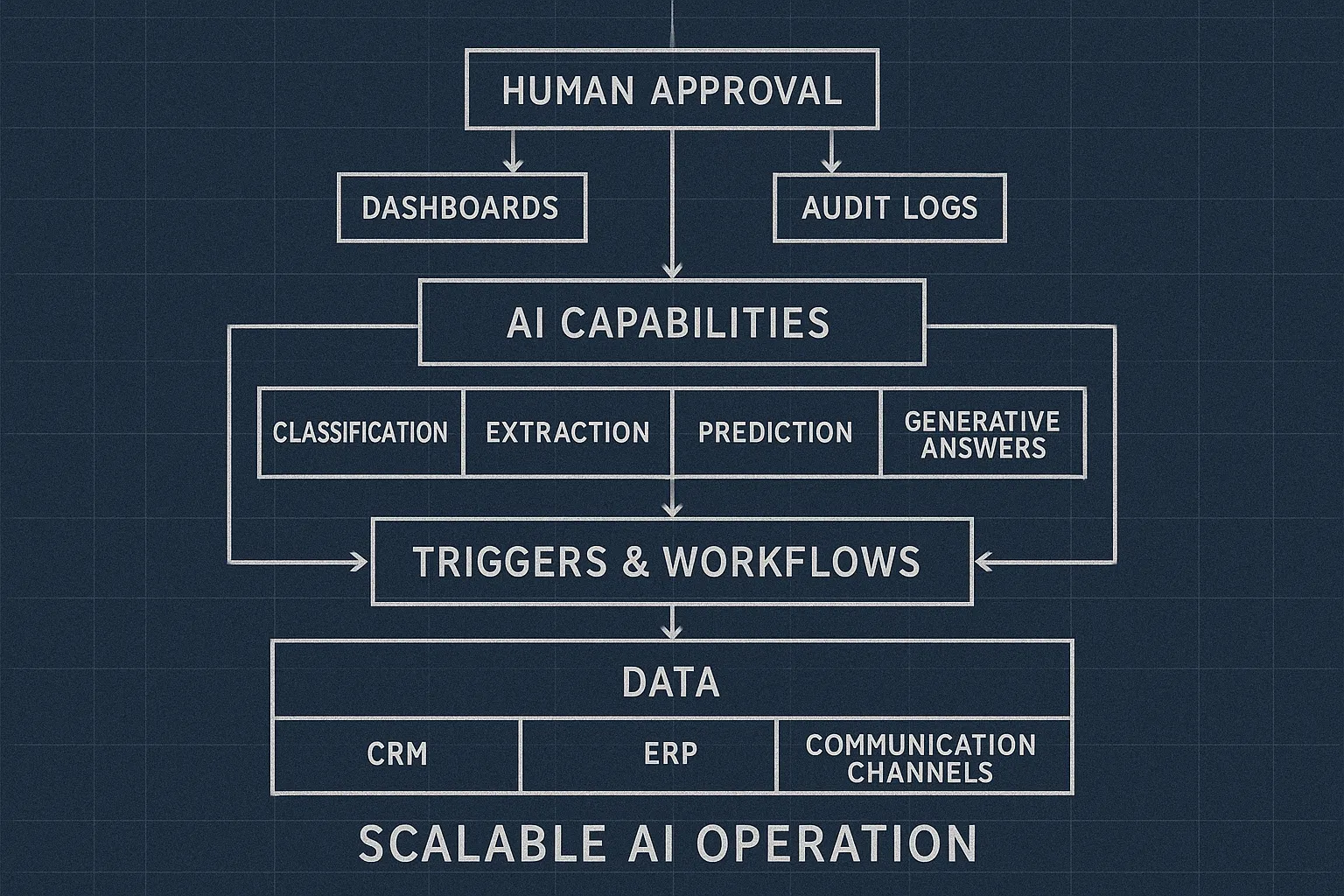
Think in five layers that together form a scalable operation:
Data layer. Reliable connections with CRM, ERP, email, WhatsApp, Slack, accounting, and external APIs. Data is validated and logged.
Triggers. Events that start the process, for example an incoming quote request, a signed contract, a low-stock alert, or an incoming payment.
Workflows. Repeatable steps with clear rules, SLAs, and an owner per step. This is where you eliminate waiting time and duplicate entry.
AI capabilities. Document parsing, entity extraction, intent recognition, predictions, generation of text and responses, plus AI agents that execute actions within clearly defined boundaries.
Human oversight. High-impact decisions remain with people. AI prepares, the employee approves. Everything with an audit trail.
Sector-specific use cases that scale immediately
Wholesalers and distributors
Order-to-cash. AI reads EDI, email, or PDF orders, matches customer and price list, checks inventory, creates the order in ERP, sends confirmation, and schedules pick-pack-ship. Exceptions, such as price discrepancies or insufficient stock, go to an employee with suggested options.
Smart backorders. The workflow predicts delivery times based on supplier performance and proactively shares updates with customers, including alternatives or partial shipments.
Credit and invoice matching. AI matches payments to invoices, detects discrepancies, and proposes a correction or credit note.
Result: shorter cycle time from order to delivery, fewer errors, and better cash management.
B2B product suppliers
Quote automation. Incoming requests via email or web form are automatically scored, enriched with company data, and translated into a draft quote with product configurations and lead times.
After-sales. Automatic maintenance reminders, upsell suggestions based on usage data, and streamlined RMA handling with clear status updates.
Legal and accounting boutiques
File intake and KYC. AI collects and checks documentation, classifies documents, and prepares a complete file with checklists and deadlines.
Document automation. Draft letters, memos, and summaries based on templates and file context, always with human review.
Billing and time tracking. Transcripts and emails are structured, time-entry suggestions are prepared for confirmation, and invoices go out on time.
Local manufacturing and installation companies
From quote to scheduling. AI reads technical requirements, checks inventory and technician availability, schedules automatically, and confirms with the customer and team.
Work orders and handover. Work orders are filled in digitally, with photos and checklists. After completion, the invoice follows automatically with a summary.
Accounting firms
Posting automation. Incoming purchase invoices and receipts are recognized, validated, and posted with suggested GL accounts and VAT codes.
Monthly reporting. AI compiles draft management reports with variance analyses and accompanying narrative.
Commercial real estate brokers
Lead scoring and matching. AI enriches leads with company data, scores intent, and automatically matches supply and demand. Relevant candidate properties can be sent to the prospect in one click.
Contract and data room. Documents are classified and anonymized, missing documents are requested automatically, and progress is visible in a dashboard.

The 90-day implementation plan
Days 1 to 14, select processes. Choose two to three high-impact processes with clear rules, such as quote requests, invoice processing, or order entry. Map the steps, define exceptions, and determine where human approval is required.
Days 15 to 30, data and integrations. Connect CRM, ERP, email, and chat channels. Set up secure storage for logs and documents. Work with production-like test data and clear data minimization.
Days 31 to 60, build the workflows. Start with the happy path, then add exceptions. Use AI models for classification and extraction, while enforcing quality thresholds and fallback rules.
Days 61 to 75, human-in-the-loop. Define approval screens, escalations, and SLAs. Train the team, and make it easy to provide feedback so the system can learn.
Days 76 to 90, measure and optimize. Launch in phases, monitor cycle times and error rates, remove bottlenecks, and document improvements. Then scale to the next process.
KPIs and ROI that make scalability visible
Focus on leading indicators that prove scale:
Cycle time per process step and end-to-end.
First-time-right percentage and number of manual touches per case.
Quote-to-order conversion and average response time to requests.
Cost per transaction and saved FTE hours, including avoided errors.
Customer and employee satisfaction, via short NPS or CES measurements.
A simple ROI calculation: add the value of time savings and error reduction plus any revenue uplift, subtract license, implementation, and maintenance costs, then divide by total costs. Factor in a learning curve, you often see measurable impact on cycle time within 60 to 90 days.
For more context on costs and savings, see our article on AI versus manual work.
Governance, risk, and compliance without friction
Scalable automation requires mature governance, especially for SMBs:
Transparency. Document what the workflow does, which data is used, and where human checks sit.
Data security. Use role-based access, encryption, and retention policies. Minimize data and mask personal data where possible.
Quality assurance. Set thresholds for AI decisions and enable human oversight for low-confidence scores.
Auditability. Log every step. This helps with internal controls and external audits.
Regulation. The upcoming EU AI Act uses a risk-based approach with attention to data governance, transparency, and human oversight. See the European Parliament’s summary of the AI Act for the main points.
Build, buy, or partner: choose what makes you scalable fastest
Build. Full control, but requires specialized engineers, MLOps, and security. A good fit for companies with in-house data and engineering capabilities.
Buy. Fast start with off-the-shelf solutions, less flexible for company-specific exceptions.
Partner. Fast results with customization where needed, including continuous optimization and integrations with your systems.
B2B GrowthMachine delivers AI-driven sales and operations automation for growing companies. Think sales workflow automation, lead generation and scoring, marketing automation, an AI assistant for daily tasks, custom AI agents, and seamless integrations with CRM, ERP, email, WhatsApp, Slack, accounting, and any API. We monitor performance, continuously optimize, and provide 24/7 AI support so your operation keeps scaling.
For a broader view on trends and adoption, you can also read our analysis on the future of AI automation or this practical list of essential AI tools.
Frequently asked questions
What is the difference between RPA and AI business process automation? RPA imitates fixed actions in systems, AI adds understanding and decision-making. Together, they deliver robust workflows that can handle unstructured data, exceptions, and context.
How do I start without taking big risks? Start with a high-volume process with clear rules, such as order entry or quote handling. Build a proof of value within 30 to 60 days, measure results, then scale.
What is the minimum data I need? Process steps, fields from CRM and ERP, example documents, and a clear definition of exceptions. Even small datasets can already deliver value through classification and extraction.
How do I ensure quality and reduce errors? Work with confidence thresholds, human-in-the-loop for high-impact decisions, versioning of prompts and models, and continuous monitoring of first-time-right.
What if my systems are outdated or do not have an API? Use middleware, email hooks, file drops, or RPA as a bridge. In parallel, plan an API roadmap to reduce technical debt.
Is this compliant with European regulations? Yes, provided you operate transparently, apply data minimization, and organize human oversight. The EU AI Act uses a risk-based approach, align governance and documentation accordingly.
When will I see results? Usually within 60 to 90 days in cycle time and error reduction. Financial ROI follows once you make the savings structural and expand to more processes.
Ready to build scalable operations
Scalability does not require extra layers of management, it requires smart automation that strengthens your team. With a phased approach, clear KPIs, and strong governance, you can achieve faster cycle times, lower costs, and greater agility. If you want to accelerate with a partner that delivers, integrates, and continuously optimizes AI automation, contact B2B GrowthMachine for a no-obligation exploration of your use cases.