
AI for your business: where do you start today?
Dec 5, 2025
AI for your business sounds big, but for SMBs the first step is rarely a multi-million project. It is about picking one time-draining process, automating it intelligently, and measuring the outcome. Companies that play this well often see shorter cycle times, more qualified leads, and less manual work within weeks. Research from McKinsey shows many organizations are already experimenting with generative AI, but scaling only works with clear goals, good data, and governance. See McKinsey’s The State of AI in 2024 for the trendlines and the caveats around risk management.
Why start today and not next quarter
Competitors are already automating, often starting with sales and service. Waiting increases your gap and makes catching up more expensive.
The EU AI Act has been adopted, and obligations will enter into force in phases. If you set up your processes, data flows, and controls now, you avoid costly rebuilds later. See the European Parliament’s explainer on the Artificial Intelligence Act.
The barrier is lower than you think. Many use cases run on data you already have, such as CRM, email, quotes, and work orders. IBM’s AI Adoption report points to skills and data quality as the biggest barriers, not the technology itself. See: IBM AI Adoption.
The shortest route to results in 7 steps
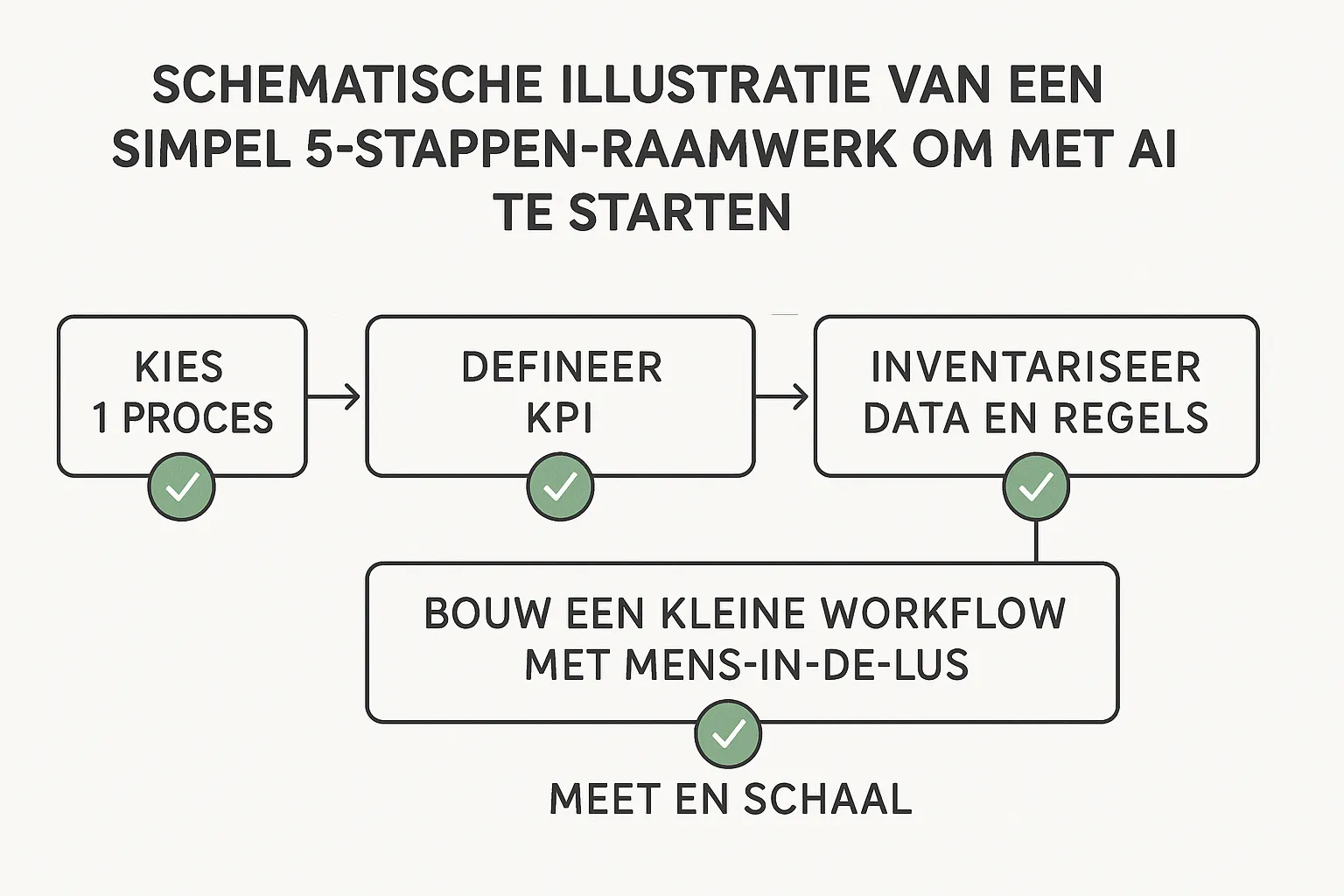
Step 1, pick a business goal that matters
Connect AI to a concrete KPI leadership actually cares about. For example, shorter quote turnaround time, more meetings from outbound, lower cost per lead, faster customer response, fewer invoicing errors. Without a clear goal, it stays an experiment.
Step 2, select one process with a lot of manual work
Choose repetitive work with clear rules. Examples that almost always pay off in SMBs:
Sales follow-ups, creating quotes, updating CRM notes.
Answering customer knowledge questions based on your documentation.
Converting work orders into invoices, including material and pricing rules.
Sending accounts receivable reminders, with a polite tone and proper context.
If you want examples by tool type, also read 5 must-have AI tools to streamline your business tasks.
Step 3, define a minimum success measurement
Set your benchmark upfront, for example 30 percent less time per quote, 20 percent more replies on outbound, or 10 hours less admin work per week. Start small, but measure everything.
Step 4, inventory data and rules
Which sources do you need, what is sensitive, and what exceptions exist? Typical sources include CRM, email, calendar, pricing and product data, work orders, and contracts. Capture decision rules, for example when a lead should go to sales, or when a reminder needs escalation. Also decide right away how you handle GDPR and which data you prefer not to send to an external model.
Step 5, choose a pragmatic solution
You can combine standard templates, workflows, and AI agents. Key criteria include integrations with your systems, auditability, roles and permissions, human-in-the-loop, cost control, and monitoring. B2B GrowthMachine supports this with sales workflow automation, an AI assistant for daily tasks, lead generation, custom agents, and integrations with CRM, ERP, email, WhatsApp, Slack, and accounting tools. We continuously optimize and deliver dashboards for data-driven decision making.
Step 6, build a mini-pilot in 10 to 14 days
Automate one task end to end, for example follow-ups after a quote request. Add a clear fallback, the employee can always override, and log all outputs. Train the team, define simple prompt and tone-of-voice guidelines, and go live.
Step 7, evaluate and scale
Compare the KPI to your baseline. If it works, expand to the next step in the same chain or to a second process. Keep momentum high, but embed governance. This is the moment to tune performance and clean up content sources.
Quick wins by industry
Wholesale and distributors
Automated quote follow-up with up-to-date availability and alternative items when out of stock.
Enrich prospect data from public sources, including AI lead scoring on fit and intent.
Communicate periodic price updates and assortment changes by segment.
B2B product suppliers
Qualify inbound leads, summarize them in the CRM, and automatically send an initial proposal.
After-sales nurturing, including cross-sell and repeat orders based on purchase history.
Accounting firms and legal boutiques
Intake triage, document summarization, and dossier-specific checklist generation.
Periodic receivables reminders with a friendly, contextual tone by customer segment.
Local manufacturing and installation companies
Planning and work order flows, from completion report to invoice with line-item details.
Proactive maintenance reminders via email or WhatsApp, including a self-service booking link.
B2B real estate brokers
Matching listings to search profiles and automated but personal follow-ups.
Scheduling viewings and sending confirmations with directions and property information.
For more context on what happens under the hood, see How AI is transforming workflow automation for businesses.
A simple ROI calculation anyone can do
Add up time savings, error reduction, and incremental revenue potential. For example, an accounting team sends 60 engagement letters per week that take 15 minutes each. A workflow that auto-personalizes and prepares them reduces the work to a 2-minute review per letter. That is 13 minutes saved, times 60 equals 780 minutes, about 13 hours per week. Multiply by your internal hourly cost, for example 60 euros, and you get more than 750 euros saved per week, excluding faster turnaround and happier clients. This kind of exercise is quick to do and immediately clarifies priorities.
To better understand where AI is structurally cheaper than manual work, read AI vs manual work: which saves more time and money?.
Safety, privacy, and the EU AI Act, what to put in place now
Keep customer data in your own systems and let models operate with as little personal data as possible. Use role-based access and logging.
Document decisions. In customer communications, you want to be able to trace which source and prompt were used.
Categorize your use cases. Most sales and operations automations are not in the AI Act’s high-risk category, but you still remain responsible for transparency and due care. Set up lightweight AI governance: who can deploy, how you test quality, and when it escalates to a human.
Involve your DPO or privacy officer early. It saves time later.
The core is simple: start small and traceable, build controls in, and document. Teams that do this from day one scale faster and more safely.
Your 90-day plan
Days 0 to 14, choose one process, define the KPI, and build a mini-pilot with human-in-the-loop. Integrate with CRM and email, train the team, and turn on monitoring.
Days 15 to 45, optimize prompts and rules, then add a second task in the same chain. For example, automatically updating the CRM after every interaction, plus an outbound sequence with personalized opening emails.
Days 46 to 90, roll out to a second domain, for example moving from sales into invoicing or service. Add dashboards for time saved and cycle time, and schedule monthly improvement loops.

Common pitfalls you can easily avoid
Starting too broad. Focus on one clear use case and deliver something tangible within two weeks.
Poor data quality. Spend a bit of time on basic cleanup of CRM and product data, the payoff is usually fast.
No human-in-the-loop. Always let employees review, correct, and provide feedback.
Tool sprawl. Choose a platform that integrates with your core systems, not five separate apps with no governance.
No monitoring. Implement basic quality checks and cost controls from day one.
When to bring in a partner and what you should expect
Bring in a partner if you want speed, need integrations, or want to set up governance properly. B2B GrowthMachine provides exactly that: AI-driven sales and operations automation, an AI assistant for daily tasks, lead generation and nurturing, custom agents for your workflow, seamless integrations with CRM, ERP, email, WhatsApp, Slack, and accounting, ongoing optimization, 24/7 AI support, and dashboards with data-driven insights. The goal is always the same: less manual work, lower costs, more revenue opportunities, and smoother operations.
If you want the strategic direction of where this is going, read The future of AI automation.
Start today, it really is that simple
Pick one process that costs a lot of time and tie it to a KPI.
Write your decision rules on a single page and list the data sources.
Build a small workflow with human-in-the-loop and turn on logging.
Measure for two weeks and compare to your baseline.
Scale what works, stop what does not, repeat.
AI for your business does not start with a vision deck. It starts by automating the next follow-up, the next quote, and the next invoice. If you are looking for speed, integrations, and solid guardrails, get in touch with B2B GrowthMachine. We help you move pragmatically from pilot to structural wins, so your team has more time for work that creates real value.