
AI in Industries: Best Use Cases by Sector
Jan 17, 2026
Most “AI in industries” articles stay at the hype layer: chatbots, robots, and vague promises. What B2B teams actually need is simpler and more useful: which workflows can AI take over in your sector, what data it needs, and what to measure to prove ROI.
Below is a practical, sector-by-sector breakdown of high-impact AI use cases for SMEs, especially in wholesale, distribution, B2B services, and operational businesses.
What “AI in industries” really means in practice
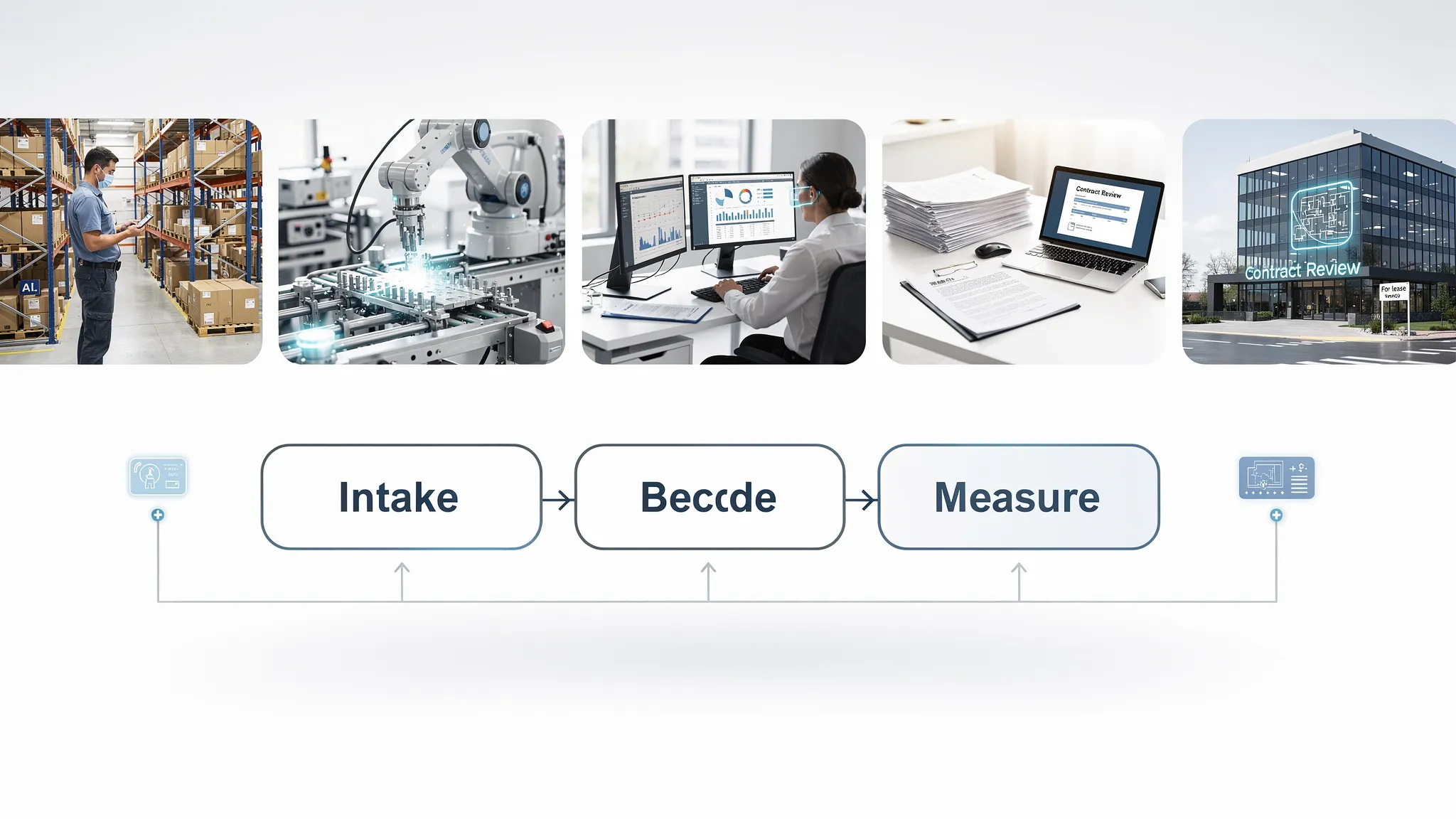
In 2026, the most reliable value from AI in business is not magic intelligence. It is repeatable automation:
Turning messy inputs (emails, PDFs, forms, calls) into structured data
Applying rules and decision logic consistently (with human checks when needed)
Executing actions across systems (CRM, ERP, email, accounting, ticketing)
Creating feedback loops so the process improves over time
This is why many successful AI deployments look like workflows and agents embedded inside daily operations, not standalone “AI tools.”
How to choose the best AI use cases (before you look at tools)
Across sectors, the best first AI use cases share the same characteristics:
1) High volume, repetitive, and time-sensitive
If a task happens dozens of times per week and delays cost money (lost deals, slower invoicing, longer response times), it is a strong candidate.
2) Clear inputs and a “definition of done”
AI succeeds when you can define what good looks like: required fields, acceptable outputs, escalation rules, and quality checks.
3) Integrates into your existing systems
The best AI use case is usually the one that updates the CRM, triggers follow-ups, creates a quote, opens a ticket, or drafts a document without someone copying and pasting.
4) Measurable business impact
You want KPIs that finance and leadership respect, such as:
Cycle time reduction (lead-to-reply, quote-to-send, ticket-to-resolution)
Error rate reduction (wrong pricing, missing fields, mis-posted invoices)
Hours recovered (admin time removed from the process)
Conversion lift (more qualified meetings, higher win rate)
Wholesale businesses and distributors: AI that protects margin and speed
Wholesale and distribution teams often win on two things: availability and responsiveness. AI is useful when it reduces friction between inquiry, quote, order, and delivery.
Best AI use cases in wholesale and distribution
Quote and pricing copilots: Turn inbound requests (email, PDF, portal forms) into structured quote drafts with the right SKUs, terms, and delivery assumptions. This is especially valuable when requests are incomplete or inconsistent.
Customer service intake and triage: Automatically classify inbound messages (order status, returns, invoice questions, product availability), route them to the right queue, and draft first responses grounded in your policies.
Stock and substitution suggestions: When an item is out of stock, AI can propose alternatives and notify account managers before the customer escalates.
Account prioritization and next-best-action: Combine signals like buying frequency, open quotes, delivery issues, and support volume to prioritize proactive outreach.
What to measure
Focus on Time to Quote, quote accuracy, order entry errors, and “sales time spent on admin.”
If you want the broader blueprint behind these wins, B2B GrowthMachine typically approaches it as connected workflows and integrations (CRM, ERP, email) rather than isolated tooling.
B2B product suppliers: AI to scale outbound and keep CRM clean
B2B suppliers often struggle with two hidden constraints: inconsistent outreach execution and CRM hygiene. AI helps when it makes sales actions more consistent and reduces manual updates.
Best AI use cases for B2B suppliers
Lead enrichment and routing: Enrich inbound leads with firmographics, match them to the right segment, and route to the right owner with clear next steps.
Personalized outreach at scale: Generate first-touch messages that reference relevant context (industry, offering fit, recent signals), while enforcing brand and compliance guardrails.
Automated follow-ups and pipeline nudges: Trigger follow-ups based on time, behavior, or deal stage, and log activity back into CRM.
RFP and questionnaire support: Draft structured responses based on your approved knowledge base and prior answers, with human review.
What to measure
Reply rate and meeting rate matter, but also track operational metrics: “% of deals with next step scheduled,” CRM field completeness, and lead response time.
Local manufacturing: AI for quoting, planning, and quality signals
Manufacturers sit on valuable operational data but often lack time to turn it into faster decisions. AI is strongest when it reduces “back-and-forth” and supports planning.
Best AI use cases in manufacturing
Quote generation from specs: Extract key parameters from drawings, PDFs, and emails, then generate quote drafts with assumptions and risk flags.
Production planning support: Identify bottlenecks early by analyzing order load, machine availability, lead times, and exceptions.
Supplier and purchase workflow automation: Triage supplier emails, match confirmations to POs, and flag discrepancies.
Quality and incident summarization: Turn nonconformance reports and shop-floor notes into structured summaries, root-cause suggestions, and corrective action drafts.
What to measure
Quote turnaround time, schedule adherence, late delivery rate, rework rate, and time spent on coordination.
Installation companies selling to businesses: AI to cut dispatch chaos and admin
Field service and installation companies often have high “ops noise”: reschedules, missing info, customer updates, and paperwork. AI shines when it improves intake quality and keeps jobs moving.
Best AI use cases for installation and field service
Smart job intake: Convert emails and web forms into complete job tickets (site address, preferred times, asset details, urgency), and request missing info automatically.
Dispatch and scheduling assistance: Recommend scheduling based on technician skills, geography, SLA, and parts availability.
Proactive customer updates: Send status updates automatically when milestones change (parts shipped, technician assigned, ETA updated).
Work report and invoicing automation: Turn technician notes into clean job summaries and invoice-ready descriptions.
What to measure
First-time fix rate, scheduling lead time, “rework caused by missing information,” and days-to-invoice.
Accountancy firms and accounting boutiques: AI that reduces review load, safely
In accounting, the mistake is trying to “replace judgment.” The practical win is reducing administrative workload while preserving controls.
Best AI use cases in accounting and finance services
Inbox triage and client request routing: Classify and route client emails (VAT, payroll, year-end, missing documents), create tasks, and draft replies.
Document intake and extraction: Extract fields from invoices, bank statements, and receipts, then push structured data into your accounting workflow (with review gates).
Month-end support: Draft variance explanations, reconcile checklists, and prepare client-facing summaries based on the numbers you provide.
Policy-grounded Q&A for staff: Internal assistants that answer “how do we handle X” based on your own procedures, templates, and standards.
What to measure
Hours recovered per month-end cycle, rework rate, turnaround time per client request, and time to close.
Legal services (boutique law firms): AI for document work and litigation prep
Legal work contains high-value judgment, but also a lot of structured drafting and document handling. AI is most effective when it speeds up preparation while keeping attorney oversight.
Best AI use cases in legal services
Intake summarization: Turn client forms, emails, and attachments into structured case summaries and issue lists.
First-draft document generation: Draft demand letters, notices, and standardized filings using firm templates, with clear citations and edit-ready formatting.
Discovery and deposition prep: Organize documents, extract timelines, and generate deposition outlines.
Medical and records summarization: Convert long records into usable summaries for negotiation and trial preparation.
A concrete example of this category is TrialBase AI for litigation support, which focuses on producing litigation-ready materials from uploaded case documents (with outputs like demand letters, medical summaries, and deposition outlines). For boutiques, the ROI often comes from faster prep cycles and less paralegal bottlenecking, while attorneys retain review control.
What to measure
Turnaround time for first drafts, hours spent per matter on document prep, and downstream quality metrics (revision cycles, missing elements caught late).
Real estate B2B brokers: AI that improves speed-to-lead and listing workflow quality
In B2B real estate brokerage, responsiveness and follow-up discipline are often the difference between winning or losing a mandate.
Best AI use cases in B2B real estate
Lead intake and qualification: Score inbound inquiries for fit and urgency, enrich with company data, and route to the right broker.
Automated follow-up sequences: Trigger follow-ups based on behavior (opened brochure, requested viewing, visited listing page) while keeping communication professional.
Listing and brochure generation: Draft property descriptions and create consistent formats from structured property inputs.
Viewing notes to CRM: Turn call notes and viewing feedback into structured CRM updates and next-step tasks.
What to measure
Speed-to-lead, meeting booked rate, follow-up compliance, and cycle time from first inquiry to signed LOI.
Cross-industry “top 3” AI workflows that almost always pay off
If you are unsure where to start, these three patterns show up in nearly every sector above:
1) Smart intake and triage (email, forms, PDFs)
This reduces delays and prevents the “missing info” loop that eats hours. Intake workflows are a great place to apply AI because they are measurable and easy to control.
2) Quote, proposal, or document drafting (with human review)
AI can produce structured first drafts quickly, but you still control what goes out the door. The biggest win is cycle time reduction.
3) Automated follow-up and system updates
When AI reliably logs into CRM, triggers the next task, and keeps the pipeline clean, you get compounding benefits: better forecasting, fewer dropped leads, and less admin work.
Implementation notes: how to deploy AI by sector without creating risk
AI across industries fails for predictable reasons: unclear scope, weak integrations, and missing quality controls. A practical rollout usually looks like this:
Start with one workflow, not “AI everywhere”
Pick a single process with a clear owner and a measurable outcome (for example, “reduce time to quote by 30%”).
Keep humans in the loop where it matters
For regulated, financial, or customer-impacting decisions, build approval steps, audit logs, and fallback rules.
Treat data access as a product requirement
The AI must have access to the right context (product catalog, policies, CRM fields, ERP status), otherwise it will generate plausible but unreliable output.
Measure outcomes weekly
If you do not instrument the workflow, you cannot defend ROI. Track cycle times, error rates, and adoption, not “number of AI messages sent.”
If your goal is to make these use cases real inside your CRM/ERP and daily ops, that’s the lane of B2B GrowthMachine: plug-and-play AI tools combined with workflows, agents, and integrations, designed to remove repetitive work while improving speed and consistency.
For a deeper foundation on safe rollout and governance, you can also read the company’s guide on AI adoption checklist for SMEs.
The bottom line
“AI in industries” is not about choosing the perfect model. It is about choosing the right workflow per sector, connecting it to the systems where work actually happens, and measuring outcomes that matter.
If you operate in wholesale, distribution, manufacturing, installation, accounting, legal, or B2B real estate, your best AI opportunities are usually hiding in plain sight: intake, quoting, follow-up, and document-heavy operations. When those workflows are automated with the right guardrails, AI stops being an experiment and becomes a growth engine.