
Personalized AI: Scale 1:1 Without Losing Trust
Jan 18, 2026
Most B2B teams want the same thing right now: the efficiency of automation with the feel of a real 1:1 relationship.
That is exactly what personalized AI promises, tailored outreach, account-specific recommendations, and customer communication that sounds like you actually know the buyer. But there’s a catch: the moment personalization becomes inaccurate, intrusive, or inconsistent, you do not just lose a lead. You lose trust.
Trust is the real constraint in 2026. Data is abundant, channels are saturated, and buyers are numb to generic messaging. The winners are the companies that can scale relevance without becoming “creepy,” sloppy, or unreliable.
What “personalized AI” should mean in B2B (and what it should not)
In B2B, personalization is not about sprinkling a first name and company name into an email. Real personalization is:
Contextual: based on a customer’s situation, industry, installed base, contract terms, product mix, or current project.
Grounded: tied to facts your business can prove (CRM, ERP, product catalog, order history, ticket history).
Actionable: it drives the next best step, not just nicer wording.
Consistent: it matches your brand, tone, and commercial rules every time.
What it is not:
A model “guessing” details about a prospect’s business.
Automated messaging that cannot explain where claims came from.
One-size-fits-all sequences that only look personalized.
If you want to scale 1:1 without losing trust, the goal is not “more AI.” The goal is more reliable relevance.
How trust breaks when you scale personalization
Trust breaks fast in B2B because buyers are risk-avoidant. A wrong promise, a made-up capability, or a careless mention of sensitive info can end a deal quietly.
Here are the most common trust-breakers we see when teams attempt AI-driven personalization.
1) Confident errors (the fastest way to burn credibility)
A buyer will forgive a human for not knowing everything. They are far less forgiving when your systems sound confident and are wrong.
Examples:
A distributor receives an “account update” that references the wrong contract discount.
A wholesale customer gets a reorder suggestion for an item they have discontinued.
A B2B real estate broker sends a property match email with incorrect floor area or zoning.
AI makes these errors feel worse because the writing is fluent. Fluency can be mistaken for certainty.
2) Privacy creep (personalization that feels invasive)
Even when data is technically available, using it in messaging can feel inappropriate.
“I saw your hiring plans…” (from scraped sources)
“Noticed you were on our pricing page yesterday…” (without consent context)
“We analyzed your financial position…” (high sensitivity)
In B2B, the line is simple: if a buyer would be surprised you know it, do not lead with it.
3) Tone drift and “uncanny” messaging
When your AI output doesn’t match how your team normally communicates, it triggers a subtle distrust.
This is especially damaging in relationship-driven sectors like accountancy, legal boutiques, installation companies, and B2B suppliers where tone is part of the service.
4) Over-automation with no human escape hatch
The quickest way to lose trust internally is also the quickest way to lose it externally.
If your salespeople cannot:
stop a workflow,
correct a record,
escalate an exception,
then the business becomes a passenger to its own automation.
The “Trust-First” model for personalized AI
To scale 1:1, you need a personalization approach that is designed for reliability, not novelty.
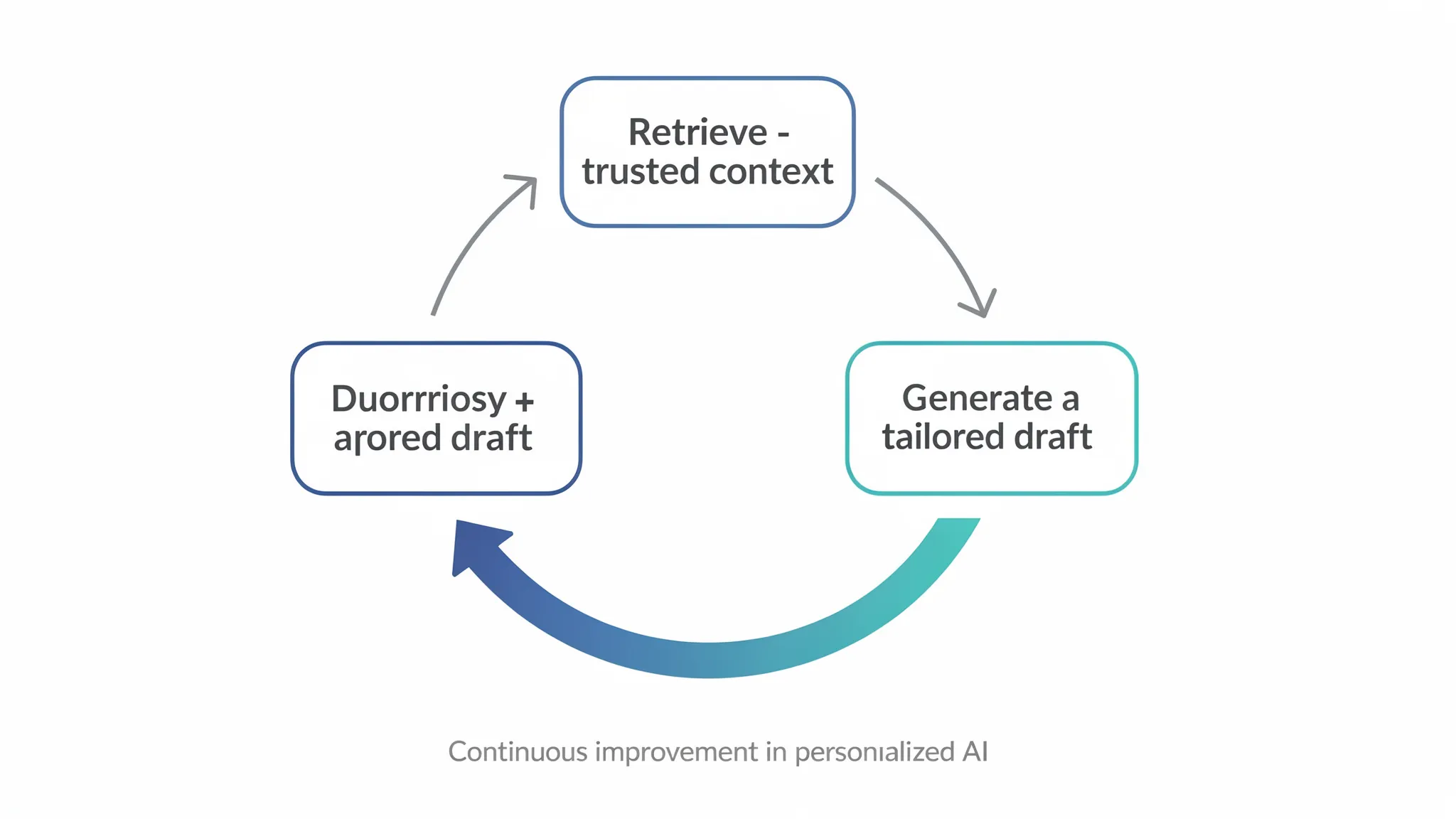
A practical trust-first model has three parts.
Context you can defend
Personalization should come from sources that your business controls.
Strong sources include:
CRM fields you maintain (ICP, segment, buying committee, last touchpoint)
ERP/order history (products purchased, frequency, lead times)
Ticketing/service history (installed base, recurring issues, SLA)
Product catalog and pricing rules
Approved knowledge base (policies, warranty terms, delivery options)
Weak sources are scraped guesses, unverified enrichment, or anything that changes without traceability.
Consent and expectation management
Trust is not only legal compliance. It is expectation alignment.
If you personalize, your buyer needs to feel:
“This is based on our relationship,” or
“This is based on what I asked for,” or
“This is based on what your company legitimately knows through doing business with me.”
Anything else increases perceived risk.
Control (quality gates that prevent reputational damage)
Control is the difference between “AI content” and “AI operations.”
For most SMEs, the winning setup is:
AI drafts and recommends.
Workflows orchestrate.
Humans approve what carries commercial, legal, or reputational risk.
If you want a deeper operational checklist for safe production use, you can borrow ideas from an AI risk and quality assessment approach like this internal guide: AI check: how to assess quality and risk.
Minimum guardrails that keep personalization trustworthy
You do not need enterprise bureaucracy to make personalized AI safe. You do need a few non-negotiables.
Here are guardrails that consistently prevent the biggest trust failures.
1) “Grounded or nothing” for factual claims
Any claim about pricing, delivery, availability, contracts, or technical specs must be grounded in a trusted system (or omitted).
A simple rule works well:
If the system cannot retrieve the fact, the AI must ask a clarifying question or route to a human.
2) Sensitive-topic boundaries
Define categories your AI can never improvise.
Common sensitive categories in B2B:
legal interpretations
financial advice
HR or employment assumptions
compliance guarantees
competitor claims
AI can still support these areas, but usually as intake, summarization, or drafting, with mandatory review.
3) Human-in-the-loop where trust is most expensive
Use human approval for:
first outbound message to a new account tier
quotes and pricing communication
contract or compliance language
escalations and complaints
This keeps trust intact while still saving time on prep and drafting.
4) Logging and auditability
If a customer disputes a message, you should be able to answer:
What data did we use?
What prompt or workflow generated this?
Who approved it?
This is not only a governance practice. It is how you debug quality.
5) A “stop button” and rollback culture
Trust-first personalization means you assume something will break eventually.
Build the operational habit of:
pausing automation when anomalies spike
reverting to manual workflows temporarily
fixing root cause before reactivating
This is how mature teams prevent small failures from becoming public failures.
Personalization patterns that scale 1:1 and still feel human
Most teams start personalization in outbound because it’s visible. In practice, the highest-trust wins often come from operational moments where relevance is obviously helpful.
Below are patterns that work well across the audiences B2B GrowthMachine serves.
Wholesalers and distributors: “reduce friction” personalization
Buyers in wholesale and distribution do not want poetic emails. They want speed, accuracy, and fewer mistakes.
High-trust personalization examples:
Quote drafts that reflect the customer’s usual pack sizes, delivery windows, and preferred substitutes
Proactive backorder updates with alternatives aligned to their purchasing history
Reorder nudges that reference consumption patterns, without exposing overly specific tracking
The trust principle: personalize around service reliability, not persuasion.
B2B product suppliers: “account clarity” personalization
Suppliers often have complex catalogs and multiple stakeholders.
High-trust personalization examples:
Account brief summaries for sales reps before meetings (recent orders, open issues, renewal dates)
Technical follow-ups that include only approved spec language from your documentation
Next-step recommendations that reference prior interactions (“last time we discussed X, here’s the next option”)
The trust principle: keep personalization verifiable and repeatable.
Installation companies selling to businesses: “project-aware” personalization
Installation and field service businesses win trust by being organized.
High-trust personalization examples:
Automated job intake summaries that capture site constraints, photos/documents, and required permits
Scheduling messages that adapt to location, SLA tier, and technician availability
Post-visit recaps that are consistent, clear, and stored back into the system of record
The trust principle: personalization should reduce coordination overhead.
Accountancy and legal boutiques: “precision and restraint” personalization
In professional services, trust is your product.
High-trust personalization examples:
Client email drafts that reference only what is inside your engagement scope and documents
Intake workflows that ask smarter questions based on the client type, then route to the right specialist
Internal copilots that prepare checklists, summaries, and draft responses with citations from your internal policies
The trust principle: less can be more. Personalize where it improves clarity, not where it creates exposure.
B2B real estate brokers: “relevance with receipts” personalization
In B2B real estate, personalization wins when it saves time and avoids mismatches.
High-trust personalization examples:
Match summaries that explain why a property fits (requirements met, constraints not met)
Stakeholder-specific recaps after calls (CFO cares about lease terms, operations cares about access)
Pipeline updates that are factual and consistent
The trust principle: show reasoning, not just conclusions.
How to roll out personalized AI without creating brand risk
Most trust problems happen when teams roll out personalization too broadly, too fast.
A safer rollout sequence for SMEs looks like this.
Start where personalization is already expected
Pick moments where customers already expect you to be specific, such as:
responding to an inbound request
sending a quote or a clarification
updating about delivery, service, or order status
Outbound personalization can come next, but it should not be your first production test.
Ship “draft mode” first
A practical first milestone is:
AI generates drafts.
Your team reviews.
You measure time saved and error rate.
This alone can deliver meaningful capacity gains, without risking uncontrolled output.
Connect to systems of record before you scale volume
Personalization that is not integrated becomes guesswork.
In most SMEs, the trust foundation is created by connecting AI workflows to the tools you already run:
CRM
ERP
ticketing/helpdesk
shared knowledge base
This is where an automation partner like B2B GrowthMachine is typically most valuable: not by “writing better prompts,” but by orchestrating workflows and integrations so AI can act on real context.
Treat brand voice as a constraint, not a preference
Codify tone and boundaries:
approved phrases
forbidden claims
escalation language
compliance disclaimers where needed
When you do this, personalization becomes consistent across reps and channels.
Measuring success: trust metrics plus growth metrics
Personalized AI is often measured with surface metrics (open rate, clicks). Those matter, but trust requires additional signals.
Track business outcomes:
reply rate and meeting rate (for outbound)
speed-to-lead (for inbound)
quote turnaround time
conversion rate by segment
retention or expansion signals (where applicable)
Track trust and quality indicators:
complaint rate related to messaging accuracy
unsubscribe and opt-out patterns
number of human edits per AI draft (trend should improve)
“hallucination” or incorrect-claim incidents (and time to containment)
A useful mental model is: you are not optimizing content. You are optimizing a system.
Transparency builds trust, even outside business
It’s worth noticing a broader pattern: people trust systems more when they can see how decisions are made and how they can influence outcomes.
You see the same principle in civic technology movements that emphasize transparency and participation, for example projects promoting continuous direct democracy tools to increase legitimacy through direct involvement.
In B2B personalization, the equivalent is simple:
be clear where information comes from,
allow customers to correct data,
and make it easy to escalate to a human.
Transparency is not a nice-to-have. It is the trust mechanism.

Where B2B teams typically go wrong (and how to avoid it)
Most failures come from one of these patterns:
Trying to personalize before defining “what good looks like”
If you cannot describe the purpose of personalization in one sentence, your AI will produce noise.
A better prompt than “make this personalized” is “write a reply that confirms availability, proposes the next step, and references the customer’s last order, but do not mention pricing.”
Using AI to compensate for messy data
Personalized AI will expose CRM and ERP hygiene issues quickly.
If your account owners do not trust the CRM, your customers will not trust the messages.
Scaling volume before you harden controls
If you go from 20 messages per week to 2,000, any small error becomes a brand incident.
Earn the right to scale by first proving:
accuracy
consistency
containment speed
A practical next step: pick one workflow where trust matters most
If you want to scale 1:1 without losing trust, do not start by asking, “What can AI do?” Start with:
Where do we currently lose trust?
Where do we currently lose time?
Where do we currently lose deals due to slow response or inconsistency?
Then build one trust-first personalized workflow with real integrations, clear boundaries, and measurable outcomes.
B2B GrowthMachine helps SMEs do exactly that: plug-and-play AI tools, workflows, and agents that automate repetitive sales and operations work while keeping quality and control in place. If you want to explore a safe pilot, start at B2B GrowthMachine and define one high-impact process to automate first.