
AI IT support for SMEs: less waiting time, more uptime
Dec 25, 2025
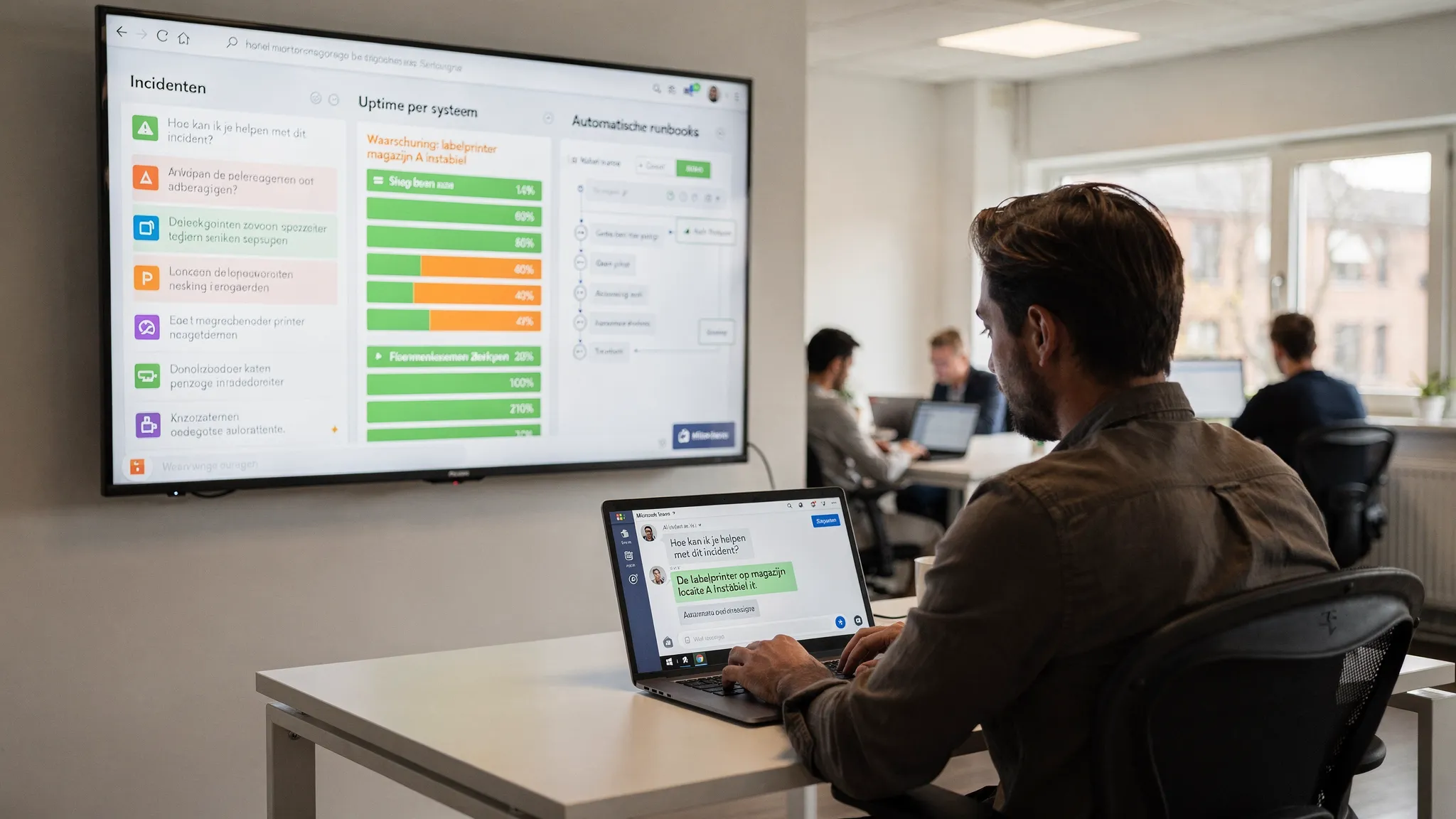
When the printer jams again, passwords have expired, or a scanner in the warehouse goes down, operations in an SME can grind to a halt immediately. Employees wait, customers wait, and deadlines slip. AI IT support tackles that waiting time directly while also increasing the uptime of your critical systems. Not a futuristic promise, but pragmatic automation that already works today in Teams, email, your ITSM, and existing management tooling.
What is AI IT support for SMEs?
AI IT support combines four components into one streamlined support experience:
A virtual L1 assistant, directly in channels like Teams, email, or WhatsApp, for intake, triage, and quick fixes such as password resets and MFA issues.
Agent assist for your IT team, with automatic summaries, suggested solutions from your knowledge base, and ticket enrichment with context.
Automation runbooks that resolve known issues autonomously, for example restarting services, clearing cache, or flushing a printer queue.
AIOps monitoring that detects patterns in logs and alerts, and intervenes early before users notice.
The result is less waiting time for employees, less noise for IT, and higher uptime for the systems that drive revenue.
Less waiting time: instant answers, instant action
The biggest frustration in IT support is the queue. AI removes time here structurally through four interventions:
Smart intake, tickets are understood in natural language, enriched with device, user, and system context, and classified immediately with the right priority.
Fast self service, common actions like password reset, VPN reconnection, mailbox quota issues, and printer problems can be handled with a single confirmation.
Real time agent assist, during a Teams or phone conversation, suggested steps and relevant articles are shown to your IT staff member, reducing handoffs.
Proactive updates, the bot automatically keeps employees informed about status so they no longer have to chase updates.
Examples that deliver immediate ROI in SMEs include password and MFA reset via chat, automatically routing “scanner is not working” to the right WMS queue, and standard solutions for recurring email deliverability issues.
More uptime: prevent problems instead of firefighting
Uptime increases when you stay ahead of outages and automatically eliminate recurring issues. AI IT support helps with:
Early detection, anomalies in log files, CPU, or network signals are linked to known causes and runbooks automatically start corrective actions.
Change and patch windows that are scheduled and announced intelligently, with automated health checks afterward so systems do not silently remain in a degraded state.
Knowledge that stays current, the assistant learns from resolved tickets and suggests improvements to your knowledge base and runbooks.
Vendor status checks, during incidents outside your own sphere of influence, the vendor status page is checked automatically and attached to tickets.
If you have internationally active teams or work with partners in other time zones, 24/7 support becomes crucial. With international expansion, for example investing or setting up a business in the UAE, it can also be wise to involve specialized partners for the business side, such as consultancy for investing and business setup in Dubai. On the IT side, the same 24/7 readiness and automation should be in place so operations and support stay in sync.
Practical industry examples
Wholesale and distribution, in warehouses issues often occur at peak moments. AI triages scanner and label printer problems, restarts services on print servers, and automatically checks network ports at docks. Employees receive a step by step fix via Teams or immediate escalation when hardware is defective.
B2B suppliers and local manufacturing businesses, production PCs and terminals have predictable failures. The assistant recognizes patterns, schedules preventive maintenance, helps operators with quick checks, and always escalates safety related issues to human oversight.
Installation companies with field service, technicians on the road do not have time to wait for the helpdesk. Via chat they get direct answers about app login, work orders, or photo upload limitations, while the bot adds device data to the ticket so L2 can act faster.
Accountancy firms and legal boutiques, strict security can sometimes cause unwanted blocks. AI helps with DLP alerts, access requests, and client portal issues, including clear explanations of why something is blocked and how temporary access can be granted safely with logging.
Real estate B2B brokers, CRM syncs with portals and email authentication are often the bottleneck. The assistant checks SPF and DKIM records, monitors integration jobs, and automatically restarts failed syncs, with a clean status update to the sales team.
Get started quickly in 30 days
Choose one frustrating L1 issue with volume and impact, for example password resets, printer queues, or VPN. Define what counts as resolved and how you will measure success.
Map the core knowledge and steps, translate existing instructions into concise articles and safe runbooks with clear boundaries for automated actions.
Integrate with your channels and ITSM, enable a chat entry point in Teams or an email entry point for tickets, enrich intake with user and device data via your directory and RMM.
Launch a pilot with human in the loop, the assistant makes suggestions, a staff member clicks approve, and you learn which rules need tightening.
Measure, learn, and scale, automate what is reliable, expand to the next issue, and plan monthly optimization based on data.
Architecture and integrations that work for SMEs
You do not need to replace your landscape. AI IT support fits into what you already have and communicates via APIs with your ITSM, directory, RMM, and collaboration tools. Think intake via Teams or email, ticketing in systems such as Jira Service Management, Freshservice, or Zendesk, directory integration with for example Microsoft Entra ID or Okta, and device context from your RMM or MDM. The orchestration layer enforces the rules that determine what can happen automatically and what always requires human approval. All actions are logged so you can audit and improve.
Security, privacy, and EU frameworks
Minimal data sharing, share only what is necessary for the task, mask personal data where possible, and enforce retention periods.
Access control and logging, give the assistant the least privilege required and log every automated action with time, source, and reason.
Human control for high risk actions, anything that impacts security, data, or production goes through explicit approval.
Governance for content and knowledge, assign one owner per article and runbook, have changes reviewed, and publish only verified steps.
DPIA and vendor assessment, map data flows, assess vendors against your GDPR requirements, and document agreements in data processing addendums.
How to show impact to leadership and finance
AI should be measurable. Set up a baseline and then consistently track the core metrics:
First Response Time, time between report and first useful response.
MTTR, average resolution time per incident category.
Deflection rate, share of requests solved without human intervention.
Uptime per critical system, including planned and unplanned downtime.
Ticket backlog and throughput, how much remains open and how quickly you close.
Cost per ticket, combine time spent with internal rates and license costs.
Agent productivity, tickets resolved per staff member per day and satisfaction score.
A simple ROI approach works well. Determine the average cycle time per common ticket and multiply it by monthly volume and your all in hourly rate. Everything AI consistently shortens or automates delivers net time and cost savings. Add the value of avoided downtime at peak moments in sales, warehouse, or production, and the business case becomes concrete enough for decision making.
Build, buy, or partner
Build in house, suitable if you already have an automation culture and internal integration specialists. Start small and embed governance from day one.
Standard software, choose this if your processes are close to best practices and you mainly want speed. Pay attention to integrations, data ownership, and exit options.
Work with a partner, ideal if you want fast results without additional FTEs. A partner helps with use case selection, integrations, runbooks, governance, and ongoing optimization.
B2B Groeimachine delivers exactly that, plug and play AI assistants, workflows, and agents that run in your existing IT landscape. With integrations into well known systems, 24/7 AI support for teams, and a cadence of continuous optimization. Whether you want to automate one process or build a broader AI operation, we make your environment faster, smarter, and less error prone.
Next step
If you want less waiting time and more uptime without overhauling your IT stack, start with one stubborn L1 issue and prove value within 30 days. Then scale in a structured way toward monitoring and automatic remediation. If you want a fast start, we can help you choose, integrate, and measure, with clear KPIs and safe governance. Contact B2B Groeimachine for a short discovery call and a concrete plan that fits your IT and budget.