
Business AI solutions for SMEs: choose smart, scale fast
Dec 30, 2025
AI promises a lot, but SMB teams do not need toys, they need results. If you are looking for business AI solutions for SMBs, it comes down to two things: choose solutions that deliver proven value in your processes, and scale them across multiple teams and systems without friction. In this article, you will get a practical selection and scaling guide that works for wholesalers, distributors, B2B suppliers, accountancy and legal boutiques, installation companies, and B2B real estate brokers.
What counts as business AI solutions for SMBs?
Business AI solutions are not isolated experiments, but production-ready building blocks that connect directly to workflows and systems. Think of:
AI-driven sales and marketing automation, such as personalized outreach, lead scoring, and follow-up sequences
Operational automation, such as intake and triage, document processing, inventory and scheduling tasks
AI assistants as a digital colleague for administrative tasks, reporting, research, and internal knowledge Q&A
Data activation, such as enrichment, analysis, decision logic, and automated actions into CRM, ERP, or accounting
Custom agents and workflows around your own product and customer data, including governance and monitoring
The key point is that the solution should not only understand or generate content, but also execute actions in your systems, with clear measurement points and, where needed, a human in the loop.
Choose smart: the 6 decision criteria that matter
Too many selection processes get stuck comparing features. Use this decision framework to filter noise and prioritize value.
1) Business fit and P&L impact
Does the use case map to a tangible KPI such as time to quote, meeting rate, first response time, error rate, or DSO?
Can you show measurable uplift within 4 to 6 weeks using real production data? If not, redefine the use case.
2) Data readiness and source authority
Where does your “truth” come from, and how do you inject it safely into the AI? Many SMB cases work reliably with retrieval augmented generation (RAG) instead of fine-tuning.
Do you have the minimum required fields, documents, and business rules available and usable? If not, plan a short data-prep sprint.
3) Integrations and ownership
Is there a standard integration with your CRM, ERP, email, WhatsApp, Slack, or accounting package? No integration, no scale.
Do logs, prompts, knowledge, and decision rules remain under your control so you are not locked into a single vendor?
4) Risk and compliance without friction
Classify risks and document controls. The EU AI Act introduces risk classes and transparency requirements with phased obligations.
For GDPR and sector standards, the baseline should include data minimization, logging, explainability for decisions that affect customers, and role-based access.
5) TCO and time-to-value
Calculate not only license or model costs, but also integration, maintenance, monitoring, prompt upkeep, and change management.
Prefer solutions that can prove a first KPI improvement within one quarter, and then expand without refactoring.
6) Measurability and feedback loop
Does the solution include metrics and feedback so the system improves week by week? Without feedback, there is no sustainable ROI.
Set a baseline and targets upfront, and automate reporting to a dashboard or weekly email.
For a deeper dive into model and orchestration choices, also read Choose the right AI engine for growth.
The minimum AI stack that actually scales
A scalable SMB implementation is simpler than you think, as long as you standardize three layers and set governance.
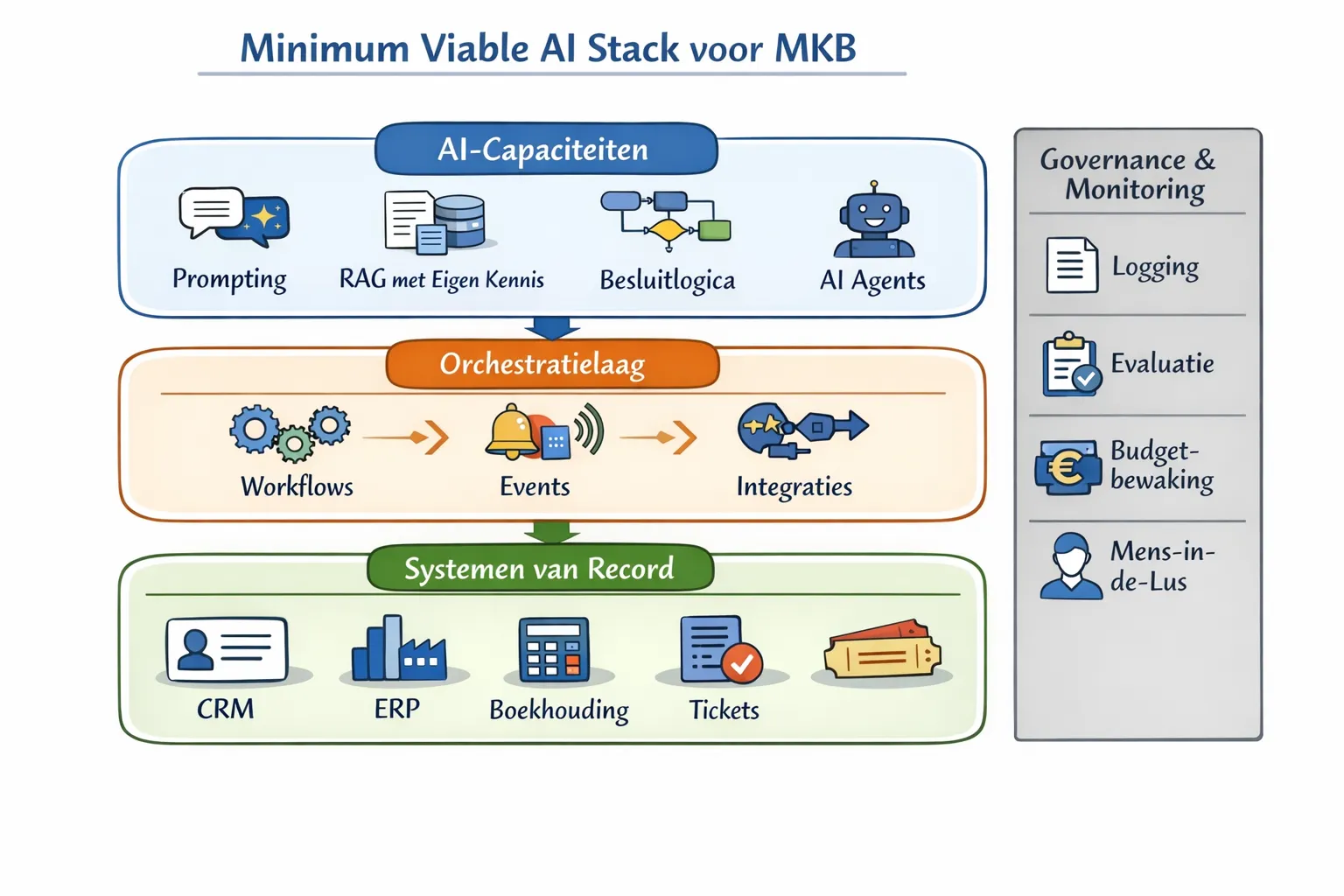
Systems of record, such as CRM, ERP, WMS, and accounting, remain the source of truth.
Orchestration, which captures events and executes actions across channels and systems, prevents spreadsheet automation and scattered scripts.
AI capabilities, including prompting, RAG, and decision logic, provide understanding, generation, and decisions with context from your data.
Governance and monitoring, with logging, budget caps, evaluations, fallback paths, and human-in-the-loop where needed.
This setup limits dependencies, accelerates new use cases, and makes audits realistic. It aligns with principles from the NIST AI Risk Management Framework without paralyzing your team with bureaucracy.
Scale fast: from pilot to production value in 6 practical steps
Many SMBs get stuck in pilots. This route delivers real value in weeks and avoids technical debt.
Step 1: Pick one high-repeat process with a clear outcome
Examples include inbound lead triage, quote preparation, document processing, or delivery delay notifications. Define start and end conditions, plus three KPIs.
Step 2: Prepare your data and define “truth”
Inventory documents, fields, and rules. Set sources for RAG, define access rights, and pseudonymize where possible.
Step 3: Build the smallest working workflow
Start with a narrow flow that completes a full task. Add validation checkpoints immediately and log all decisions, tokens, and duration.
Step 4: Put human-in-the-loop at critical points
Quote approval, invoice exceptions, or high-impact customer communication. Limit the number of approvers and provide context plus suggested copy.
Step 5: Measure, evaluate, and strengthen
Automate evaluation, such as accuracy, error type, throughput time, and failure recovery. Improve prompts, retrieval, and rules weekly.
Step 6: Roll out in a controlled way
Start with one team or segment, ramp volume gradually, and enable fallback to the old process during incidents. Secure SLOs and budget controls.
A concrete implementation framework for orchestration and human-in-the-loop can be found in AI business process automation for scalable operations.
Industry plays that often pay off within 30 days
The scenarios below are intentionally narrow, so you can see value quickly and expand afterward.
Wholesale and distribution
Time-to-quote autopilot that pulls product data and price lists, applies terms, and drafts a quote for approval.
Proactive ETA updates to customers via email or WhatsApp, connected to order status and carrier data.
Purchasing and inventory triage that flags anomalies and suggests replenishment or substitution.
B2B product suppliers and manufacturers
Prospecting and data enrichment, followed by personalized outreach tailored to industry, role, and recent signals.
After-sales assistant that surfaces manuals and service procedures, triages tickets, and suggests parts.
Accountancy and legal boutiques
Document intake and validation for annual accounts or contracts, including extraction, checks, and file building.
Customer portal Q&A based on your proprietary knowledge, with secure access and verifiable sources.
Installation and field service companies
Smart scheduling and route suggestions based on skills, location, and SLA, including automated customer communication.
Work-order to ERP processing with checks on materials, codes, and hours.
B2B real estate brokers
Lead scoring and prioritization combined with personalized follow-up and meeting scheduling.
Property information assistant that consolidates documentation and gives customers fast answers.
Success factors are always the same: clear source data, narrow scope, human-in-the-loop for high-impact steps, and direct action inside your systems.
Budget and ROI: make it concrete
A simple calculation prevents endless discussions and keeps everyone honest.
Time saved: total minutes saved per task, multiplied by monthly volume and internal hourly cost.
Error reduction: estimate current error costs per type and the reduction from automated checks and assistance.
Revenue upside: connect faster throughput and better follow-up to conversion or retention uplift where you have historical data.
Costs: include licenses, model usage, integration work, maintenance, change management, and training.
You reach break-even when the monthly value of time and error reduction plus revenue uplift exceeds the total monthly costs of the solution. Embed this calculation in your reporting, not in a spreadsheet that is outdated after day one.
Governance that does not slow you down
Compliance and speed can coexist if you lock in a few principles:
Risk-based execution, with clear criteria for when human-in-the-loop is mandatory and when full automation is acceptable.
Transparency, by including decision logs and source references in customer communication and internal reporting.
Privacy and data hygiene, with data minimization, pseudonymization where possible, and role-based access.
Continuous evaluation, with periodic quality checks, bias screening, and incident procedures. The EU AI Act and frameworks such as NIST AI RMF provide useful structure without paralyzing your organization.
Build, buy, or partner?
Buying is practical if your process is generic and the standard flow fits. Pay attention to data ownership and exportability of knowledge and prompts.
Building gives maximum control over integrations, data, and costs, but requires orchestration, MLOps-like hygiene, and maintenance discipline.
Partnering works well when you want to deliver fast with customization on your systems, but without building an internal team. Choose a partner that keeps ownership of data and knowledge with you, and delivers transferable artifacts.
How B2B GrowthMachine helps you choose smart and scale fast
B2B GrowthMachine is built for the SMB reality: limited time, recognizable bottlenecks, and the need for fast, measurable results. We deliver, among other things:
Sales and marketing automation for outreach, follow-up, lead nurturing, and CRM discipline
AI assistants that take over repetitive admin, scheduling, reporting, and research
Lead generation with multi-channel prospecting, data enrichment, and AI lead scoring
Custom agents and workflows on your processes and systems, with human-in-the-loop where needed
Seamless integrations with CRM, ERP, email, WhatsApp, Slack, accounting, or any API
Monitoring, optimization, and data-driven dashboards so you can manage performance and costs tightly
The result is less manual work, shorter sales cycles, lower costs, and systems that grow with you instead of against you.

Frequently Asked Questions
What are business AI solutions for SMBs? Business AI solutions for SMBs are production-ready AI capabilities (automation, assistants, analytics, and custom agents) that connect directly to your workflows and systems, and that can be measured and governed.
How do we avoid getting stuck in an AI pilot? Pick one repeatable process with clear KPIs, build the smallest end-to-end workflow, log decisions and outcomes, add human-in-the-loop where impact is high, and roll out gradually with fallbacks.
Do we need to fine-tune a model to use our company knowledge? Often not. Many SMB implementations can use retrieval augmented generation (RAG) to safely ground outputs in your own documents and systems without fine-tuning.
What should we measure to prove ROI? Track time saved, error reduction, and revenue impact (conversion, retention, throughput). Compare against total monthly cost of ownership, including integration, maintenance, and change management.
Next step: from intent to impact
Choose one process you run frequently today, and that becomes valuable if it is faster and error-free.
Prepare the data and rules, define three KPIs, and record the baseline.
Build the smallest working flow with validation at the right moment, and connect it directly to your systems.
Report performance weekly, improve prompts and rules, then scale in a controlled rollout.
If you want to accelerate this with a proven approach to business AI solutions for SMBs, including integrations, governance, and monitoring, get in touch via B2B Groeimachine. Together, we will choose smart and scale fast toward lasting value.