
AI-powered workflows in CRM: less manual work, faster deals
Dec 31, 2025
Many CRMs promise order in your sales process, but in practice there is still a surprising amount happening through loose spreadsheets, inbox triage, and mental math. AI-powered workflows bring structure and speed. They take repetitive manual work off your team’s plate, ensure every lead is followed up quickly, and help reps reach agreement faster. The result is less friction in your pipeline, faster deals, and lower cost per acquired customer.
What do we mean by AI-powered workflows in CRM?
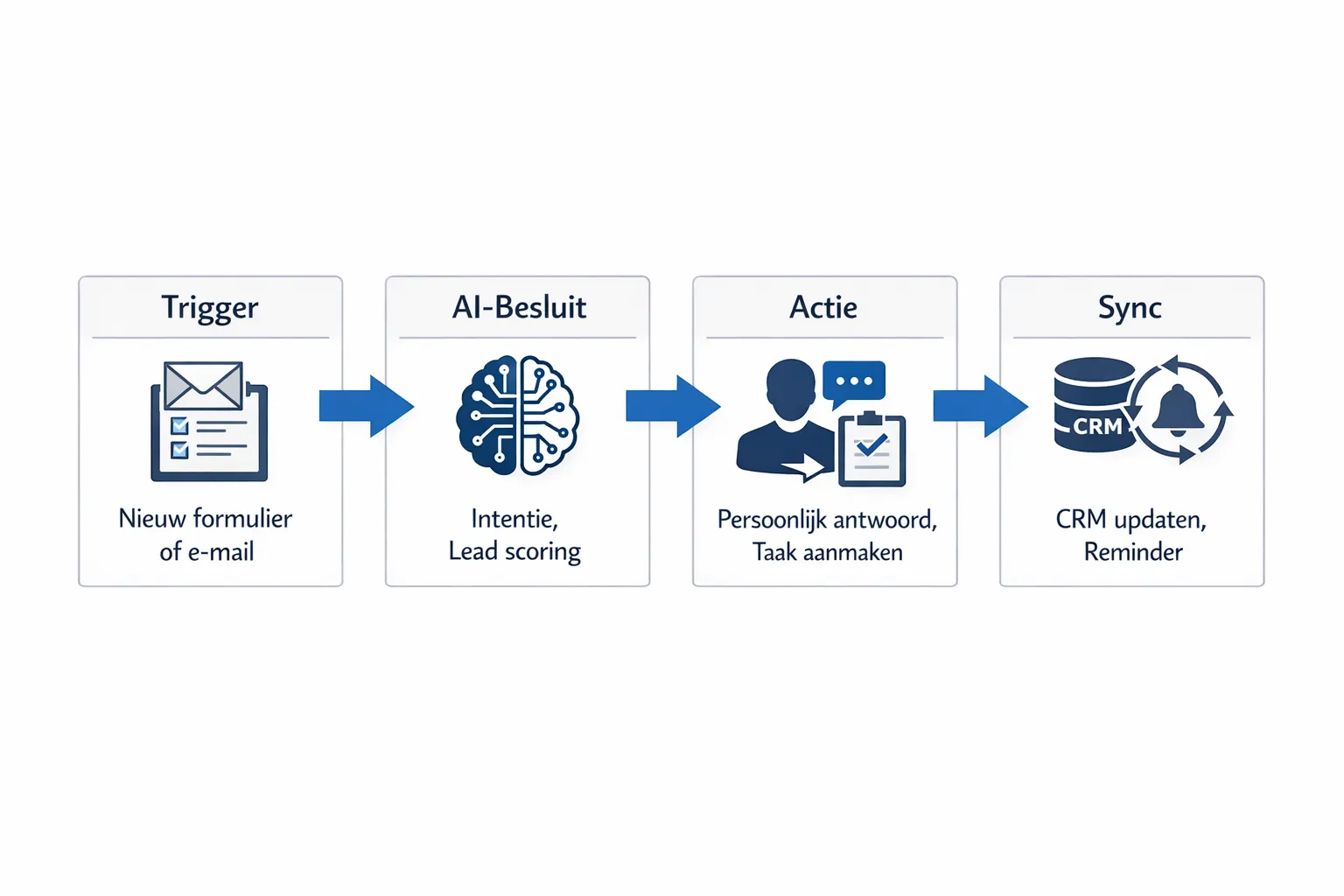
AI-powered workflows are automated chains in and around your CRM that intelligently combine three elements: triggers from data and events, AI for interpretation and decision-making, and actions toward your systems and customers. Think of it like this: an email or web form comes in, AI pulls company data, detects intent and qualifies the lead, drafts a personalized response, schedules a follow-up task or meeting, and updates your CRM. Without anyone manually copying and pasting.
Why this matters right now for SMB sales
Your lead volume and channels are growing, but your team is not. Automation absorbs peaks without sacrificing quality.
Reps lose time on admin. AI can summarize conversations, fill fields, enrich accounts, and keep the pipeline clean.
Customers expect speed. In B2B, the fastest relevant response often wins the deal. Automation reduces time to first touch and time to quote.
9 CRM workflows that eliminate manual work and speed up deals
Fast lead intake and enrichment. A new lead comes in, AI identifies the company, domain, and role, enriches it using the Chamber of Commerce (KvK) or a public company profile, matches the lead to an existing account to prevent duplicates, and creates the first follow-up action.
Automatic lead qualification. Based on submitted fields, email text, or website behavior, AI evaluates fit and intent, with an explanatory note for the rep. This prevents hot leads from getting stuck.
A personalized first response within minutes. AI builds a contextual email reply tailored to industry, use case, and even the product page the lead visited. The rep approves templates once, then the workflow runs autonomously with clear opt-out moments and respect for GDPR.
Meeting booking without the back-and-forth. When a lead shows interest, the workflow sends a proposal with two concrete time slots or a scheduling link, syncs with the calendar, and creates a prep task with summarized context.
Quote copilot. Based on your product catalog and pricing rules, AI prepares a draft quote, fills in references and terms, and requests internal approval if needed. After approval, the PDF is sent and the CRM stage updates automatically.
Background pipeline hygiene. Stale deals are automatically checked, AI reads recent emails and notes, suggests the right stage, creates follow-up tasks, or archives with reason codes if there is no signal.
Next Best Action for active deals. AI looks at historical win data and signals, for example email opens, website visits, budget mentions, and advises the rep: call the DMU now, send an ROI summary, or ask for access to procurement.
Handover from sales to operations. After a deal is won, the workflow generates a clean handover package summarizing goals, scope, deadlines, and risks, and automatically creates tasks for onboarding, implementation, or procurement.
KYC and risk checks where needed. In sectors with compliance requirements, workflows can trigger sanctions and company checks and store the outcome in the CRM. Across industries, it is noticeable how mature modular platforms with open APIs and real-time dashboards have already built this in. One example is a modular iGaming platform with open API and real-time analytics that supports KYC and AML by default. The same integration patterns can be applied to B2B CRM processes with risk assessments.
Real-world sector examples
Wholesale and distribution. Consolidate inquiries from email, WhatsApp, and web forms, automatically recognize SKUs and quantities, retrieve pricing and delivery times, and send a draft quote within 2 hours. A follow-up goes out automatically after 48 hours, including alternative delivery options if there are stock issues.
B2B product suppliers. Lead-to-account matching and multi-thread outreach, AI identifies the economic buyer, end user, and IT influencer and suggests who to involve in the next step. Quote variants are generated based on bundling rules.
Accounting firms and legal boutiques. Intake forms are parsed, KYC and UBO checks are started, engagement letters and fee proposals are generated from templates. The CRM logs each step and schedules an onboarding call.
Installation companies. After a website request, AI creates a pre-scope based on photos and description, schedules a site visit, and drafts a quote including materials and lead time. Updates and appointments run via email or WhatsApp, with logging back to the CRM.
B2B real estate brokers. AI matches leads to the right property, creates a short investment summary, and sends a personalized brochure. After a viewing, an automatic summary with action items is added to the deal record.
Blueprint to go live within 60 days
Sprint 1, foundation and quick wins (week 1 to 2)
Choose 1 or 2 workflows with high volume and low risk, for example intake and first response or pipeline hygiene.
Define KPIs: time to first touch, time to quote, manual minutes per deal, conversion per stage.
Connect systems: CRM, email, calendar, and optionally a data enrichment source. Start with human-in-the-loop approval for critical outputs.
Sprint 2, automate and validate with real data (week 3 to 4)
Train prompts and rules using 50 to 100 real cases. Add guardrails: language, tone, price limits, GDPR filters.
Let reps work with AI suggestions, measure acceptance rate and impact on speed and quality.
Gradually remove approvals where accuracy is high and risk is low.
Sprint 3, expand and operationalize (week 5 to 8)
Add 1 to 2 new workflows, for example quote copilot and handover to operations.
Turn on monitoring and logging: error rates, cycle times, privacy logs. Add rollback and fail-safes.
Formalize ownership: who maintains prompts, templates, and rules, and schedule monthly optimization.
KPIs that matter
Time to first touch. From hours to minutes, this directly impacts your meeting rate.
Time to quote. The faster you send a sharp, complete proposal, the higher your win rate.
Tasks and notes created automatically. Fewer forgotten follow-ups and stronger pipeline management.
Rep productivity. Minutes of admin per deal, compared to baseline.
Conversion per stage. Especially MQL to first meeting and proposal to won.
A simple ROI check: take the number of deals per month times the time saved per deal. If you save 15 minutes on admin and 20 minutes on quotes, you gain 35 minutes per deal. At 120 deals per month, that is 70 hours. Multiply by your team’s fully loaded hourly cost and you have a conservative savings estimate. Often, additional revenue comes on top due to faster follow-up and better conversion.
Data, privacy, and quality assurance
Start GDPR-safe: minimize personal data in prompts and logs, pseudonymize where possible, and log access via role-based permissions.
Keep a human in the loop for price deviations, legal text, and exceptions. Automate the standard, review edge cases.
Protect data quality: deduplication, which fields AI may update, and which fields can only be filled by systems.
Document decision rules and prompt versions so changes are traceable and auditable.
Common mistakes and how to avoid them
Starting too broad. Focus on 1 or 2 critical moments in your funnel. Quick results build buy-in.
Prompts without rules. Always combine generative AI with clear constraints, approved templates, and validation.
No integrations. Workflows that live outside the CRM become outdated quickly. Let your CRM be the single source of truth.
No measurement. Without a baseline, there is no proof of value. Track the same KPIs weekly and adjust.
Forgetting change management. Teach reps how to collaborate with AI, share wins, and embed small rituals (daily standup with NBA suggestions, weekly review of open deals).
FAQ
Does this work with my CRM? In practice, yes for most modern CRMs that have an API. Think of systems that support webhooks, email integration, and custom fields. Without an API, there is little to orchestrate.
How do I make sure AI does not write nonsense into my CRM? Use validation, clear decision rules, and human-in-the-loop for high-risk actions. Start with suggestions a rep approves, then gradually enable automatic actions where reliability is proven.
Is this GDPR-proof? Yes, as long as you apply data minimization, enable logging and role-based access, and avoid putting sensitive content into prompts unnecessarily. Define which data the system is allowed to process and provide opt-outs in outbound flows.
How quickly will I see results? Often within 2 to 4 weeks for time to first touch and administrative time. For conversion improvements, you need a few sales cycles, but the trend is usually visible quickly.
Do I need a data scientist? Not necessarily. A lot of value comes from smart orchestration, strong prompts, integrations, and governance. For more complex models or custom agents, specialized help can be worth it.
What does it cost? Costs depend on licenses, integrations, and implementation time. Start with a scoped pilot so you can see return per workflow before scaling.
Ready for less manual work and faster deals?
B2B GrowthMachine helps SMB teams implement AI-powered workflows in sales and operations quickly and safely. From outreach and follow-up to quotes, CRM updates, and integrations with email, WhatsApp, Slack, ERP, or accounting. We deliver plug-and-play automation, an AI assistant that executes tasks, continuous optimization, and dashboards for visibility.
Want to have three CRM workflows live in 30 days: intake and first response, quote copilot, and pipeline hygiene? Get in touch via our site and schedule a short discovery call. Together we make your sales organization faster, more predictable, and scalable, without adding extra FTEs.
Visit B2B GrowthMachine, https://www.b2bgroeimachine.nl