
Detect AI for B2B: check leads, quotes, and emails
Dec 27, 2025
B2B inboxes in 2025 are fuller than ever with AI-generated messages. From lead forms to vendor quotes and cold emails, the flow is faster and smoother, but not always more trustworthy. That is why Detect AI is no longer a nice-to-have, it is a quality and risk control that directly protects revenue, margin, and reputation. In this article, we show how wholesalers, distributors, suppliers, accounting or law firms, installation companies, or B2B real estate brokers can quickly and fairly check AI content in leads, quotes, and emails, and how to integrate that check automatically into your CRM and workflows.
Why Detect AI is now essential for business
AI makes it easy to produce text quickly. That is useful for your own team, but it also increases the chance of spam leads, polished-but-empty claims in quotes, and misleading emails. Detection is not about banning AI, it is about reliability and fit for purpose.
Quality control, you ensure what you receive or send matches your brand, your terms, and the facts.
Shorter cycle times, you automatically route low-quality leads to nurture and prioritize high-intent leads immediately.
Less risk, you spot boilerplate, hallucinated claims, and phishing patterns before costs or reputational damage occur.
Better conversion, you adapt follow-up based on the origin and quality of the content, so sales spends time on real opportunities.
What Detect AI means in a B2B context
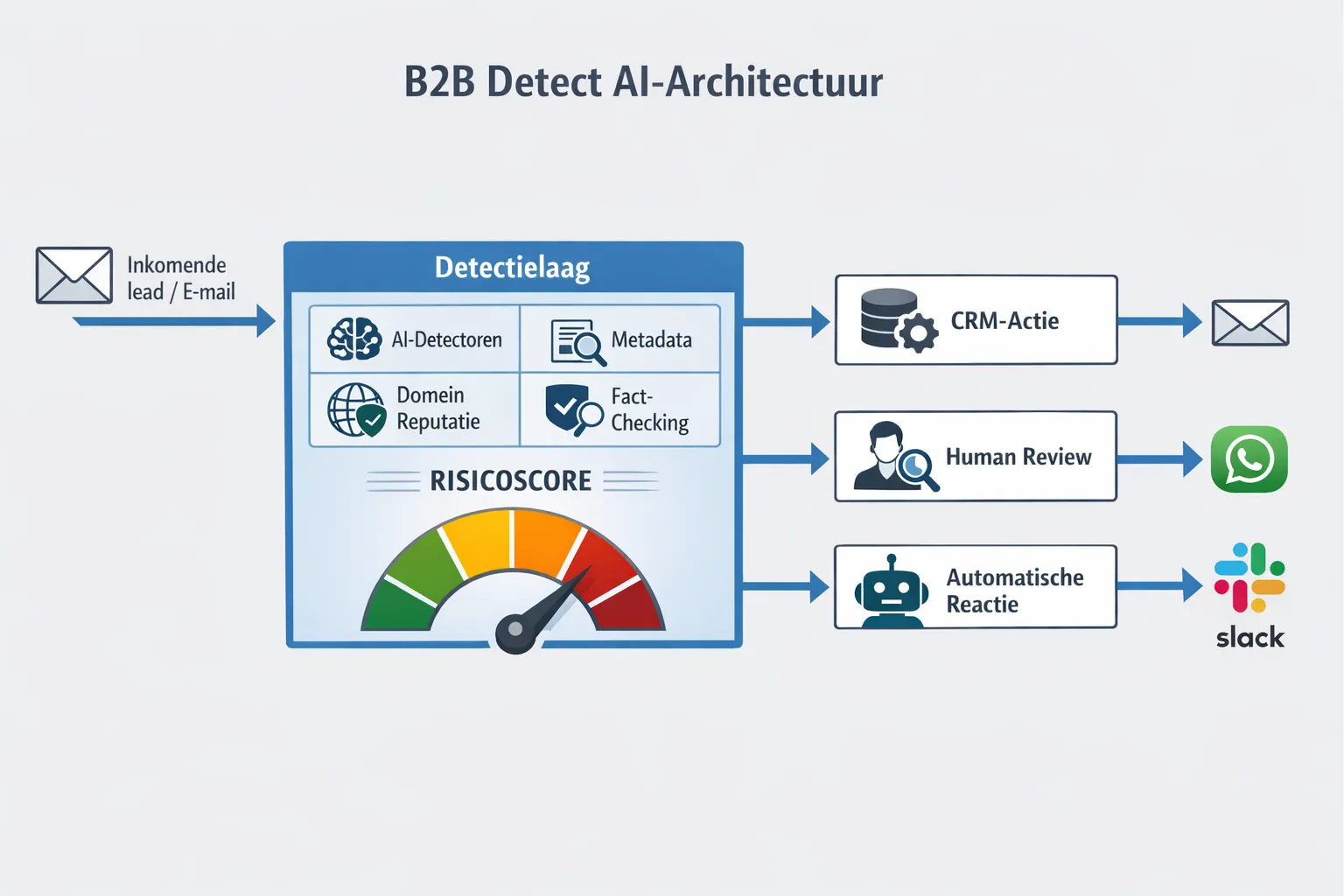
Detect AI is a combination of signals and decision rules that run inside your systems. You do not just assess whether text may have been written by a model, you combine that with context. Think sender domain, link behavior, citations, consistency with previous interactions, and deviations in writing style. The result is a risk score and an appropriate action, for example automatically rejecting, sending to human review, or prioritizing immediately.
Critical B2B use cases
1. Qualify leads without wasting time
Inbound forms, detect generic AI text, disposable emails, and copy-paste claims. Combine the AI signal with domain reputation and enrichment so bots and low-fit leads automatically enter a nurture path and do not pollute your sales calendar.
Conversational intake, use a chat-based intake that asks follow-up questions and checks whether answers are consistent. AI-generated fluff falls apart when asked for concrete examples, quantities, or references.
2. Quotes and RFPs, send better and assess smarter
Outbound, have your own quote copilot run three standard checks, citations, price and terms consistency, and style matching with your brand. This keeps AI speeding you up without letting hollow claims slip into your PDF.
Inbound vendor quotes, detect boilerplate and generic copy. Flag missing details, unrealistic lead times, or vague warranty clauses for a quick legal or procurement check.
Dynamic pricing and bid processes, if you maximize yield through bidding, transparency is crucial. A self-service bidding platform for price optimization, such as Rankbid, helps capture market value, while in parallel you automatically score incoming bid emails and quotes for authenticity and completeness.
3. Email triage with respect for the customer
Recognize cold outreach, send AI outreach that does not match your ICP to a polite auto-reply or opt-out, so your team stays focused.
Protect customer communications, prevent unreviewed AI answers from being sent from your side. Use a quality gate, fact checks, and human-in-the-loop for sensitive replies or price changes.
A quick 5-minute check for a lead, quote, or email
Run two independent AI detectors and note both scores, never combine one tool with an absolute conclusion.
Check metadata and context, domain age, SPF and DKIM status, link destinations, and consistent contact details.
Fact check, verify quantities, product codes, references, or certifications using your own knowledge base or public sources.
Plagiarism or heavy paraphrasing, compare with known web content. Full overlap or unnatural synonyms often indicate generative reuse.
Style comparison, if word choice and punctuation differ strongly from earlier emails from the same contact person, a human review makes sense.
Apply the decision rule, low risk follow up immediately, medium risk to human review, high risk politely reject or request additional information.
Important nuance, no detector is 100 percent accurate. Treat detection as a signal amplifier, not a judge. Make decisions based on multiple signals and always log your choice.
Architecture, how to build a reliable AI check without noise
Triggers, form submission, attachment upload, inbound email, or quote generation by your team.
Signals, AI detectors, stylometry on sentence length and variation, metadata such as domain reputation, SPF and DKIM, citations, link behavior, and optionally entity extraction to validate products, prices, and lead times.
Orchestration, a workflow that calculates a risk score per channel and routes into CRM, ERP, or helpdesk. Use clear thresholds and exceptions.
Human-in-the-loop, make review in Slack or your CRM lightweight, with sample text, signals, and suggested actions. Keep clicks to a minimum.
Logging and compliance, store the score, signals used, and decision taken. This helps with audits, complaints, and training better rules.
KPIs that matter
Lead hygiene, percentage of spam or low-fit leads filtered automatically, and the time sales saves on qualification.
Time to qualify, time from submission to first human action for high-intent leads.
Quote quality, number of corrections to price and terms, and the percentage of quotes sent without escalation.
Email productivity, reduction in time spent on cold outreach and nonsense emails, plus faster response times for real customers.
Risk reduction, number of suspicious submissions blocked and incidents prevented.
A simple ROI argument, if you receive 400 leads per month and 20 percent are low quality that currently take 6 minutes each, you save more than 8 hours per month by filtering automatically. Add fewer quote correction cycles and faster response to high-intent deals, and the business case becomes obvious quickly.
30 days to go live, a pragmatic path
Week 1, baseline and policy
Inventory your flows, forms, email addresses, RFPs, and quote processes. Define do’s and don’ts, when AI is fine, when human judgment is required. Set KPIs and define thresholds for low, medium, and high risk.
Week 2, lead pilot
Start with one ICP form and one channel. Connect enrichment, AI detection, and domain checks. Automatically route into CRM statuses, accept, nurture, review, and give sales a simple review card.
Week 3, quality gate for quotes
Enable three checks for the quotes you send, facts, terms, and style. For inbound vendor quotes, flag boilerplate and missing details. Log decisions and measure revision cycles.
Week 4, email triage and training
Enable auto-triage for cold outreach. Train the team to interpret signals and log decisions consistently. Evaluate KPIs, adjust thresholds, and plan rollout to additional channels.
Industry examples at a glance
Wholesalers and distributors, filter generic price requests, prioritize re-orders with clear SKUs and volumes, and check vendor quotes for unrealistic lead times.
B2B product suppliers, protect sales calendars from AI outreach that does not match your ICP, and ensure your own quote copilot always validates terms.
Accounting and legal boutiques, have intake emails automatically request missing documents, and route sensitive replies to human review to ensure compliance.
Installation and field services, triage project requests based on address, photos, and measurements, and automatically ask for clarification when claims conflict with context.
B2B real estate, check property pitches for factual errors and placeholder text, and prioritize emails with verifiable companies and budgets.
Governance and fairness, avoid false certainty
Use multiple signals, combine detectors with context. One score is never enough.
Avoid discrimination, keep rules objective, domain, behavior, facts, not a person or origin.
Log and explain, store decisions with reasons. This is needed for complaints handling and supports transparency requirements in regulation.
Respect privacy, process only what you need, set retention periods, and sign data processing agreements with vendors.
Review regularly, sampling false positives and false negatives keeps your model and rules healthy.
What B2B GrowthMachine can do for you
B2B GrowthMachine delivers AI-driven sales and operations automation that fits into your existing stack. Specifically, we set up Detect AI where it matters, lead intake, quotes, and email. We connect to your CRM, ERP, email, and chat channels, build decision rules with human-in-the-loop where needed, and monitor performance so you have less noise, respond faster, and close deals with more confidence. Because we continuously optimize, quality stays high while costs go down.
Frequently asked questions
How reliable is AI detection? Detection tools provide signals, not a verdict. Combine two detectors with context signals such as domain reputation, fact checks, and historical behavior. Use thresholds and keep a human in the loop for uncertain cases.
Can I use AI for my own quotes? Yes, as long as you use a quality gate. Automatically validate claims, prices, and terms, and require human review for large amounts or legal impact.
Will this reduce my conversion rate? On the contrary, by filtering low-quality leads and accelerating high-intent requests, net conversion usually increases. Measure this explicitly using time to qualify and win rate.
How do I start without large IT projects? Start with one form and one mailbox. Use workflow automation to collect signals and apply decision rules, then connect the outcome to your CRM statuses. Scale from there.
What if a good lead is rejected by mistake? Use a safe fallback, send a polite follow-up question or a verification step. Log and learn, adjust thresholds based on samples.
Which documents should I check first in quotes? Product codes, quantities, lead times, warranties, exceptions, and references to standards or certifications. Also check consistency between the email text and the attachment.
Is this required by regulation? Not specifically, but transparency, logging, and human review align with the intent of current AI regulation. It reduces legal and reputational risk.
Want to roll out Detect AI in your lead intake, quotes, and email within 30 days, with measurable KPIs and minimal noise? Schedule a no-obligation strategy session with B2B GrowthMachine. We will show you where the biggest gains are and set up a pragmatic pilot that immediately saves time and accelerates deals.