
Detect AI: quickly identify AI-generated content
Nov 28, 2025
Imagine this: you receive a product description that looks perfect, but later it turns out to be language model generated text packed with incorrect specifications. In a world where Gartner predicts that by 2026 more than 80 percent of all digital content will be created partly by generative AI, SMBs need to learn how to spot AI content fast and verify it properly. In this article, you will discover practical methods, free tools, and a streamlined workflow that helps your team determine within five minutes whether a text was written by a human or by an algorithm.
Why AI detection is essential for SMBs
Trust and reputation: Customers, accountants, and distributors expect reliable, authentic information. A single AI mistake can trigger legal claims or reputational damage.
SEO quality: Google does not automatically penalize AI content, but it does penalize unhelpful, unreliable, or duplicative pages. Manual checks help keep your domain authoritative.
Compliance: Industries like accounting and real estate must comply with reporting standards. AI content without proper sourcing can violate rules.
Operational efficiency: Early detection prevents hours of rework. This ties directly into the cost savings we discussed in AI versus manual work.
How do you recognize AI generated text?
AI models like GPT-4 and Gemini can produce extremely fluent writing, but they often leave subtle traces. Watch for these signals:
Overly polished language: long, smooth sentences with no typos, no idiosyncrasies, and little natural variation.
Repetitive sentence patterns: the same cadence over and over (for example, “First… second…”).
Generic claims without concrete examples or sources.
Inconsistent factual details: years or numbers change between paragraphs.
Missing emotional nuance: the text feels flat, or unrealistically enthusiastic.
1. Use AI detectors
There are several online detectors that provide a probability score. Popular options:
GPTZero: free, supports Dutch, shows a per sentence probability.
Copyleaks AI Content Detector: clear visual highlighting.
Sapling AI Detector: integrates with CRM systems via API.
Copy the text, paste it into two detectors, and compare scores. If you see more than 50 percent “AI” in both, you should run additional checks.
2. Metadata and image analysis
Some generators add hidden watermarks or EXIF tags. Download the document or image and open its properties. Notes like “model: Stable Diffusion” or “generator: OpenAI” can reveal the origin.
3. Stylometric comparison
Compare the suspicious text to earlier, unquestionably human written work from your company. Tools like Writeprint analyze word length, punctuation patterns, and unique stop word frequency. Big deviations can indicate a different (AI) author.
4. Domain specific fact check
Ask an internal expert, for example a tax specialist, to verify three random claims. AI models often hallucinate statistics that are not grounded in real sources. Incorrect or outdated numbers are a red flag.
5. Spot prompt artifacts
Texts that start with lines like “As an AI language model” or phrasing such as “Sure, here is a list:” clearly point to a chatbot origin. While modern models often remove this, leftovers still appear in rushed work.
6. Consistency and context test
Ask follow up questions about details in the text. If the writer cannot immediately clarify or provide sources, there is a good chance the passage was generated automatically.
7. Use AI to catch AI
Ironically, you can use an advanced language model to assess other AI written content. For example, ask: “Analyze this text and describe patterns typical of LLM output.” Combine that with your own review criteria.

The 5 minute workflow for busy teams
Paste into a detector (1 minute): Scan the text in at least two free tools.
Plagiarism check (1 minute): Use a service like Scribbr or Grammarly. AI sometimes reproduces larger fragments.
Read it out loud (1 minute): Unnatural rhythm or repetition stands out immediately when spoken.
Double check facts (1 minute): Verify a number, a date, and a source.
Style check against your internal brand voice (1 minute): Does the tone match your guidelines? If not, rewrite or reject the passage.
By building this quick check into your publishing process, you prevent generic AI text from weakening (or awkwardly “strengthening”) your brand.
Limitations of current AI detectors
False positives: strong human writers can be so clean and consistent that algorithms flag their work as “AI.”
False negatives: fine tuning models on proprietary data can lower detection scores.
Multilingual challenges: Dutch language content is less represented in many detector training sets, reducing accuracy.
Lack of context: detectors analyze text, not intent or ethical implications. Human review remains necessary.
Best practices for a robust detection strategy
Create an editorial protocol with acceptance criteria and origin disclosure.
Use version control so you can track how each text evolves.
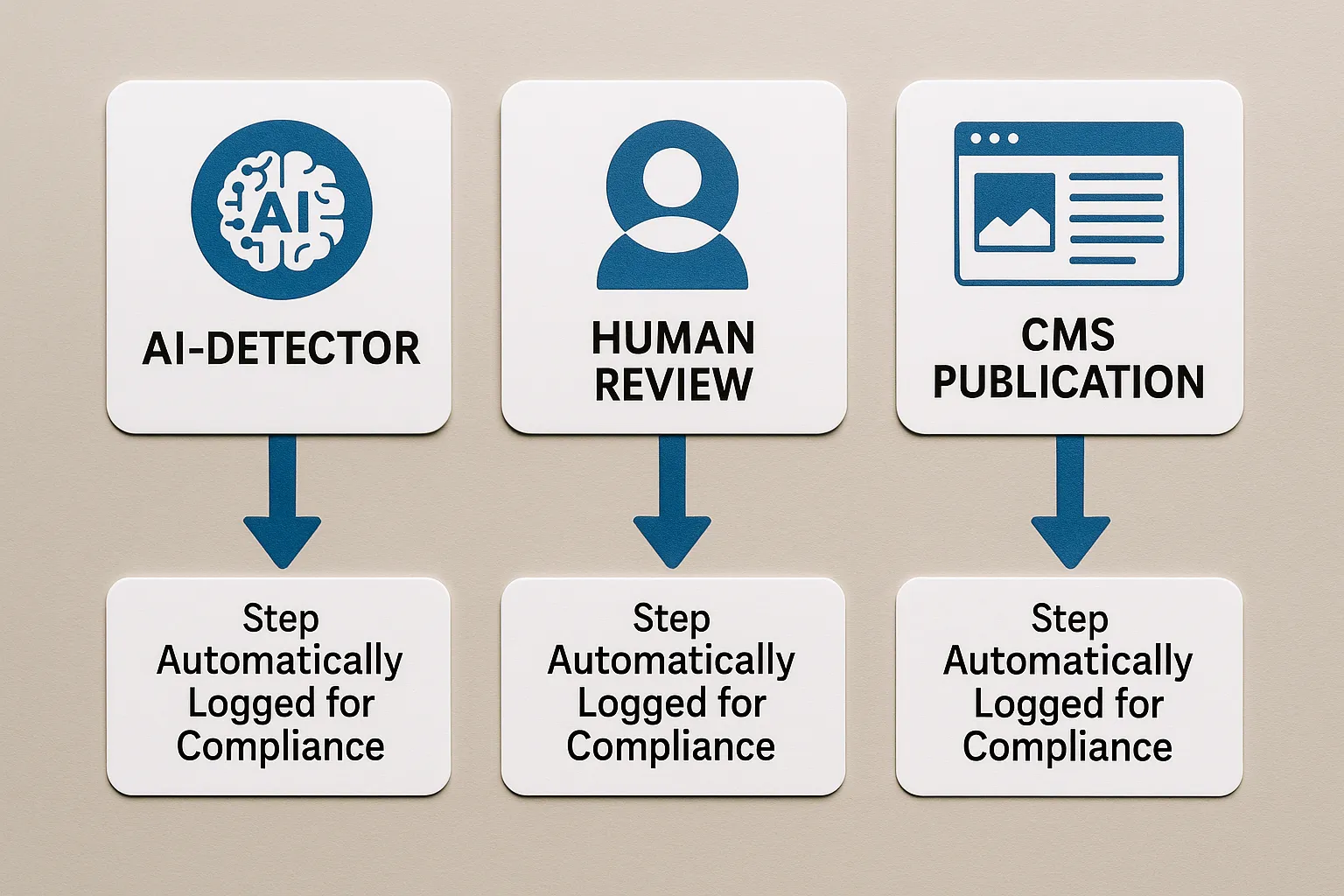
Integrate API based detectors directly into your CMS or CRM. B2B GrowthMachine automates these workflows with AI agents, so your sales or marketing team does not need extra clicks.
Train employees in prompt engineering and fact checking. Teams that understand AI spot deviations faster.
Label your own AI output transparently when you use generative tools, this builds trust with customers and partners.
Real world example
A wholesaler of installation materials in Limburg received 500 product descriptions “ready to upload” from a supplier. After a quick scan with GPTZero, 65 percent of the texts appeared likely AI generated. The wholesaler used the 5 minute workflow to spot errors and corrected 120 critical details in a single afternoon (including incorrect CE markings). This helped them avoid product recalls and extra customer questions, while keeping their webshop’s SEO rankings intact.
What does the future look like?
OpenAI is working on cryptographic watermarks in tokens, while European lawmakers are proposing transparency requirements in the AI Act. That means detection may become more reliable in the coming years, but it also means generators will get better at hiding. A hybrid approach, tools plus human expertise, remains essential. Read how automation continues to evolve in our analysis The future of AI automation.
Frequently asked questions
Is AI content illegal? No, but inaccurate or misleading AI content can lead to claims or fines in regulated industries.
Which detector is the most accurate? There is no gold standard. Combine at least two detectors and always include human review.
Can I simply rewrite AI content? Yes, as long as you verify facts and adjust the tone. The end result must meet your quality standards.
Does Google always detect AI content? Google evaluates quality, not origin. Relevant, trustworthy AI content can rank well, but duplication or inaccuracies can be penalized.
How do I integrate detection without slowing down my workflow? Automate the first check with API tools. Platforms like B2B GrowthMachine can automatically log the detection score and route only high risk texts for human review.
Ready to automate AI detection?
With B2B GrowthMachine, you can build a workflow in days, not months, that detects, logs, and, when needed, automatically corrects AI content. That means safer publishing, less manual work, and more time for strategic growth.
Book a free demo today and discover how our AI driven workflows can protect and accelerate your business.