
Finance AI that improves cash flow and margins
Dec 19, 2025
Cash is king, especially in 2025. Margins are under pressure from higher input costs and wage inflation, while payment terms are stretching and inventory ties up expensive capital. Finance AI makes this tangible and solvable, not with buzzwords, but with predictive insights and smart automation that can run alongside your ERP and accounting today. In this article, we explain how Finance AI can accelerate cashflow, close margin leaks, and reduce risk, with pragmatic steps for wholesale, distribution, installation, accounting, and B2B services.
What is Finance AI, and why now?
Finance AI is the combination of predictive models, data driven rules, and AI agents that execute or prepare financial workflows. Think of automated cashflow forecasting per customer, smart dunning with context, price and margin monitoring, project margin control, and three way matching for purchase invoices. It works on top of your existing systems, connects with ERP, CRM, bank feeds, and email, and keeps a human in the loop for decisions that have real impact.
The promise is straightforward: faster collections, less capital tied up, fewer errors, and more deals at the margin you actually want. For SMB finance teams, that means less manual work and more time for control, scenarios, and decision making.
Where does money leak away, and what can AI do about it?
Quote to cash delays, quotes are followed up too late and contract terms are not monitored.
DSO increases, follow up is reactive instead of risk driven.
Pricing agreements and discounts, margin drops due to inconsistencies, rebates, and freight not being included in pocket margin.
Purchasing and spend, missed early payment discounts, duplicate or late payments, subscriptions without an owner.
Inventory and WIP, too much capital stuck in slow movers and projects where scope changes are not invoiced in time.
Manual work, closing, reconciliation, three way matching, and reporting take hours and create errors.
Finance AI addresses each of these leaks by predicting, prioritizing, and automating.
Eight Finance AI use cases with immediate impact
1) Predictive cashflow by customer and channel
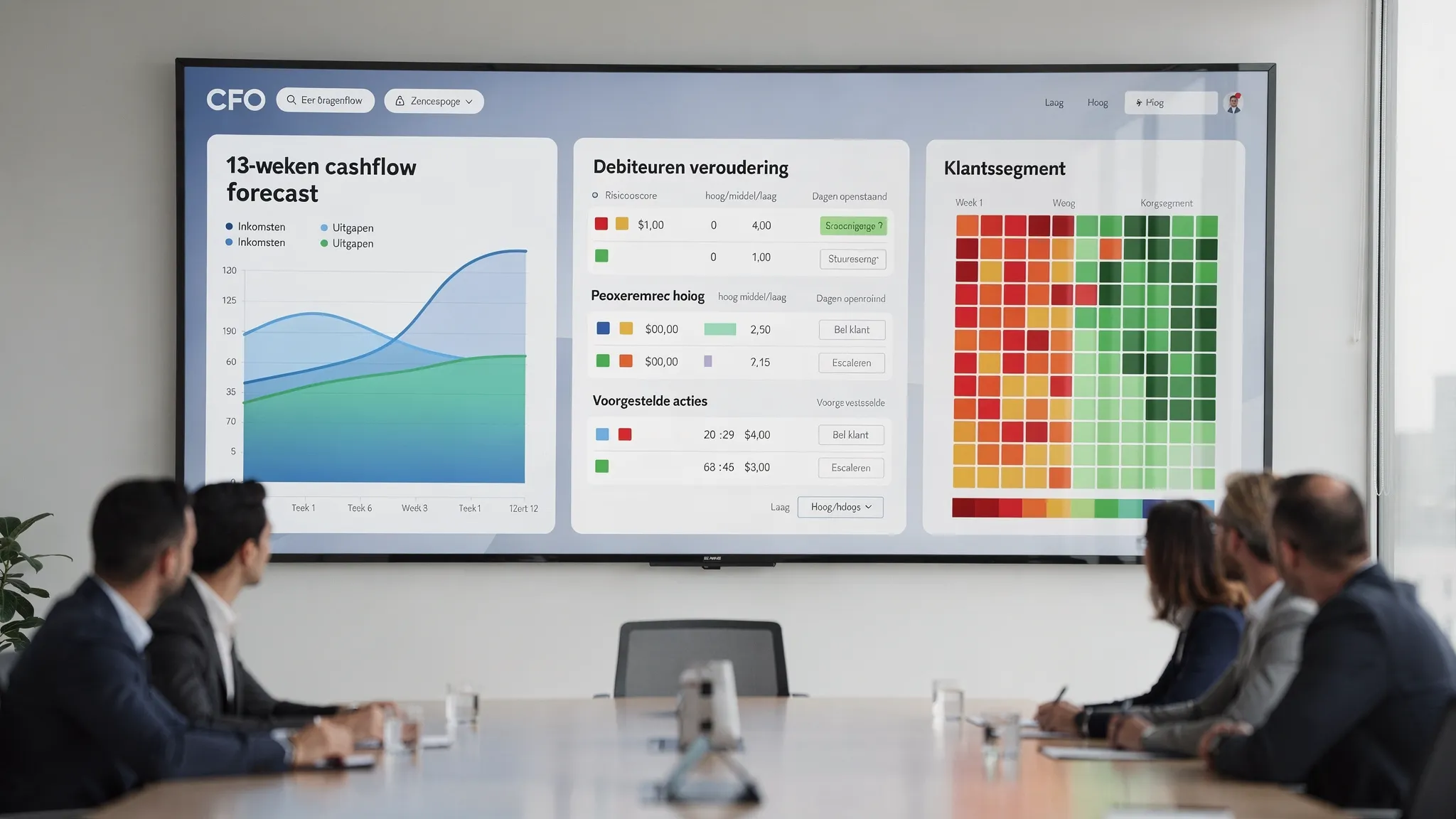
Model cash flows driver based, fueled by order data, payment history, contract terms, seasonality, and campaign activity. You get a rolling 13 week forecast, including scenarios for volume growth or longer payment terms. This supports decisions on working capital, credit limits, and purchasing pace.
2) AR prioritization and a smart collections agent
An AI agent ranks open invoices by risk and amount, proposes friendly but targeted messages per customer segment, and automatically moves to call scripts or escalation. Disputes are detected and triaged with the right attachments from ERP and email. The result is fewer overdue days and fewer write offs.
3) Purchase invoices, three way match, and payments
OCR is step one, but Finance AI goes further. Suppliers are normalized, contract rates are checked, and exceptions are flagged with a suggested next action. Payments are bundled at cash optimal moments, with signals for early payment discounts and controls on bank account changes.
4) Price and margin intelligence in sales
Detect margin leaks by customer, product, and region. AI compares quote discounts with history, volume, and price floors, and advises the smallest concession that still wins the deal within target margin. Pocket margin is calculated in near real time, including transport, rebates, and service bundles.
5) Demand and inventory, financially steered
Combine demand forecasting with cash targets. AI proposes orders that meet service levels with minimal DIO. Slow movers are actively reduced with pricing or bundling suggestions, and dead stock surfaces before it eats capital.
6) Spend analytics and contract monitoring
Spend is categorized, duplicates and unused licenses are uncovered, and contracts with auto renewal trigger alerts. The agent prepares renegotiations with benchmark inputs and savings scenarios.
7) CPQ copilot for profitable quotes
In complex B2B quoting, a copilot shows the impact on gross and pocket margin instantly, suggests alternative components or service bundles, and enforces contractual guardrails. Sales gains speed, finance keeps control.
8) Project margin and WIP monitoring
For installation and professional services, AI predicts whether projects will land on margin, flags scope creep, and suggests change orders or partial invoicing. Cash arrives earlier and end of project surprises disappear.
Sector specific examples
Wholesale and distribution
An AR agent that proactively follows up key accounts with delivery references and proof of delivery attachments.
Inventory optimization per SKU cluster, driven by cash targets instead of only service levels.
Price and rebate monitoring so pocket margin stays on track, including transport and energy surcharges.
Local manufacturing and installation companies
Project margin control with alerts for rising input prices and delayed billing moments.
Supplier risk signals, alternatives, and bundling suggestions that protect margin without hurting lead time.
Accountancy and legal, accounting boutiques
Automated pre close checks, anomalies in the general ledger, VAT, and payroll journals.
CFO as a Service with AI driven cash forecasts and scenarios delivered to clients monthly.
Real estate and B2B brokerage
Forecast commission and fee cashflow from pipeline, contract milestones, and delivery moments.
Detect and follow up payment behavior from tenants or buyers with less friction.
Data and architecture, what is the minimum needed?
Data sources: ERP and accounting, CRM and quotes, bank feeds, purchasing and contracts, inventory, and optionally project planning.
Orchestration: workflows that respond to triggers such as invoice received, term overdue, margin below floor, and an AI agent that initiates the next action.
Knowledge injection: company policy, payment terms, price floors, legal templates, and tone of voice for communication.
Human in the loop: finance or sales approve exceptions, large discounts, and payment arrangements.
Logging and audit: every AI action is recorded with source, recommendation, and decision, including an explanation.
To feed forecasting with commercial signals, it can be useful to include marketing and social data. An API first approach, for example via a social media scheduling and analytics API, can consolidate campaign volume and engagement by channel so revenue drivers flow directly into cash forecasting and margin planning.
Governance, risk, and compliance
EU AI Act: work with data minimization, clear use case classification, and human oversight. Ensure that decisive actions, such as credit blocks or formal payment plans, are always explicitly approved.
Privacy and GDPR: process customer data for specific purposes, pseudonymize where possible, and sign data processing agreements with vendors.
Financial controls: enforce segregation of duties, four eyes approval for payments, and role based rights for master data changes. AI can propose, humans sign off.
Quality and explainability: monitor predictive accuracy and keep fallback rules ready. Report deviations, for example forecast versus actuals.
KPIs that matter
Cash: DSO, DPO, DIO, and the cash conversion cycle.
Accuracy: WAPE or MAPE on the 13 week cash forecast and demand forecast.
Revenue: quote win rate at or above target margin, time to quote, and time to invoice.
Cost: manual touches per process, payment errors, disputes, missed discounts.
Margin: gross and pocket margin by customer, product, and channel, including rebates and freight.
A 30 60 90 day plan to get started
Days 1 to 30, focus on cash
Pick one process, AR prioritization and dunning is often the fastest win.
Connect ERP and bank feed, establish a baseline for DSO and open balance.
Deploy an AI agent that drafts messages and schedules call rounds, with human review.
Start a simple 13 week cash forecast, manage by exceptions.
Days 31 to 60, margin and manual work
Activate price and margin monitoring in the quoting process with soft guardrails.
Automate purchase invoices with three way matching and duplicate payment detection.
Build a weekly report that combines cash, margin, and workload, automatically sent to finance and sales.
Days 61 to 90, scale and embed
Inventory optimization for top SKUs or project margin monitoring for your largest projects.
Expand the forecast with scenarios, for example 5 percent revenue growth or 10 extra days of payment terms.
Formalize governance, roles, audit trail, and model retraining moments.
Simple ROI logic
The Finance AI business case is usually a combination of hard savings plus risk reduction:
Working capital: lower DSO and DIO reduce financing pressure and create room for growth.
Margin: less leakage and better pricing discipline raise pocket margin structurally.
Operational: fewer manual hours and fewer errors reduce cost and speed up closing.
Discounts and penalties: more early payment discounts, fewer late fees, and fewer write offs.
Add those up and subtract licensing and implementation. Many SMBs see payback in a few months from just one use case, especially when finance, sales, and operations share KPIs.
Best practices for durable results
Start with one pain point, make the win visible, then scale across processes.
Let AI propose and prepare tasks, keep decisions with people.
Use pocket margin as your compass, not only revenue or gross margin.
Automate the facts, discuss the exceptions. That preserves time for the hard cases.
Measure and learn, manage weekly based on forecast versus actuals.
How B2B GrowthMachine helps
With B2B GrowthMachine, you implement Finance AI pragmatically. We automate repetitive financial and commercial workflows, build AI agents that work alongside your team, and connect ERP, CRM, email, banking, and tools through existing APIs. You get dashboards and reports you actually use, and we continuously optimize for accuracy, speed, and cost, with human in the loop oversight and audit logging.
Want a noticeably better cash position and more stable margins in 90 days? Schedule a short strategy session and start with one proven use case. Then scale with speed, with control, and with results you can see in both the P&L and the balance sheet.