
Real time AI for sales en operations
Dec 20, 2025
Speed increasingly decides who wins the deal and who ends up doing the work twice. Real-time AI gives sales and operations immediate context, decision logic, and automation exactly when it matters, not after an overnight batch. This article explains what real-time AI concretely means for B2B teams, which use cases deliver fast ROI in SMEs, how to set up a robust low-latency architecture, and how to roll it out safely and compliantly.
What is real-time AI, and why now?
Real-time AI processes events and data within seconds and responds immediately with a recommendation or action. Think of a quote copilot that fills in pricing and lead times during the call, or a warehouse alert that, when a backorder is imminent, instantly suggests an alternative SKU and a replenishment recommendation.
User experience research highlights three response-time thresholds that people intuitively experience as fast: around 0.1 seconds feels instantaneous, around 1 second keeps the flow intact, and after 10 seconds users switch tasks and frustration rises. See the Nielsen Norman Group explanation on response-time limits. For B2B workflows, that means recommendations and actions in the 0.1 to 2 second range provide a clear advantage, especially in sales conversations, planning, and order handling.
Real-time AI in sales, from lead to order confirmation
1) Lead to meeting within minutes
Incoming leads are enriched and scored in real time, so high-intent leads get priority.
An AI assistant responds with a personalized message and a direct calendar link, then books automatically into the right calendar based on region, product, or SLA.
Inbound calls, email, or WhatsApp messages are routed within seconds to the right employee, with a context summary and suggested next steps.
Practical breakthrough: combine real-time scoring with intelligent outreach. See our guide on doubling meetings with AI, including playbooks and KPIs in AI tools that double sales meetings.
2) Live agent assist during the conversation
During a phone or video call, a speech-to-text module listens in, detects intent, and immediately surfaces relevant knowledge articles, recent tickets, or contract terms.
The assistant suggests follow-up questions, fills CRM notes, and drafts a quote while the conversation is still happening.
Result: fewer “I’ll come back to you later,” higher first contact resolution, and shorter time to quote.
3) Quote copilot and instant pricing and lead times
Integrate with ERP for up-to-date inventory, tiered pricing, and discount rules.
Based on product configuration, customer segment, and contract conditions, the AI proposes a draft quote immediately, including lead time, alternatives, and service options.
For exceptions, the system asks for targeted human approval, with a clear explanation and source references.
4) Proactive follow-up without manual work
If a quote is not opened within 48 hours, a real-time workflow triggers a friendly reminder with a summary and call-to-action.
When a quote is opened and engagement is high, AI starts a follow-up that addresses the sections viewed and likely objections.
These sales capabilities are most powerful when orchestrated in one sales workflow. Read how to approach this end-to-end in AI Business Process Automation for scalable operations.
Real-time AI in operations, the engine behind smooth execution
1) Getting ahead of inventory and order exceptions
As soon as an order drops below safety stock, AI sends a preventive recommendation: alternative SKUs, bundles, or replenishment advice, including margins and lead times.
When deliveries are delayed, the assistant proactively communicates to the customer with realistic ETAs and mitigation suggestions.
2) Smarter planning and dispatch for installation and field service
New service requests are matched in real time to the right technician based on skills, location, SLA, and availability.
The customer immediately receives a proposed time slot and preparation instructions, reducing no-shows and improving first time fix.
3) Warehouse productivity without extra headcount
Pick waves are optimized live based on walking routes and priority.
When there are anomalies in weight or barcode matching, AI requests verification and logs the reason for the deviation for audit purposes.
4) Finance and accounting with instant signal value
Invoices are recognized, validated, and posted upon arrival, with real-time checks for VAT, payment terms, and duplicate invoices.
For deviations above a threshold, a block is placed and context is provided to the human reviewer.
5) For lawyers and real estate agents
Incoming documents are classified, summarized, and checked for missing clauses or risks within seconds.
In real estate, the latest property updates are instantly matched to client criteria and a draft proposal message is prepared with the key highlights.
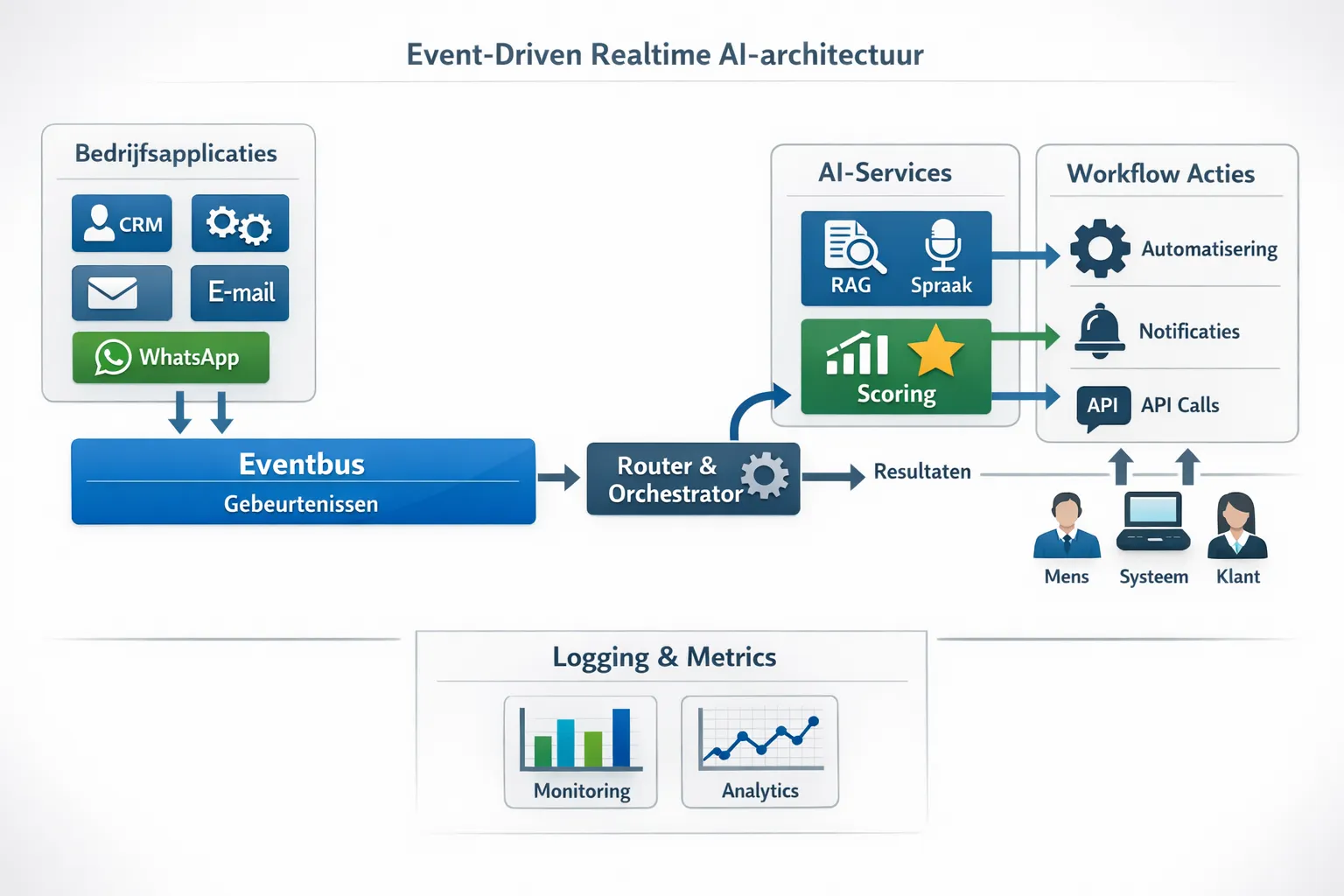
What makes AI truly real-time, the architecture in brief
Event-driven, no polling. Use webhooks and message queues to process every relevant event immediately, for example a new lead, quote opened, order delay.
Low latency at every layer. Use smaller or optimized models for inference, token streaming for faster first output, aggressive caching of frequently requested knowledge, and pre-computation of embeddings.
Retrieval-augmented generation with warm cache. Keep a vector index warm for frequently used product and contract knowledge and use delta updates when changes occur.
Guardrails and fallbacks. When uncertain, fall back to short structured answers with source references, or ask for a human check with context.
Observability by design. Log prompts, decisions, latency, success rate, and human corrections. Monitor drift and exceptions and continuously improve.
Integrations that click. Connect CRM, ERP, email, WhatsApp, Slack, and accounting via APIs so actions land in the source systems.
When you need real-time, near-real-time, or batch
Choose real-time when a human is in a conversation or when a customer is waiting, for example live sales call, chat, call center, checkout, or planning.
Choose near-real-time, seconds to a few minutes, for proactive customer communication and internal alerts, such as quote opens, inventory thresholds, and delivery updates.
Choose batch for heavy analytics or periodic tasks, such as monthly forecasting, data cleansing, or KPI reporting.
A good rule is to make only the steps real-time where speed saves time or prevents errors, and bundle the rest into near-real-time or batch. That optimizes both customer experience and cost.
KPIs that prove you are working in real time
Time to first response for leads and service requests.
Time to quote from request to draft quote.
First contact resolution and call handle time for agent assist.
On-time delivery and inventory fill rate.
Exception rate and recovery time in operations.
Automation rate, percentage of tasks without human actions.
Latency per step, time from event to action in seconds.
McKinsey emphasizes that productivity gains from generative AI become real primarily when it is embedded in processes, instead of used as standalone tools. See also McKinsey on the productivity potential of GenAI.
A pragmatic implementation path in 4 sprints
Sprint 1, instrument your events
Map critical events, for example lead arrives, quote opened, inventory below threshold, and set up webhooks or integration connectors to capture them immediately. Define latency budgets per use case and create a baseline measurement of your KPIs.
Sprint 2, build the minimal real-time loop
Connect one event to one meaningful action, for example lead arrives triggers live enrichment, scoring, and a personalized email with a booking link. Keep a human in the loop for exceptions. Monitor end-to-end latency.
Sprint 3, add knowledge and speech
Add RAG with strict source selection and content governance. Enable speech-to-text and text-to-speech where conversations happen, for example phone or Teams. Use token streaming so an agent sees the first suggestion within a second.
Sprint 4, embed into your systems and scale gradually
Write results back to CRM, ERP, and accounting. Set up alerts and dashboards, configure thresholds and fallbacks, and roll out to more teams. Automate model and prompt updates based on corrections and performance data.
For a safe rollout with risk coverage, a quality check is smart. Our approach for testing data quality, model performance, and operational risks is in AI check, how to test quality and risk.
Security, privacy, and the EU AI Act
Minimize data, process only what is necessary for the task and pseudonymize where possible.
Record who viewed or changed what and keep audit logs of prompts and decisions.
Add clear source references in answers and show uncertainty so employees can judge.
Document DPIAs for sensitive flows and establish DPAs with vendors.
Classify your use cases against the EU AI Act and build appropriate safeguards. More information is available on the official EU AI Act portal.
Common pitfalls with real-time AI
Trying to make everything real-time, which unnecessarily increases cost and complexity.
Not defining latency targets per step, resulting in disappointing experiences for agents or customers.
RAG without content governance, causing outdated information to keep circulating.
No fallbacks to rules or a human in the loop when model confidence is low.
Not writing outputs back to source systems, leading to shadow administration.
Forgetting monitoring, so drift, errors, and data leakage risks are noticed too late.
Real-time AI, concrete playbooks by industry
Wholesale and distributors, real-time inventory alternatives in the quote, proactive ETA updates, and dynamic tiering suggestions aligned to margin targets.
B2B product suppliers, live CPQ assistant that prevents configuration errors and suggests cross-sell during the call.
Installation companies, dispatch optimization by skills and location, with immediate customer communication and material checks.
Accounting, real-time invoice triage with VAT and duplicate checks and alerts for anomalies in the general ledger or bank feed.
Legal boutiques, smart intake that classifies documents and flags missing clauses with source citations.
B2B real estate, automatically matching property updates to search profiles and instantly drafting personalized proposals.

Technology choices that make the difference
Models, combine compact fast models for detection and routing with larger models for language and reasoning when needed. Consider on-edge or regionally hosted options for privacy and latency.
Speech, choose low-latency speech-to-text and text-to-speech with streaming. Optimize noise reduction and diarization for call centers or field environments.
Retrieval, organize your knowledge with versions, access levels, and validation dates. Cache popular chunks and process updates incrementally.
Orchestration, use clear state machines or workflows so exceptions remain manageable and the whole system stays testable.
Observability, measure P50, P90, and P99 latency, success rate, and human corrections, and trigger automatic retraining or prompt updates.
If you want to go deeper into model choice, latency, and cost, including RAG versus fine-tuning, read our practical guide: Choose the right AI engine for growth.
How B2B GrowthMachine helps you go live
B2B GrowthMachine builds and maintains AI-driven sales and operations automation for SME teams. We focus on:
Sales workflow automation, from follow-ups and outreach to CRM updates, quoting, and pipeline management.
AI assistants for daily work that speed up admin, planning, reporting, and research, with a human in the loop where needed.
Lead generation with multichannel outreach, prospecting automation, data enrichment, and AI lead scoring.
Custom AI agents and integrations tailored to your workflows, systems, and KPIs, with connections to CRM, ERP, email, WhatsApp, Slack, and accounting.
Continuous optimization, we monitor performance, improve prompts and workflows, and keep automations up to date.
In short, you provide the goals, we deliver the real-time AI that makes them achievable, including governance, logging, and performance monitoring.
The next step, launch one real-time use case
Pick one moment in your process where speed drives revenue, for example time to first response on leads or automatically drafting a quote after intake.
Define a latency target, for example first suggestion within 2 seconds, and a success KPI, for example plus 20 percent more meetings or minus 30 percent time to quote.
Build a minimal event, action, check loop with a human in the loop, roll it out to a small team, and measure for 2 weeks.
If you want to move faster with a proven approach, orchestration, and integrations that work directly in your CRM and ERP, plan a strategy session with B2B GrowthMachine. Together we choose the right real-time use case, set the latency budget and KPIs, and quickly deliver a working pilot that can scale.
Real time AI, or real-time AI as most teams call it, only becomes valuable when responses are not only smart but also on time and delivered into the right system. That is exactly what our growth machine is built for.