
AI Are You? A 5-Minute Readiness Test
Jan 7, 2026
Most SMEs don’t fail with AI because the tech is “not good enough.” They fail because they try to automate the wrong work, with unclear ownership, messy inputs, and no plan to ship into real operations.
This quick readiness test is designed for busy B2B teams (wholesale, distribution, professional services, installation, and B2B real estate). It helps you answer one practical question:
If you started an AI pilot next week, would it ship into production, or stall as another experiment?
What “AI-ready” actually means in a B2B SME
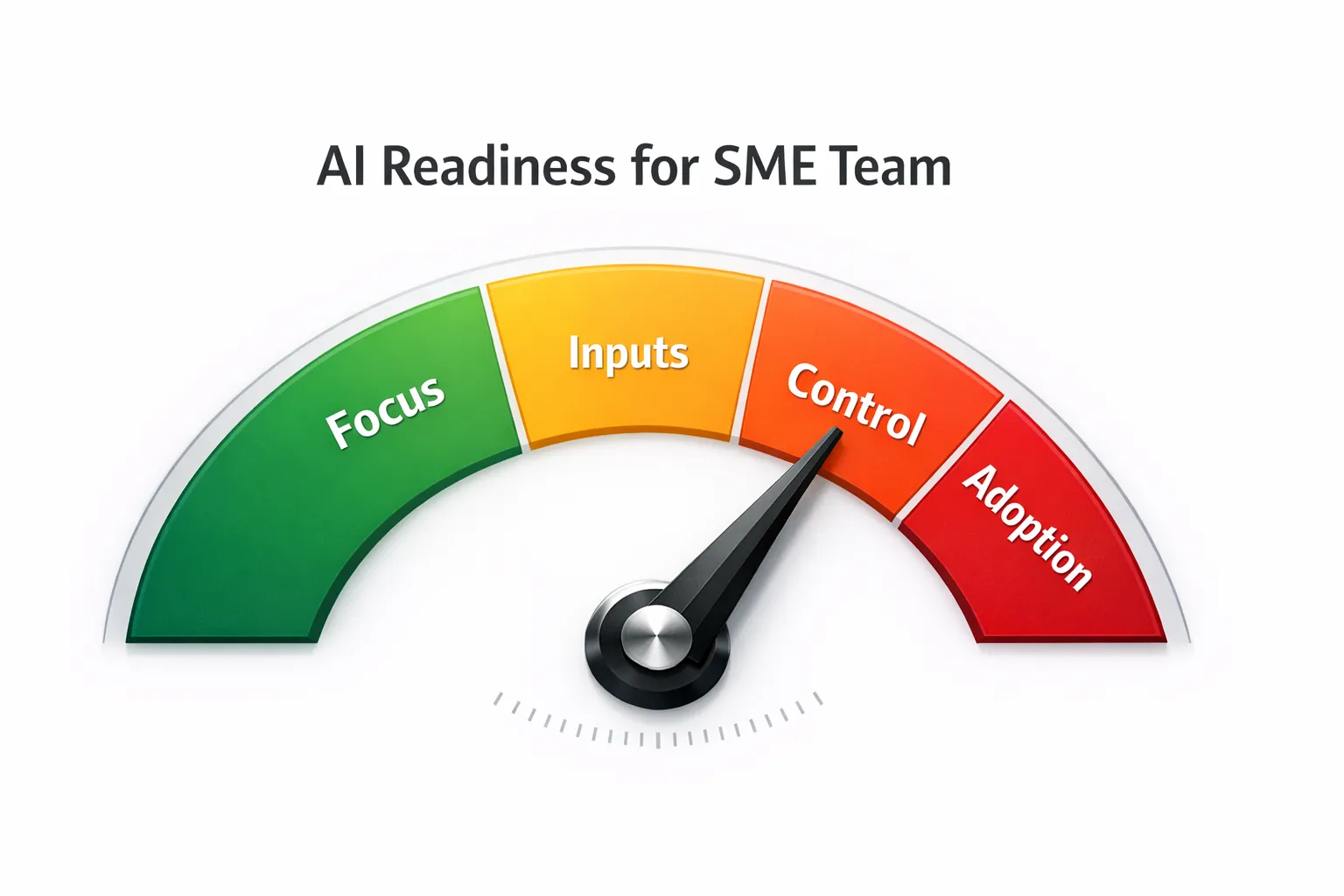
AI readiness is not “we bought a tool” or “we have a prompt library.” In an SME, readiness usually comes down to four things:
1) Focus (a real business outcome) You can name one process where speed, accuracy, or throughput is limiting revenue or margin. Examples: quote turnaround, lead qualification, invoice matching, service scheduling, or contract review.
2) Inputs (data and systems you can trust enough) You do not need perfect data. You do need access to the systems where work happens (CRM/ERP/email/helpdesk) and a minimum standard for the inputs AI will read.
3) Control (risk, privacy, and quality checks) If AI touches customer-facing communication or operational decisions, you need guardrails. In the EU, you also need to keep an eye on compliance requirements like GDPR and the EU AI Act.
4) Adoption (humans, ownership, and feedback loops) A pilot becomes value when someone owns it, the team actually uses it, and you measure performance so it improves.
AI Are You? The 5-minute readiness test
How to score: For each question, give yourself 0, 1, or 2 points.
0 = not true today
1 = partly true, inconsistent, or undocumented
2 = true, repeatable, and owned
Answer quickly. Overthinking defeats the point.
The test (12 questions)
We have one priority workflow to improve in the next 30 to 60 days (not ten ideas). 0 = unclear, 1 = shortlist, 2 = one workflow with a clear start and finish.
We can state the business metric we want to move. 0 = “be more efficient,” 1 = rough KPI, 2 = baseline + target (for example, Time to Quote down 30%).
We know who owns the workflow end-to-end. 0 = nobody, 1 = shared ownership, 2 = one accountable owner.
The workflow has a stable trigger. 0 = ad hoc, 1 = sometimes consistent, 2 = clear trigger (new lead, inbound email, ticket, RFQ, overdue invoice).
The key information exists in a system of record. 0 = mostly in inboxes, 1 = mixed, 2 = CRM/ERP/helpdesk holds the truth.
We can access the inputs without manual copy-paste. 0 = manual, 1 = partial exports, 2 = API or integration access.
We have a “definition of done” for AI outputs. 0 = subjective, 1 = informal, 2 = documented acceptance criteria (accuracy, format, tone, fields).
We can keep a human in the loop where needed. 0 = no, 1 = sometimes, 2 = clear review steps and escalation paths.
We know what data must never be sent to an AI tool. 0 = unclear, 1 = informal rules, 2 = documented rules (PII, contracts, client financials, credentials).
We can log what happened and why (at least at workflow level). 0 = no logging, 1 = partial, 2 = reliable audit trail for inputs, actions, and outcomes.
We have change capacity. 0 = team overloaded, 1 = a few hours weekly, 2 = time blocked for building, testing, and training.
We have a plan to maintain the automation after go-live. 0 = “set and forget,” 1 = reactive fixes, 2 = owner + cadence for continuous improvement.
Your score: Add up your points (maximum is 24).
What your score means (and what to do next)
0 to 10: Not ready to automate, but ready to prepare
This is the most common range for SMEs that are interested in AI but still run on tribal knowledge.
What to do next:
First, pick one workflow where the cost of delay is obvious (quotes, follow-ups, ticket triage, finance checks). If you want a practical model for prioritizing, you can borrow the logic from your “AI vs manual work” discussion: start where repetitive volume and error cost are highest, and where AI can assist without taking full control. (Related read: AI vs. Manual Work: Which One Saves More Time & Money?)
Second, make the workflow “integration-ready”: decide where the source of truth lives and what the trigger is. Many pilots die because the team has to copy, paste, and clean inputs every time.
11 to 18: Pilot-ready (you can build something useful fast)
You likely have enough clarity to launch a pilot that saves hours weekly.
What to do next:
Focus your pilot on a narrow slice of the workflow and keep the human in the loop. For example, do not “automate sales.” Automate a specific handoff like:
inbound RFQ to structured quote draft
meeting booked to CRM updates and follow-up email
invoice received to coding suggestion and approval routing
If your pilot needs CRM/ERP connections, review proven do’s and don’ts for safe integration (human approval, idempotency, clear boundaries). (Related read: AI integration with CRM and ERP: do’s and don’ts)
19 to 24: Scale-ready (start thinking like a system)
You have the elements that separate “cool automations” from a durable AI engine.
What to do next:
Define standards for how you deploy and monitor AI across workflows: naming, prompts, permissions, logging, review steps, and feedback loops. This is also the right moment to formalize quality checks so AI does not quietly degrade over time.
If you want a deeper view on scaling beyond a pilot, you can compare your situation to this roadmap: AI for business growth: from pilot to traction.
The most common “readiness blockers” (by industry)
Even if your score is strong, certain blockers show up repeatedly in the B2B sectors you serve.
Wholesale businesses, distributors, and B2B product suppliers
The blocker is rarely “no data.” It is usually fragmented truth: product data in ERP, pricing rules in spreadsheets, customer context in inboxes, and contract exceptions in PDFs.
A simple fix that unlocks pilots: standardize the intake. If inbound orders and RFQs arrive by email, build a structured capture step first (extract, validate, then route). AI becomes far more reliable once the workflow produces consistent fields.
Legal and accounting boutiques, accountancy firms
The blocker is risk ambiguity. Teams want the speed, but worry about confidentiality, client data, and accountability.
A simple fix: decide what AI is allowed to do without approval. For most firms, “draft and summarize” is safe with review, while “send to client” requires explicit human approval. For governance references, the NIST AI Risk Management Framework (AI RMF) is a helpful, practical standard.
Local manufacturing and installation companies
The blocker is operational complexity: scheduling, dispatch, parts availability, and job notes vary wildly.
A simple fix: start with “assistive automation” around the edges. For example, auto-generate job summaries, prep checklists, customer updates, and internal handoff notes. You reduce errors and rework without trying to automate the entire operation at once.
B2B real estate brokers
The blocker is lead quality volatility and slow follow-up. Many teams have leads coming from portals, referrals, and inbound forms, but qualification is inconsistent.
A simple fix: implement an AI triage step with clear routing rules (high intent gets fast human response, low intent gets nurture). You get speed without sacrificing personal relationships.
If you scored low: a simple 7-day “readiness sprint”
You do not need a 3-month transformation program to become pilot-ready. You need a week of clarity.
Day 1: Choose the workflow and draw the boundary
Write down the start trigger and end state. Example: “Inbound RFQ email received” to “Quote draft created and assigned in CRM.”
Day 2: Define the KPI and baseline
Pick one metric you can measure now. Time saved is fine, but business-facing metrics are better: response time, conversion to meeting, quote turnaround, error rate.
Day 3: Map the inputs
List what the AI needs to read (emails, ERP fields, product catalog, pricing rules, customer history). Identify where the truth lives.
Day 4: Decide your guardrails
Document what must be reviewed by a human. Decide what data is sensitive. If you operate in the EU, align with GDPR expectations and monitor evolving requirements under the EU AI Act using official sources like the European Commission AI policy hub.
Day 5: Define “good output”
Create an acceptance checklist: format, tone, mandatory fields, and what happens if information is missing.
Day 6: Set ownership and cadence
Assign an owner and set a weekly 30-minute improvement slot. Automation without maintenance becomes slow failure.
Day 7: Pick build, buy, or partner
If you need integrations across CRM, ERP, email, and messaging, plan it like a system, not a collection of hacks.
Where B2B GrowthMachine fits (if you want to move fast)
If your goal is to automate repetitive sales and operations work without hiring more people, B2B GrowthMachine is built for exactly that: prompting, workflows, and AI agents connected to the tools you already use.
Teams typically come to B2B GrowthMachine when they want to:
automate follow-ups, outreach, CRM updates, quoting, and pipeline hygiene
run outbound and lead nurturing with less manual work
enrich and score leads with consistent rules
integrate AI automations with CRM/ERP, email, WhatsApp, Slack, and other APIs
keep improving performance over time instead of shipping a one-off pilot
The smartest first step is not “buy AI.” It is to pick one workflow and make it production-shaped.
Frequently Asked Questions
Is this readiness test only for sales teams? No. Sales is often the easiest place to start, but the test works for operations, finance, customer service, and compliance workflows too.
What is a good first AI automation for an SME? One that has a clear trigger, clear inputs, and a measurable outcome. Examples include inbound lead triage, quote drafting, CRM update automation, and invoice or document extraction with human approval.
Do we need perfect data to start? No. You need “usable” data and a controlled workflow. Many successful pilots begin by standardizing intake and adding validation checks rather than trying to clean the entire database first.
How do we reduce the risk of AI making mistakes? Use human-in-the-loop approvals for high-impact steps, define acceptance criteria, and keep logs so you can trace errors. Start with assistive tasks before autonomous actions.
Does the EU AI Act apply to SMEs? The obligations depend on your role (provider vs deployer) and the risk level of the AI use case. If AI influences regulated decisions or processes, you should treat governance seriously. When in doubt, use official guidance and get professional advice for your specific situation.
How long should an AI pilot take? A useful pilot can often be built in weeks if the workflow is narrow, the trigger is clear, and the integrations are straightforward. The bigger challenge is usually adoption and maintenance, not model selection.
Ready to turn your score into a working workflow?
If you want, you can take this readiness test and use it as the agenda for a first implementation conversation. B2B GrowthMachine helps SMEs build plug-and-play AI automations, connect them to real systems (CRM/ERP/email), and keep them performing through continuous optimization.
Explore how we work at B2B GrowthMachine, and if you are aiming for a practical pilot, book a demo or reach out through the site to discuss your highest-impact workflow.