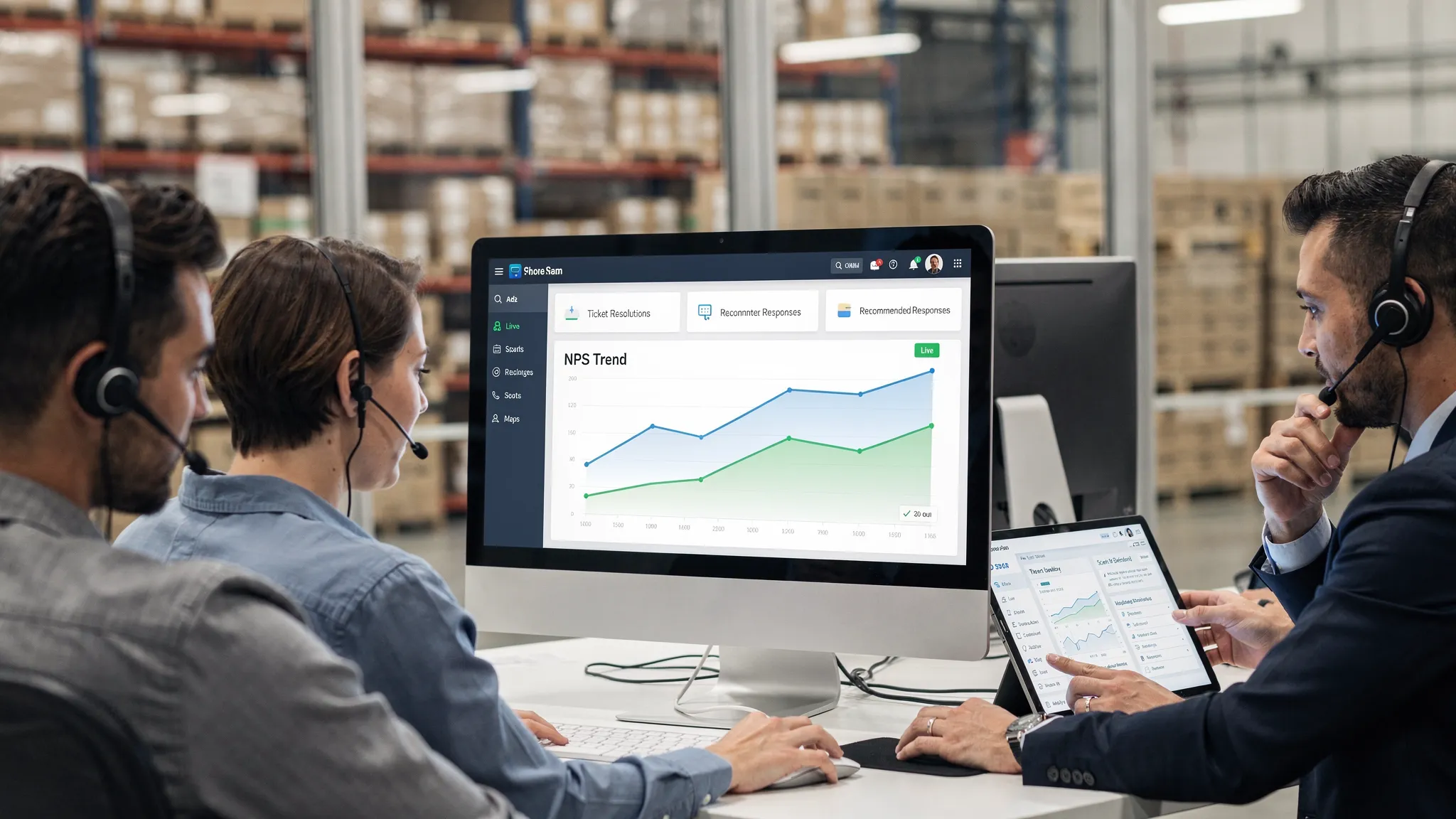
Customer service with AI: faster responses, higher NPS
Dec 10, 2025
In B2B, loyalty is built on speed, clarity, and consistency. When a customer calls about an order status, an invoice discrepancy, or an outage report, every minute matters. AI customer service makes support faster, more consistent, and more personal, which directly impacts NPS and repeat purchases. Major studies, including Zendesk’s CX Trends and McKinsey’s analysis of generative AI, show that AI in service processes can reduce wait times and increase resolution rates, especially when AI and humans collaborate in one flow. See insights from Zendesk CX Trends and McKinsey’s work on the productivity potential of generative AI.
What do we mean by AI in customer service in 2025?
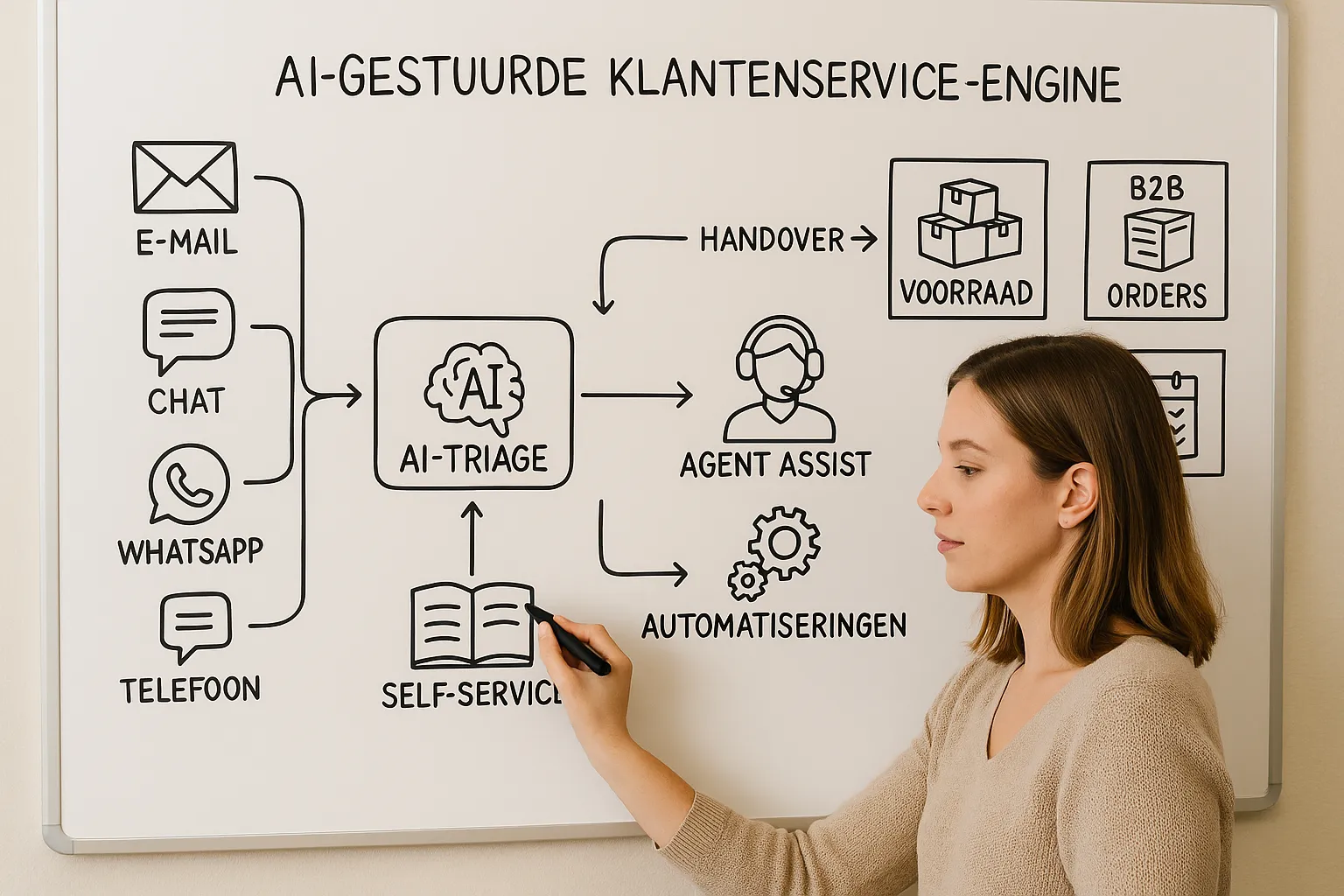
AI in customer service is more than a chatbot on the homepage. It is a layered approach that works across channels and supports your team at every step of a ticket or conversation.
Self-service assistant, a 24/7 helper that answers questions, looks up orders, schedules appointments, and automatically handles recurring requests.
Agent assist, an AI that reads along in the background, suggests replies, creates summaries, surfaces relevant knowledge articles, and drafts responses that your agent reviews and sends.
Process automation, AI that triggers workflow steps such as CRM updates, RMA creation, quote generation, reminders, and escalations based on content and priority.
Voice and transcription, AI that transcribes calls, summarizes them instantly, and creates the next action in your systems.
The difference from traditional bots is contextual understanding, integration with your systems, and a clear handover to humans when needed. That hybrid approach delivers speed without losing human nuance.
Why AI customer service increases NPS
NPS is largely driven by how easy and predictable the experience feels. According to Bain, the creators of NPS, it comes down to whether customers would recommend you, which is strongly connected to their overall experience. Learn more about NPS at Bain & Company.
Lower customer effort, fast and consistent answers reduce customer effort, which is a strong predictor of loyalty.
Higher first contact resolution, with direct access to order, contract, and product data, AI can solve more issues in one interaction or route them with high precision.
Proactive communication, automatic notifications for delays, delivery updates, and maintenance reminders prevent frustration.
Personal context, AI recognizes history, segment, and preferences so customers do not have to repeat themselves.
Practical by industry: proven B2B scenarios
Wholesalers and distributors
Order and delivery status, the assistant retrieves status, ETA, and tracking immediately and triggers a priority follow-up if needed.
Inventory and alternatives, AI answers availability questions and suggests alternative SKUs or replacements based on attributes.
Returns and RMA, automatic creation of return labels, instructions, and updates to the customer and account manager.
Portal support, login issues, price lists, backorders, and Incoterms explained in clear language.
Installation companies and manufacturing
Outage reporting and triage, AI asks in a structured way for photos and serial numbers, links to history, and schedules a technician with the right parts.
Maintenance and service contracts, automatic reminders, checklists, and status updates via email or WhatsApp.
Manuals and knowledge, step-by-step instructions based on product version and up-to-date technical documentation.
Accounting and legal boutiques
Intake and document checks, AI guides clients in providing the right documents and flags missing items.
Deadlines and compliance, automatic reminders around deadlines with explanations tailored to the case.
Summarizing and replying, AI summarizes long emails, drafts a response, and submits it for approval.
Commercial real estate brokers
On-demand information, instant answers about square footage, facilities, permits, and availability, including scheduling viewings.
Documents, AI automatically sends NDAs, brochures, and data room access and logs everything in the CRM.
A pragmatic 90-day implementation plan
Phase 1, days 0 to 30, foundation and quick wins
Inventory top questions and top tasks, the 20 most frequently asked questions and 10 most common processes.
Map data and systems, CRM, ERP, service desk, inboxes, and chat channels, then define minimal integrations.
Start with a knowledge base, consolidate product and process knowledge, FAQs, policies, and macro templates. Let AI help organize and keep content current.
Set guardrails, tone of voice, legal disclaimers, escalation criteria, and data masking from day one.
Phase 2, days 31 to 60, go live with human-in-the-loop
Launch a self-service assistant on web and WhatsApp with clear handover to your team.
Agent assist for the team, automatic summaries, reply drafts, and relevant knowledge articles directly in the ticket.
Measure and learn, capture a baseline for first response time, average resolution time, FCR, and customer satisfaction.
Phase 3, days 61 to 90, scale and optimize
Proactive service, delivery and maintenance alerts, payment reminders, and status updates without the customer needing to ask.
Deeper automation, automatic CRM updates, pipeline tasks, quote or RMA creation, and quality checks on responses.
Knowledge cleanup and training, structured content reviews and continuous fine-tuning based on real conversations.
Measure what matters, from speed to NPS
First response time, how quickly customers receive a first meaningful answer per channel.
Average resolution time, time to full completion, including internal handoffs.
First contact resolution, percentage of issues solved in one interaction.
Deflection and self-service containment, how many questions are fully handled through self-service.
Quality and consistency, sampling, AI-driven QA, and compliance with policy and tone of voice.
NPS, CSAT, and CES, collect feedback right after contact and after full resolution.
Tip, manage leading indicators like first response time and FCR because improvements there are often visible within weeks and later translate into NPS and retention.
Quality, risks, and compliance, how to build trust
Human-in-the-loop, have agents review responses where there is risk of incorrect or sensitive output.
Transparency, make it clear when a customer is speaking with an AI assistant and always offer an easy path to a human.
GDPR and data security, minimize personal data, mask sensitive fields, and log only what is necessary for audit and improvement.
Source and knowledge management, ensure AI grounds answers in policies, manuals, and order data you control, and prevent outdated content.
Validation and testing, review scenarios including edge cases like urgency, multilingual input, and unclear requests.
Also consider insights from Salesforce State of Service. Many organizations combine AI with clear processes, guidelines, and training for employees.
The business case, how to quantify value without fluff
Time savings, calculate hours saved from shorter handle time, faster first response, and fewer internal handoffs, multiplied by your cost per hour.
Volume control, count tickets fully resolved through self-service and compare against your average handling cost.
Revenue impact, connect higher FCR and faster responses to higher NPS and retention. Small NPS increases often have disproportionate value in B2B due to higher contract values and longer terms.
Quality risk, include a safety margin for necessary human quality checks to keep your business case realistic.
How B2B GrowthMachine helps
B2B GrowthMachine delivers AI-driven sales and operations automation that can be applied directly to service processes. You get plug-and-play AI tools and, where needed, custom agents that fit your workflow and systems.
Sales workflow automation, automated follow-up, CRM updates, and pipeline actions from service conversations.
AI assistant for daily tasks, summarizing, planning, reporting, and research, including within the service team.
Service and marketing automation, omnichannel campaigns, nurturing, and personalized customer updates.
Lead generation and data enrichment, so service insights translate into commercial opportunities, with AI-driven lead scoring.
Custom AI projects, agents and automations tailored to your processes and systems, with human-in-the-loop.
Integrations, connections to CRM, ERP, email, WhatsApp, Slack, and other systems via APIs.
Continuous optimization and 24/7 AI support, performance monitoring, improvements, and help when you need it.
If you want to read more broadly about the impact of AI on your operations, also check our articles about How AI workflow automation transforms operations, The future of AI automation, and AI versus manual work.

Frequently asked questions
What is the difference between a chatbot and agent assist? A chatbot handles customer questions independently in self-service. Agent assist supports your employee with summaries, knowledge, and drafted responses. The employee stays in control and ensures quality.
How does AI concretely improve our NPS? Faster first responses, higher first contact resolution, and proactive updates reduce customer effort and increase predictability. These are direct drivers of higher NPS.
Does AI also support WhatsApp and email? Yes, modern solutions work across channels, for example web chat, email, WhatsApp, and phone transcriptions, using a single logic for triage and knowledge.
Will AI replace my support team? No. AI removes repetitive work and makes human work more effective. Employees focus on exceptions, customization, and relationships, while AI does the heavy lifting.
How do we prevent incorrect or fabricated answers? Use approved knowledge sources, human-in-the-loop review, clear boundaries for the AI, and monitoring. Start with low-risk scenarios and expand in a controlled way.
Is AI customer service GDPR-compliant? Yes, if you apply data minimization, mask sensitive fields, put processor agreements in place, and define logging and retention policies.
How quickly can we go live? Many organizations launch a first version within 4 to 8 weeks, starting with the top FAQs and an agent assist pilot, then expanding in phases.
Which KPIs should we track weekly? First response time, average resolution time, FCR, deflection, QA quality, and NPS. Review by channel and by question type so you can improve precisely.
Can we start without completely new systems? Yes, connect the AI to your existing CRM, ERP, and ticketing through APIs. Start small, measure impact, and scale up.
Ready for faster answers and a higher NPS?
Want to deploy customer service with AI that fits your B2B reality, without months-long implementations? Schedule a short exploration with B2B GrowthMachine. We will help you move from first pilot to scalable automation, with a focus on measurable results and customer experience. Start via our homepage, b2bgroeimachine.nl.