
AI for business growth: from pilot to traction
Jan 4, 2026
Many SMB teams have already run an AI pilot. A proof of concept for lead scoring, a smart quote generator, an agent that summarizes emails, or a workflow that automates CRM updates. And then it goes quiet. The pilot worked, but the growth impact never shows up.
That moment is the real turning point: from pilot to traction. Traction means AI is not “something extra”, but a reliable engine that delivers measurable value every week, with acceptable risk and without everything depending on one person.
In this article, you will get a pragmatic route to turn AI for business growth into real traction, with concrete decisions, metrics, and pitfalls. Aimed at SMB sectors such as wholesale and distribution, B2B suppliers, accounting and legal boutiques, installation companies, and B2B real estate.
Why AI pilots so often get stuck
A pilot is designed to prove something. Traction requires something else: repeatability, ownership, and embedding into day-to-day operations. In practice, pilots often stall for these five reasons.
1) The pilot was “demo-ready”, not “operations-ready”
In a demo, a human can still copy-paste, or handle an edge case manually. In operations, that breaks you.
Signals your pilot is not operational yet:
There is no logging or audit trail (you do not know why something went wrong)
Exceptions are solved ad hoc in Slack or email
There is no clear fallback if AI fails (manual or rule-based)
2) The problem was formulated too broadly
“Use AI for sales” is not a use case. “Send quotes within 2 hours for the top 3 product groups” is.
A pilot that is too broad leads to:
Results you cannot measure
Scope creep
Teams dropping off after two weeks (“this does not make my work easier”)
3) Data and integrations were underestimated
Without stable connections to CRM, ERP, and email, AI becomes an island. Then someone still has to retype the output and the ROI disappears.
4) Nobody owns the rollout
Pilots often have an initiator. Traction requires an owner.
Who decides on changes?
Who monitors quality?
Who trains the team?
Who handles incidents?
5) There is no mature measurement plan
Without a measurement plan, you end up relying on gut feel: “It seems faster.” Traction requires KPIs, a baseline, and a cadence.
What does traction mean in practice?
Traction is not the same as “AI runs in production.” Traction means the solution:
Delivers measurable business impact (growth, speed, cost reduction, error reduction)
Performs consistently (predictable quality and cycle time)
Has adoption (the team uses it without pushing)
Is scalable (more volume, more customers, more processes, without proportional headcount)
A useful distinction:
Lagging KPIs (impact): revenue, margin, conversion, cost per order, DSO, NPS
Leading KPIs (behavior and performance): time-to-quote, response time, number of follow-ups per week, % tasks without manual work, error rate, manual escalations
If you only look at impact, you discover problems too late. If you only look at leading KPIs, your solution can be “busy” without delivering results.
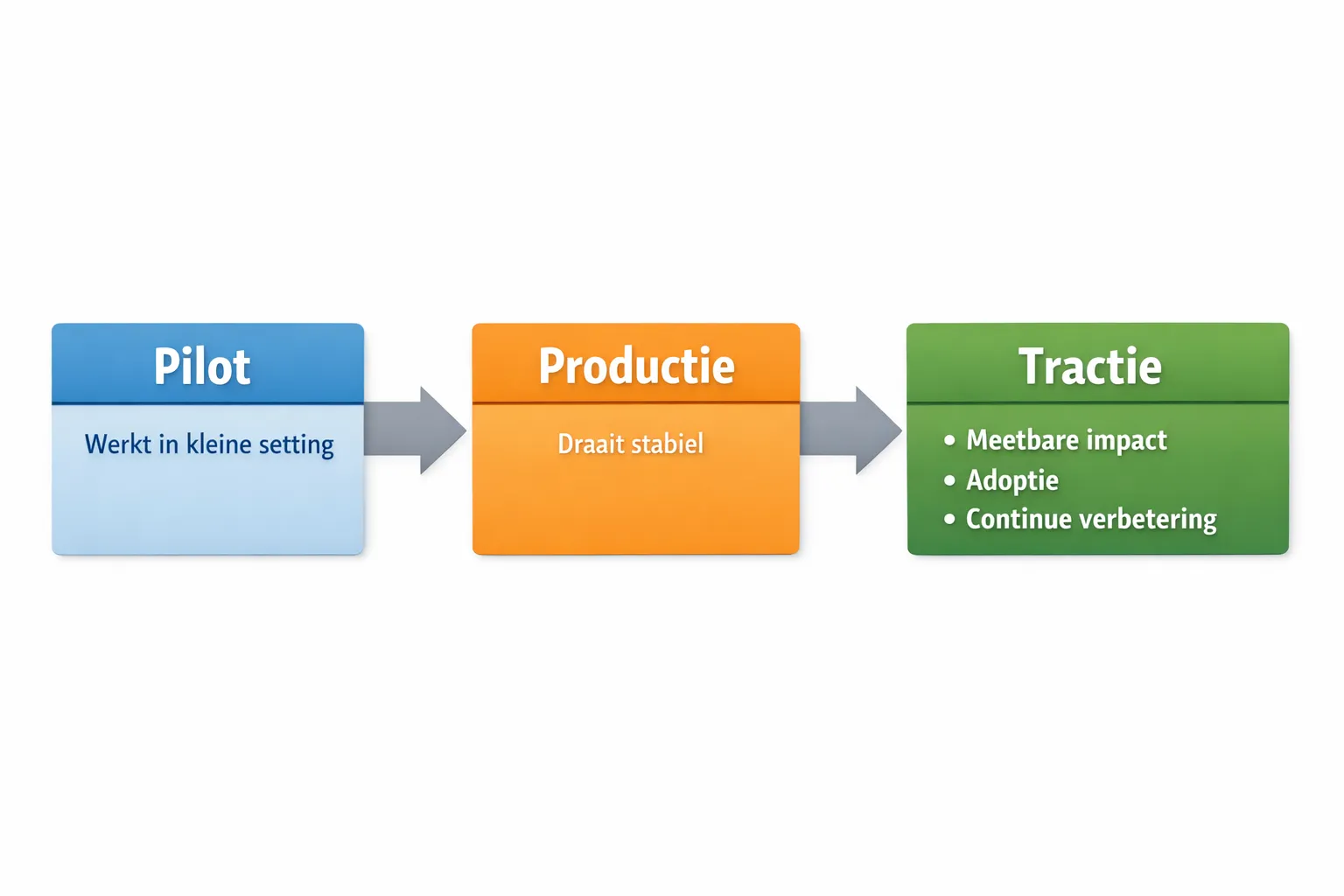
The transition: from pilot to traction in 6 building blocks
The approach below is intentionally practical. Not “more AI”, but better choices and setup.
Building block 1: Make the use case small enough to win
Choose one process where growth and efficiency reinforce each other. In B2B, this is often a moment where speed directly affects revenue or retention.
Examples that often create traction in SMBs:
Wholesale and distribution: quote faster (time-to-quote), automatically qualify order questions, answer product information consistently
B2B product suppliers: automate follow-ups based on intent signals, process datasheets and pricing faster in quotes
Accounting and legal boutiques: automate intake, summarize files, draft responses to client questions with source references
Installation companies (B2B): speed up work preparation, automatically follow up on inquiries, get planning information more complete
B2B real estate: lead intake and qualification, automated follow-up, share property information consistently
Practical selection criteria:
The process has clear input and output
There is a clear “definition of done”
The output can be checked (human-in-the-loop where needed)
There is a system where the output must be written back (CRM or ERP), so it actually saves work
Building block 2: Set a hard baseline and a definition of done
A pilot becomes traction when you know exactly what success is.
Define:
Baseline: current cycle time, error rate, weekly volume, cost (time)
Goal: for example, 30% faster quoting within 6 weeks, with the same level of quality
Acceptance criteria: what is “good enough” for live usage?
Tip: choose one KPI the team feels in daily work. “Less manual work” sounds vague. “A complete intake in CRM within 15 minutes” is concrete.
Building block 3: Design the workflow as if you have to scale it
Traction happens in the workflow, not in the prompt.
A scale-ready workflow includes at minimum:
Trigger: when does the process start?
Input contract: which fields or documents are required?
Decision logic: when may AI proceed autonomously, and when should it escalate?
Output format: exactly what the result should look like (fields, labels, status)
Exception handling: what happens with missing data, conflicts, uncertainty?
If you struggle here, it helps to first write a “human SOP”: how would a new employee execute this process step by step?
Building block 4: Integrate back into your core systems (or you lose ROI)
Pilots often stall because they are disconnected from where the work actually happens.
Make integration a hard requirement:
CRM: updates, tasks, logging, follow-up moments
ERP and accounting: order data, invoice status, inventory, customer agreements
Communication: email, WhatsApp, Slack, tickets
Important: integration is not only “pulling data.” Traction only really happens when AI also writes back and executes actions, with control where needed.
If you want to read more about scaling automation, this aligns with the ideas behind AI business process automation for scalable operations.
Building block 5: Make adoption a deliverable (not something for later)
You cannot “roll out” traction if the team does not trust the solution.
Build trust with:
Transparency: show why AI suggests something (source, rules, summary)
Control: a simple review flow for exceptions
Training: short playbooks per role (sales, back office, service)
Feedback button: “good” and “not good”, with a reason
Practical: assign one process owner (business) and one automation owner (technical or operations). Without this duo, every improvement becomes a debate.
Building block 6: Set up continuous optimization as a rhythm
Traction means you improve every month without rebuilding.
A workable rhythm:
Weekly: review exceptions and errors, small fixes
Monthly: KPI review (leading and lagging), test new variants
Quarterly: expand to a second process or channel
If you do not organize this, AI will drift: reality changes and your workflow becomes outdated.
From “AI output” to “AI decision”: the growth accelerator
Many pilots stop at generation: text, summaries, draft emails. Traction often starts when you connect AI to a decision.
Examples of decisions that accelerate growth:
Which leads get follow-up within 5 minutes?
Which quote goes out the same day?
Which customer request is urgent (and why)?
Which inquiry is incomplete and should go back to the customer?
That is how you move from “AI creates content” to “AI orchestrates actions.” If this interests you, also read Decision making AI: making decisions with more certainty.
Governance and compliance: start small, mature over time
Traction also means you manage risk. Especially in sectors with customer data, financial information, or contracts.
Two frameworks every SMB should at least know:
The GDPR for personal data
The EU AI Act (new European AI legislation) for risk classification and obligations, see the official EU page via EUR-Lex
You do not need to start heavy, but you do need minimum viable governance:
Data classification: what can and cannot go into AI?
Access control: who can see prompts, workflows, and logs?
Evaluation: how do you test quality (before go-live and after updates)?
Audit trail: what happened, when, with which input?
Incident process: what do you do in case of wrong advice, a data leak, or a customer complaint?
Practical tip: treat your most important AI workflows like a new employee. You would not give that employee access to everything immediately, and you would have their work reviewed.
For a risk and quality approach, you can go deeper via AI check: how to assess quality and risk.
Quick diagnosis: is your pilot ready for traction?
Use this checklist to decide whether you should scale now, or strengthen first.
We have a process owner (business) and a technical owner
The workflow has clear triggers, input requirements, and an output format
There is a fallback or escalation path in case of uncertainty
The solution writes back to CRM or ERP (no copy-paste work)
We measure at least 1 leading KPI and 1 lagging KPI
Exceptions are logged and reviewed weekly
There is simple training or a playbook for end users
We know which data can and cannot be used (GDPR)
If you answer “no” on 3 or more items, scaling is often more expensive than strengthening first.
Common scaling mistakes (and how to avoid them)
Expanding too quickly to too many processes
Scaling means depth first, then breadth. One process that runs 80% reliably is more valuable than five that nobody trusts.
Managing only for time savings
Time savings matter, but traction also requires:
Quality (fewer errors)
Speed at critical moments (time-to-quote, response time)
Adoption (use without friction)
Not including an AI cost model
In production, you deal with volume, exceptions, and maintenance. From the start, consider:
Which tasks are high-volume and must be efficient?
Which tasks are high-risk and must be controlled?
Which tasks are low-value and can be simpler, or even done without AI?
FAQ
What is the difference between an AI pilot and traction? A pilot proves something can work. Traction means it delivers measurable value every week, is embedded in your systems and processes, and is used by the team with manageable risk.
How long does it typically take to go from pilot to traction? For many SMB use cases, 4 to 10 weeks is realistic, provided the use case is well-defined, integrations are in place, and ownership exists. If you still lack a solid baseline or data access, it takes longer.
Do you need to integrate everything with CRM/ERP right away? Not everything, but without at least one core integration (usually CRM), ROI often stalls. Traction happens when AI also performs actions and writes back, instead of only producing output.
How do you keep quality high if AI performs actions autonomously? Use human-in-the-loop where risk is high, set clear escalation rules, standardize output, and run a fixed review cycle on exceptions.
What does the EU AI Act mean for SMBs using AI? It depends on your use case and risk category. In practice, it is smart to already work with basics like documentation, logging, data management, and evaluation, so you do not have to rebuild later. When in doubt, consult legal counsel or official sources such as EUR-Lex.
From pilot to traction with B2B GrowthMachine
If your pilot “works” but you notice that integrations, adoption, governance, or measurability are slowing down growth, that is exactly where many SMB teams need help.
B2B GrowthMachine helps companies make AI practical in sales and operations, with workflow automation, AI assistance, lead generation automations, custom AI projects, and integrations with your existing systems.
Want to discuss which use case can create traction fastest in your organization, and what it takes to scale safely? Schedule a conversation via b2bgroeimachine.nl and bring your pilot (or idea). We will build a concrete traction plan together.