AI growth for SMEs: realistic steps
Dec 8, 2025
AI is everywhere, but SMEs are mainly looking for results. Not another demo, but less manual work, faster quotes, and a fuller pipeline without extra headcount. In this article, you will get a practical roadmap to achieve AI growth in 90 days, with examples for wholesalers, distributors, service providers, and manufacturing companies.

Why now, and what is realistic AI growth?
AI growth is not the next hype, it is goal-oriented automation that adds measurable value to your core processes. Think shorter quotation times, higher conversions, fewer errors, and lower cost per order.
McKinsey estimates that generative AI could add between $2.6 trillion and $4.4 trillion in value annually, with a significant share in marketing, sales, and customer processes. See McKinsey’s research for the rationale and industry examples: The economic potential of generative AI.
For SMEs, this means starting small, learning fast, and then scaling. Not endlessly testing tools, but choosing one process, defining KPIs, and working in sprints.
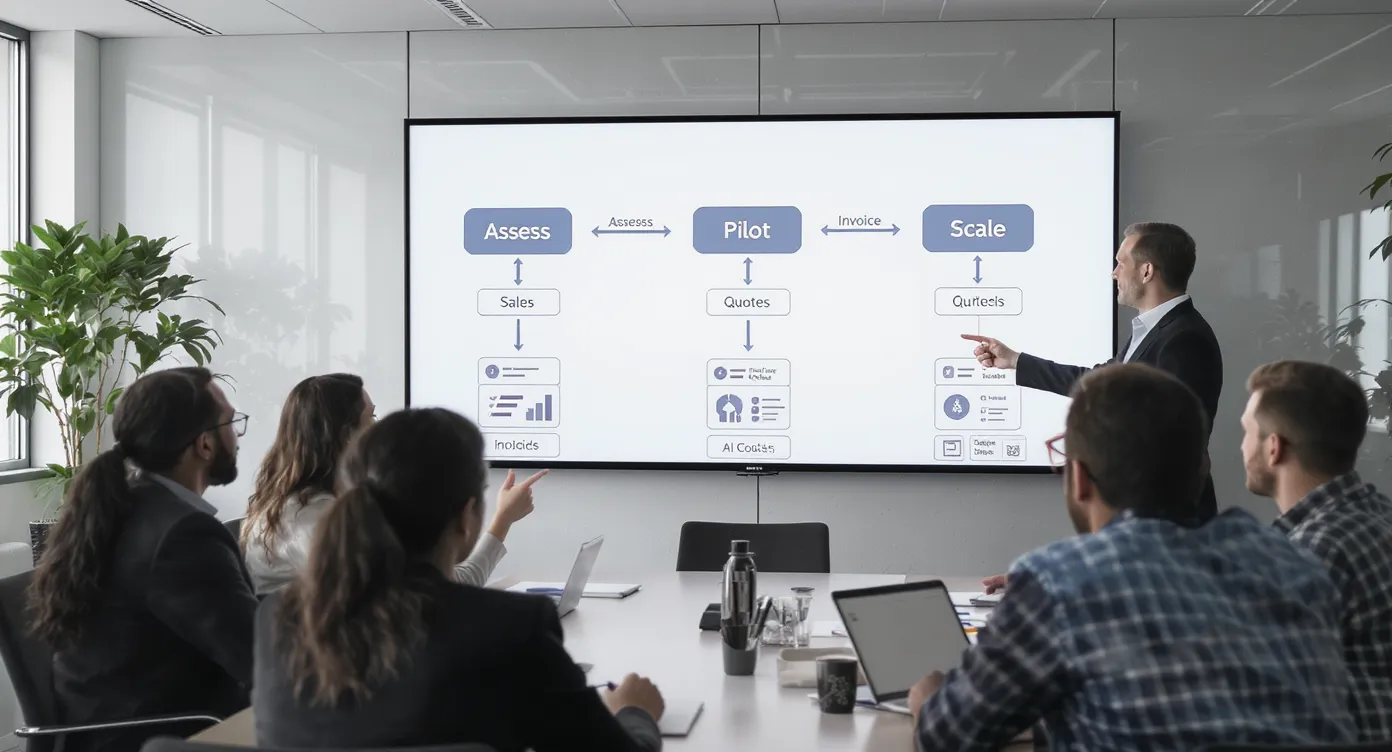
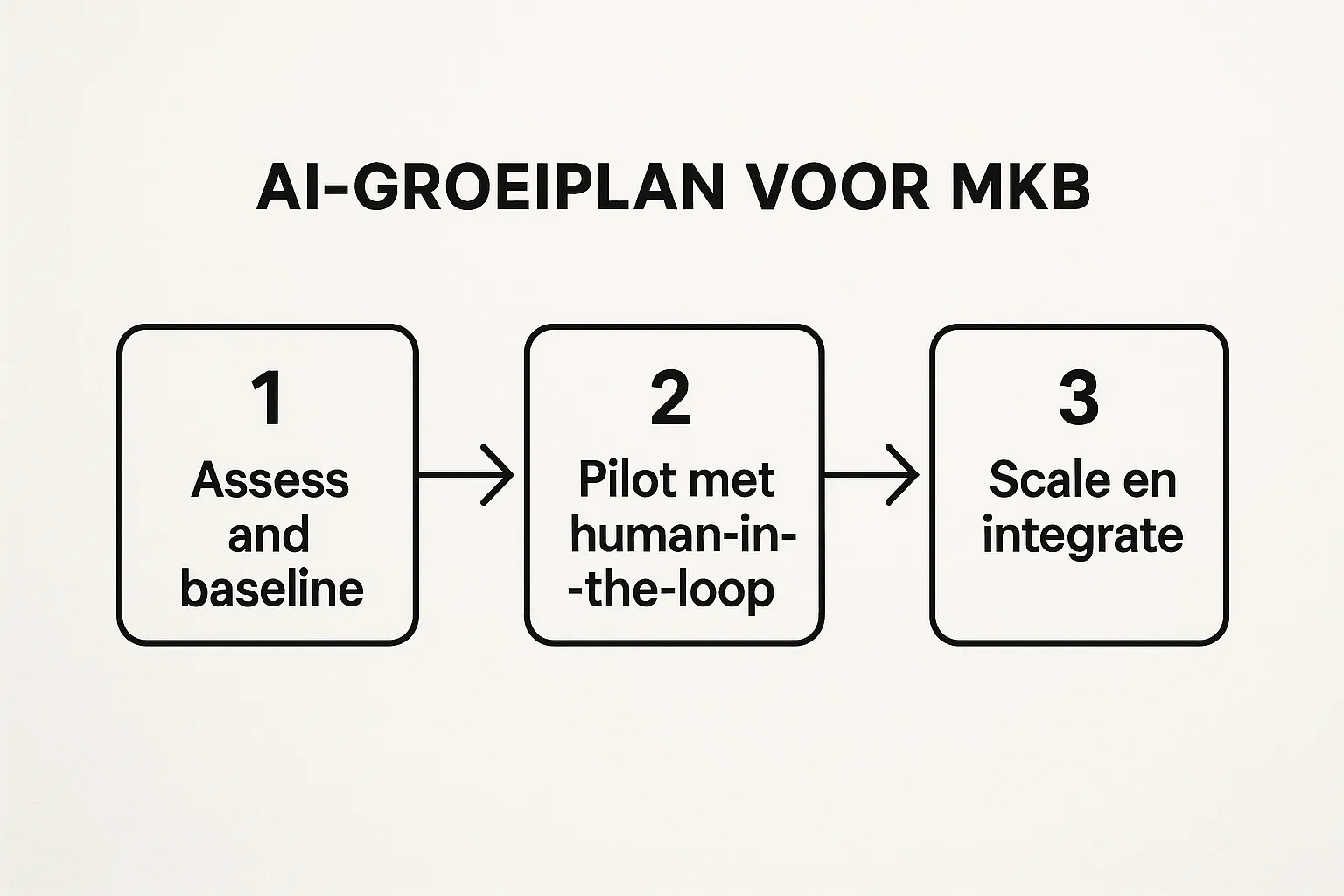
The 90-day roadmap for SMEs
Phase 1: Focus and baseline (week 0 to 2)
Choose one revenue-critical workflow with a lot of repetition, such as lead follow-ups, qualification, quote creation, order intake, invoice matching, or appointment scheduling.
Establish a baseline with hard numbers, including step-by-step lead time, number of actions per task, error rate, conversion per stage, no-shows, and waiting time for customer responses.
Check data and systems: is the CRM up to date, are fields consistent, how is email deliverability, which channels are you using now (email, WhatsApp, phone), and how does it connect to ERP or accounting.
Define success criteria, for example 30 percent less manual work, 20 percent shorter quote cycle, 15 percent higher meeting rate per 100 leads, fewer errors in order data.
Phase 2: Pilot and human in the loop (week 3 to 6)
Build a minimal but end-to-end automation to relieve one bottleneck. Think automated follow-up sequences with personalized emails, AI summaries in CRM notes, automatic data enrichment, or generating quote text from templates.
Keep people in the loop. Have an employee quickly review and approve the first output, so you keep quality high and the system learns from feedback.
Measure KPIs weekly and capture friction points. Optimize prompts, rules, timing, and segmentation.
Phase 3: Scale and integrate (week 7 to 12)
Expand to a second segment or product line. Now also connect other channels, such as WhatsApp or LinkedIn messaging when this fits your market and policy.
Safeguard quality: build a prompt library, add spot-check quality controls, A/B test variants, and set fallback scenarios when data is missing or a model is uncertain.
Document SOPs, train the team, and let dashboards report automatically on time saved, pipeline progress, and error reduction.
Evaluate ROI and decide which processes you add next.
Quick wins by sector
Wholesalers and distributors
Automate lead follow-ups and price requests with personalized emails that propose availability and alternatives. Have AI summarize order history in the CRM, so sales has relevant cross-sell options within 60 seconds. Use AI to flag backorders and proactively send updates.
B2B product suppliers and manufacturers
Have AI read incoming RFQs, extract key specifications, and draft an initial quote based on your price lists and lead times. Add data enrichment so incomplete requests are automatically supplemented with company details and decision-makers.
Accountancy and legal boutiques
Automatically classify intake forms, summarize files, and check documents for missing items. AI can pre-book invoices and bank transactions and flag discrepancies for review. For legal work, automate file creation and clause comparisons with human review.
Installation companies and field services
Convert site survey photos and notes into a structured quote, including a materials and scheduling proposal. Automate appointment confirmations and service reporting into CRM and ERP, including follow-up actions for incidents.
B2B real estate and brokerage
Have AI summarize property information and lease terms into shareable fact sheets. Automate nurture sequences for leads by sector, schedule viewings automatically, and log interactions in CRM with priority on purchase-ready accounts.
Data, integrations, and governance without headaches
Strong AI growth depends on reliable data and solid integrations. With B2B GrowthMachine, you can integrate with CRM, ERP, email, WhatsApp, Slack, accounting, or any API you use. Follow data minimization and purpose limitation, and document why you process personal data.
Privacy and regulation: consult the European Commission’s GDPR guidance: Data protection in the EU.
Risk management: use principles from the NIST AI Risk Management Framework for risk identification, mitigation, and monitoring: NIST AI RMF 1.0.
Logging and audit: log decisions and AI actions so you can trace what happened where. Set fallback rules for exceptions.
People and change
AI is a team sport. Assign a process owner, involve end users in the test plan, and plan short trainings. Reward improvements in KPIs, not just the number of tools implemented. Start small, communicate progress weekly, and make it easy to share feedback from the floor.
Build, buy, or partner
Use standard tools where possible, build custom solutions where you create competitive advantage, and partner where orchestration, integration, and continuous optimization are needed.
B2B GrowthMachine provides exactly that for growing companies: sales workflow automation, an AI assistant for daily tasks, outbound and lead nurturing, prospecting and AI lead scoring, custom AI agents and integrations, plus monitoring and updates, with data-driven insights and 24/7 AI support. That way you accelerate without needing an extra IT team.
Measuring ROI, the simple way
Time saved: hours of manual work per month x internal cost per hour.
Revenue impact: additional meetings or quotes x conversion rate x average order value.
Error reduction: fewer corrections and credit notes, add up the avoided costs.
Net result: value of time savings and revenue growth minus license and implementation costs.
In the first 90 days, focus on hard time savings and shorter cycle times. Pipeline and revenue impact typically follows in sprint 2 or 3, when you scale to more leads or product lines.
Common pitfalls and how to avoid them
Starting too broad: choose 1 process and 1 segment, not everything at once.
Poor data hygiene: fix core CRM fields before you automate.
No owner: without a process owner, the initiative becomes fragmented.
Tool hopping: optimize first, only switch tools when you truly need to.
No human check: keep human-in-the-loop until the error rate is acceptably low.
Start today: mini checklist
Identify 1 workflow where 1 hour per day leaks into manual work.
Measure 2 baseline KPIs: lead time and error rate or conversion.
Build 1 pilot with human-in-the-loop that can go live within 2 weeks.
Plan a weekly 30-minute optimization check-in with the owner and 1 user.
Dive deeper with these articles on our site: on workflow automation, see How AI Workflow Automation Transforms Businesses, on costs and time savings, see AI vs manual work, which saves more time and money, or for practical tooling, see 5 essential AI tools to streamline your business tasks.
Frequently asked questions
Where do I start if I have not done anything with AI yet? Choose one high-volume process with clear KPIs, such as lead follow-ups or quote creation. Measure the current lead time and errors, build a small pilot with human review, and optimize weekly.
Do I need a data scientist? For most SME automations, no. You mainly need a process owner, a marketer or sales colleague for content feedback, and someone who can connect systems. For custom agents or complex integrations, a specialist or partner can help.
How quickly will I see results? Often within 4 to 6 weeks in time savings, and within 8 to 12 weeks in pipeline or revenue impact when you scale to more leads or product lines.
Is this safe with customer data and GDPR? Yes, provided you apply data minimization, clarify processing purposes, sign data processing agreements, and set up logging. Also see the European Commission’s GDPR guidance: Data protection in the EU.
What if my CRM is messy? Start with a cleanup step for the 3 to 5 fields your pilot needs, such as email, sector, lifecycle stage. You do not need everything perfect, but the core fields must be consistent.
Which KPIs are most important to track? Lead time per step, time per task, error rate, meeting rate per 100 leads, quote win rate, and number of manual actions. Start with two KPIs and only add more later.
Ready to make AI growth concrete?
You do not have to grow bigger to work smarter. With B2B GrowthMachine, you automate sales and operations, get more leads, shorten sales cycles, and reduce manual work, while costs go down. Discuss your first 90-day pilot and discover what realistic AI growth means for your organization. Visit our website at b2bgroeimachine.nl and get in touch.