
Personalized AI in sales: convert more leads
Dec 9, 2025
Your leads click, but they do not book a meeting. You send more emails, but conversion stays flat. The problem is rarely volume, it is relevance. Personalized AI in sales turns every interaction into a 1-to-1 conversation at scale. The result is a higher reply rate, more meetings, and shorter sales cycles.

What is Personalized AI in sales, and what is it not?
Personalized AI is more than putting a first name in the subject line. It combines your own data with smart models that decide, per lead, what you should say, through which channel, and at what moment.
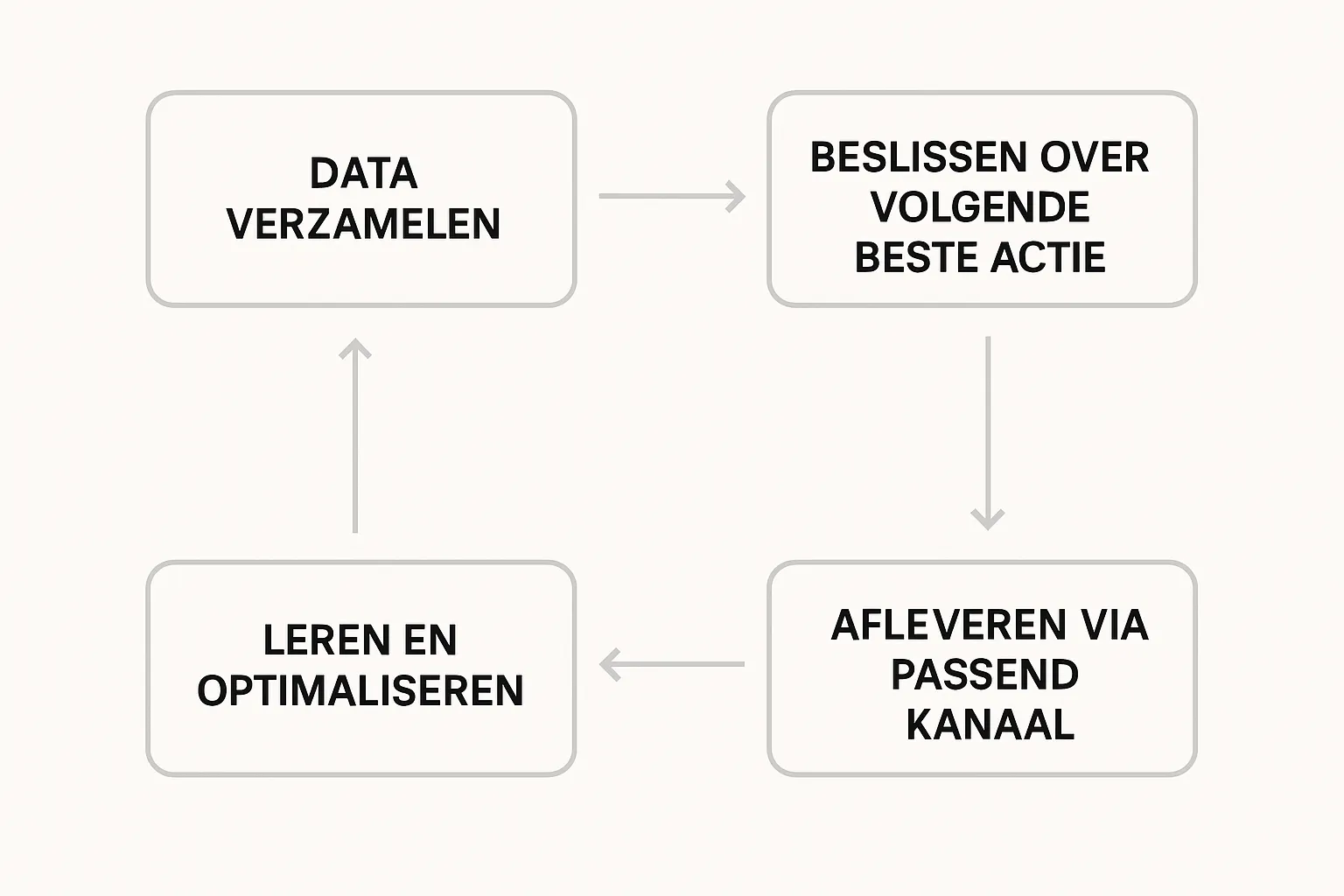
It works with four building blocks:
Data: CRM fields, purchase or quote history, website behavior, and support tickets.
Understanding: AI detects context such as role, industry, intent, and pain points.
Decisioning: the system chooses the next best action, for example a call, WhatsApp message, or product offer.
Delivery: messages are automatically personalized and sent, with feedback written back to your CRM.
This is fundamentally different from classic mail merge or generic sequences. Personalized AI learns from every interaction, improves continuously, and optimizes for conversion, not volume.
Why now, the business case in 2025
B2B buyers are moving heavily to digital channels. Gartner predicted that by 2025, 80 percent of B2B sales interactions would happen through digital channels. See Gartner’s 2020 press release for the context behind that shift, which is now clearly visible across many markets. This increases the need to be personal and relevant digitally.
Decision makers also expect the same level of personalization they experience in B2C. McKinsey has reported for years that customers expect personalized interactions, and that the absence of personalization creates frustration. B2B decision makers are the same people, with the same expectations around speed and relevance. Finally, talent shortages and rising costs put pressure on margins. AI that takes repetitive work off the team’s plate while also increasing conversion is therefore a double win. Salesforce’s State of Sales also shows that teams using AI report higher productivity, strengthening the adoption case.
What you need at a minimum to get started
A clean CRM with baseline fields you trust, such as industry, role, deal stage, and last touchpoint.
Access to core systems, such as ERP or order history, plus email, WhatsApp, LinkedIn, or phone for outreach.
A compact content library, 5 to 10 core messages per persona or industry, including a case quote and proof.
Clear guardrails: tone of voice, approved product claims, and legal boundaries, including opt-ins and privacy language.
When these are in place, Personalized AI can deliver value in days rather than months.
7 proven playbooks that drive more leads right away
Warm outbound based on intent: If a buyer visits your pricing page or a specific product category three times, AI sends a short, relevant follow-up email with two bullet points on value for their role and a suggested time to talk.
Fast lead response within 5 minutes: AI reads the form, detects urgency, and sends a tailored response, including a proposed time slot on the right rep’s calendar. Human follow-up remains possible, but the first touch is extremely fast and relevant.
Quote follow-up with a summary and a next step: After a quote is sent, AI creates a brief summary, highlights the business outcome, and asks for missing information or proposes a short call. This reduces time between quote and decision.
Reorder and cross-sell for wholesalers and distributors: AI predicts the reorder window per customer based on buying patterns and sends a personal reminder with replenishment suggestions. This increases recurring revenue without extra manual work.
Role-based nurture in professional services: A CFO receives different content than an operations manager, for example tax updates or cashflow improvement cases, written in the language of their role.
Service-to-sales for installation companies: After a service visit, a personal recommendation follows, for example preventative maintenance or a more energy-efficient alternative, including a rough savings indication and a CTA to book an inspection.
Account alerts for B2B brokers: AI matches profiles on square meters, location, ESG requirements, and lease term, then sends a short, personal update as soon as there is a match, with a suggested viewing.
These playbooks automate the first 80 percent of the work and give your team time for the 20 percent that wins deals: relationships, negotiation, and tailoring.
Implementing without hassle, a 30-day roadmap
Week 1, connect data and channels: Connect CRM and, if relevant, ERP. Enable email and WhatsApp. Define 3 priority personas, such as CFO, Operations, and Procurement.
Week 2, content and guardrails: Write core messages per persona, plus 5 common objections with short responses. Document tone of voice and legal boundaries, and have AI check messages against them.
Week 3, go live with the first playbooks: Start with fast lead response, quote follow-up, and one nurture sequence. Define clear KPIs, such as time-to-first-touch, reply rate, and meetings booked.
Week 4, measure and scale: Keep only what converts, stop what does not work, and add a channel, for example LinkedIn or WhatsApp. Then expand to reorder and cross-sell once the base is stable.
Quality, compliance, and brand protection
Human in the loop: Let AI generate suggestions and have sales quickly review them at critical moments, such as pricing and contracts.
Consistent facts: Use only approved product claims and have AI pull those claims from a controlled source. This prevents inconsistencies.
Privacy and consent: Respect opt-ins, provide clear opt-outs, and log every interaction. Adjust language and frequency per channel and region.
Brand voice: Define tone, length, and style, and test messages for readability. In B2B, short and concrete copy often performs better.
What to measure to prove it works
Time-to-first-touch: from new lead to the first relevant response. The target is minutes, not hours or days.
Reply rate and positive intent: not just opens. Look at real responses and requests to talk.
Meetings booked and show rate: ultimately, it is about conversations with decision makers.
Pipeline created and win rate: the revenue outcomes that justify the initiative.
Productivity: how much time your team gets back through auto-summaries, follow-ups, and CRM updates.
Anchor this with a baseline measurement and A/B tests per playbook. That keeps investment decisions sharp and transparent.
Industry examples, what personalization looks like in practice
Wholesalers and distributors: A buyer with historical orders in packaging receives a reminder right before the expected reorder date, with a proposal for pallet pricing and an alternative with a shorter lead time. The CTA is a quick confirmation link or direct WhatsApp contact with the account manager.
B2B product suppliers: A technical manager in the food industry receives a short case on hygiene and maintenance ease of your equipment, including an audit-prep checklist, plus an invitation for a 15-minute call.
Accountancy: A CFO gets a personal update on a tax regulation change relevant to their sector, plus a concrete calculation of the potential impact and an invitation for a free impact scan.
Installation companies: After an incident report, the customer receives a summary, advice for preventative maintenance, and a quote indication. If there is no response, a short voicemail follows on day three with a direct link to schedule a meeting.
B2B real estate brokers: A scale-up with a growing team receives a personal note about a new location with expansion options, parking ratio, and energy label, aligned to their search profile and budget range, with a proposed viewing slot.
Personalized AI with B2B GrowthMachine, what you get in practice
B2B GrowthMachine is built to accelerate SME sales with smart automation, without requiring you to build a data team.
Sales workflow automation: automatic follow-ups, outreach, CRM updates, quotes, and pipeline management so nothing gets dropped.
AI assistant for daily tasks: from summaries and reporting to research and planning, available at any time.
Sales and marketing automation: multichannel campaigns, nurtures, content generation, and customer engagement in one flow.
Lead generation: prospecting, data enrichment, and AI lead scoring to focus where buying intent exists.
Custom AI projects: agents and automations aligned to your processes and systems.
Integrations: connections with CRM, ERP, email, WhatsApp, Slack, accounting, or any API you use.
Ongoing optimization: monitor performance and improve playbooks when the data calls for it.
24/7 AI support and data-driven insights: dashboards and reports that support decisions.
The result is less manual work, more high-quality conversations, and a scalable system that grows with your pipeline.
Start fast and safely, without risk
Pick one playbook, such as fast lead response or quote follow-up, and run a 30-day pilot with clear KPIs. Work with small target groups, keep human review at the important moments, and expand once the data proves the uplift. This reduces risk and accelerates time-to-value.
If you want to minimize the technical setup and change management load, we can support you with data configuration, playbooks, guardrails, and dashboards. You go live in weeks, not quarters.
Next step
Plan a short discovery call to identify your three best personalization opportunities.
Start with one pilot and prove impact on reply rate, meetings, and pipeline.
Scale with additional channels and playbooks once the foundation converts.
To learn more about the broader role of AI in your operations, also read our article on how AI workflow automation transforms work and the analysis of AI versus manual work. For a forward-looking view on trends around hyperautomation and autonomous systems, see the future of AI automation.
Personalized AI in sales is not about sending more messages, it is about delivering the right message to the right person at the right time. Teams that do this consistently convert more leads and build a predictable, scalable growth engine.