
AI strategy consulting for SMEs: what’s the ROI?
Dec 23, 2025
AI is everywhere, but the real question for SME leaders is simple: what does AI strategy consulting deliver in euros, time saved, and less hassle. Whether you run a wholesaler, an installation company, a B2B supplier, a boutique accounting or law firm, or a real estate intermediary, a sharp AI strategy prevents scattered tools, duplicate costs, and disappointment. Below you will read what a strong engagement delivers in practice, how to calculate ROI, and how to drive noticeable results within 90 days without overloading your organization.
What is AI strategy consulting for SMEs, in one sentence?
A short, focused advisory engagement that translates your business goals into a feasible 90-day roadmap with proven use cases, the right data sources and integrations, clear KPIs, governance agreements, and a step-by-step plan to automate with human oversight where needed.
Where enterprise programs often become large and abstract, SME consulting stays pragmatic: pick one or two priorities, measure, prove value, and only then scale.
What does it deliver, concretely?
1. More revenue with the same team
By using AI in sales and marketing, you can make outreach, follow-ups, lead qualification, and content production faster and more consistent. The result is more qualified conversations, shorter time-to-quote, and fewer missed opportunities. Especially in wholesale and B2B supply, standard questions, price updates, and product advice can be handled well by AI assistants and workflows, so account managers spend time on high-value deals.
2. Shorter cycle times and fewer mistakes
From intake to invoicing, AI automates repetitive work and catches common errors. In boutique accounting and legal firms, document analysis and case file building speeds up, while in installation companies, scheduling, dispatch, and status updates run more smoothly. Less manual work means lower rework costs and higher customer satisfaction.
3. Lower cost per transaction
Automating small but frequent steps, such as CRM updates, quote revisions, status emails, inventory checks, or EDI messages, structurally reduces the cost per order or ticket. You feel this scale advantage immediately during peaks, without adding extra FTEs.
4. Better decisions with data that immediately triggers action
AI analyses only become valuable when insights lead directly to action. Think of prioritizing quotes with the highest win probability, re-order alerts that automatically start the right workflow, or proactive service messages that reduce inbound calls. Decisions get faster, with more confidence.
5. Less risk through governance and control points
A solid advisory engagement embeds privacy, data source management, and human-in-the-loop control, and gives you direction toward the EU AI Act. You decide up front what the assistant may and may not do, how output is logged, and how exceptions are handled.
Typical deliverables of a strong AI strategy sprint
Focus document with 2 to 4 priority use cases that deliver immediate value, including business framing, desired KPIs, and scope boundaries.
Data and integration blueprint, connected to your CRM/ERP, email, WhatsApp, Slack, or other systems you already use.
Governance agreements, such as source management, privacy, human-in-the-loop, and audit logging.
30-60-90 day roadmap with clear milestones, owners, and risk mitigations.
Business case and measurement plan, so you can prove results per sprint.
Buy/build/partner guidance, including a shortlist and selection criteria for tools and vendors.

A simple ROI calculation method that works
The core is straightforward: calculate based on hours saved, fewer errors, and extra margin from faster revenue. A workable formula:
ROI per quarter = (hours saved x internal hourly rate) + (errors prevented x average cost per error) + (additional profit contribution from deals that close earlier) minus (software + implementation + training)
Example, installation company with 12 technicians:
25 hours per week less manual work through scheduling automation and standard updates via WhatsApp and email, at a 45 euro internal hourly rate. That is roughly 4,500 euros per month in time savings.
Lower failure costs due to better intake and checklists, say 8 fewer incidents per quarter at 200 euros, 1,600 euros per quarter.
Faster quoting brings in 3 extra orders per quarter with 700 euros gross margin per order, 2,100 euros per quarter.
Subtract tooling and implementation costs. If net profit remains, you scale in a controlled way.
The numbers differ per company, but this way of calculating makes a pilot discussable with finance and leadership.
Sector examples, briefly
Wholesale and distribution. AI helps with quote generation based on current inventory and margins, demand forecasting, and proactive customer communication. The result is less waiting time, faster decisions, and higher order value.
B2B suppliers and manufacturers. From order intake to quality checks, AI assistants and workflows reduce handoff time between systems. You see earlier which orders are at risk and where acceleration pays off most.
Boutique accounting and legal firms. Document recognition, file building, and standard correspondence become faster and more consistent, with human review where needed. You gain time during peak periods without sacrificing quality.
Installation companies. Smarter scheduling and dispatch, automatic status updates, and an assistant that checks materials and re-order points. Technicians spend less time on admin, customers are better informed.
B2B real estate. Lead qualification, property documents, and standard reporting speed up, while appointments and follow-ups are logged automatically. The funnel becomes more transparent and predictable.
Choosing tooling without the hype
An AI strategy is stronger than the individual tools you choose, but in the end tooling does make the difference in day-to-day efficiency. Put the emphasis on integrations, ease of use, scalability, and total cost of ownership. A pragmatic approach to selecting AI solutions is clearly explained in this guide on selecting the right AI tools for your business. It helps you focus internally on real pain points, measurable goals, and structured trials with user feedback.
How B2B GrowthMachine runs an engagement like this
B2B GrowthMachine is built to modernize sales and operations for SMEs. We combine AI assistants, workflow automation, and integrations with your existing stack, plus ongoing optimization and 24/7 AI support for your team. No assumptions, with a measurement plan.
Our approach, short and to the point:
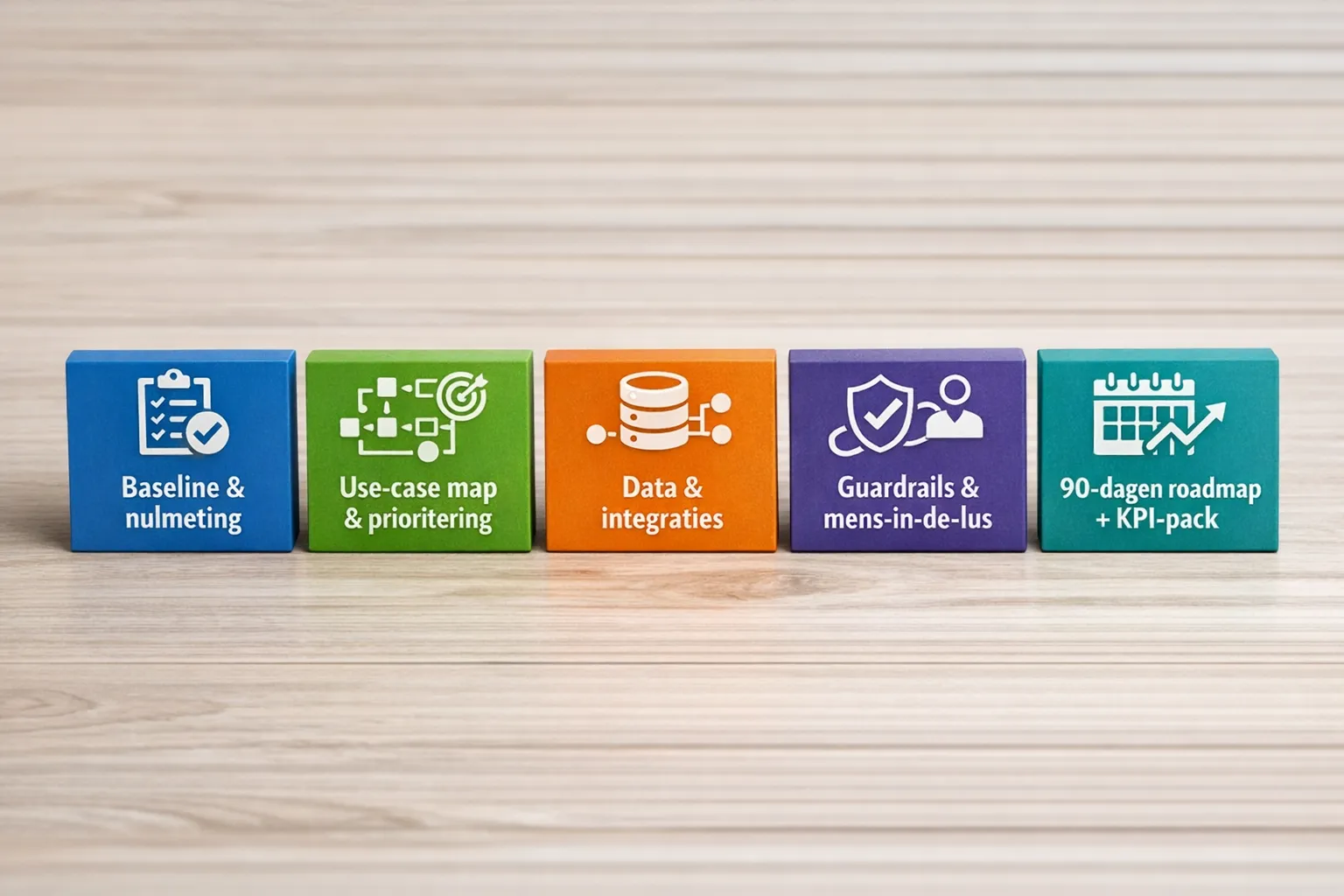
Weeks 0 to 2, Strategy Sprint. Goals, baseline measurement, prioritization of use cases, data and integration blueprint, governance, and measurement plan. You get a 90-day roadmap with clear KPIs.
Weeks 3 to 6, Pilot with human-in-the-loop. We automate 1 to 2 processes, for example outreach and follow-ups, CRM updates, a quoting copilot, or service intake. Your team tests, we monitor and improve.
Weeks 7 to 12, Scale and embed. We make successful pilots robust and extend them to other teams or processes. We set up dashboards, alerts, and continuous optimization.
What you notice: more leads, faster sales cycles, less manual work, and lower costs, while your systems keep running.
Quality, risk, and compliance handled
Privacy and source management. We limit data access, work with clear source lists, and separate production from experiments.
Human-in-the-loop. AI handles the routine work, people take exceptions and final decisions. That is faster and safer.
Logging and audit. Interactions and decisions are traceable. This helps with quality improvement and meets governance requirements.
EU AI Act aware. We work with proportional risk controls and document processes, so you do not have to fix later what you forget now.
Common pitfalls you want to avoid
Starting without clear KPIs, so nobody knows if it works.
Choosing tooling before your process and data are in order.
Starting too big, which stalls adoption and makes ROI invisible.
Not assigning an owner, so pilots get stuck.
Not building a feedback loop, so quality does not improve structurally.
Frequently asked questions
Isn’t AI strategy consulting only for large corporates? No. A compact strategy sprint is ideal for SMEs, because you target one or two processes, test quickly, and only scale when it works.
How fast will I see results? Often within 30 days on one process, for example faster lead follow-up, automatic CRM updates, or a quoting copilot. Structural gains build over 60 to 90 days.
What does an engagement like this cost? Costs depend on scope, chosen tools, and integrations. The key is to start small, build a clear business case, and scale based on proof.
Do I need to replace my entire IT stack? Usually not. Impact typically comes from AI assistants and workflows around systems you already use, such as CRM, ERP, email, WhatsApp, and Slack.
What about privacy and the EU AI Act? We work with clear data access, logging, source management, and human-in-the-loop. This keeps quality high and helps you move toward compliance step by step.
What is the minimum data I need to get started? Start with what you already have and what supports the goal, for example CRM activity, order history, or support FAQs. Smaller and reliable beats large and messy.
Ready to see proof in 90 days?
Do you want more revenue with the same team, shorter cycle times, and lower costs, without overloading your organization? Plan a short strategy session with B2B GrowthMachine. Together we pick one priority, deliver a pilot with measurable KPIs within 30 days, and scale as soon as the business case is proven. That is how AI becomes a growth engine instead of a cost center.