
Intelligent automation for growth without additional hiring
Dec 22, 2025
Extra hires are expensive, scarce, and slow to ramp up. Yet your organization still needs to respond faster, handle more quotes, and serve customers more consistently. The most direct way to increase capacity without adding FTEs is intelligent automation, smart automation that brings together AI, workflow orchestration, and system integrations. Not as a standalone tool, but as a growth engine that accelerates your entire value chain.
What intelligent automation in 2025 actually is
Smart automation is not classic RPA that only copies clicks. It is a combination of four building blocks that together form a scalable growth engine:
Signals, data, and triggers, for example new leads, customer questions, ERP events, or inventory changes.
A decision layer with AI, such as retrieval augmented generation for knowledge, scoring and prioritization, or rules with thresholds for risk and margin.
An action layer that actually does the work, such as sending email and WhatsApp, updating the CRM, drafting quotes, routing tickets, and generating reports.
A human check for exceptions, so employees only step in when risk, value, or uncertainty is high.
The result is straight-through processing where possible and human-in-the-loop where necessary. That delivers speed, a lower error rate, and predictable throughput without extra hiring.
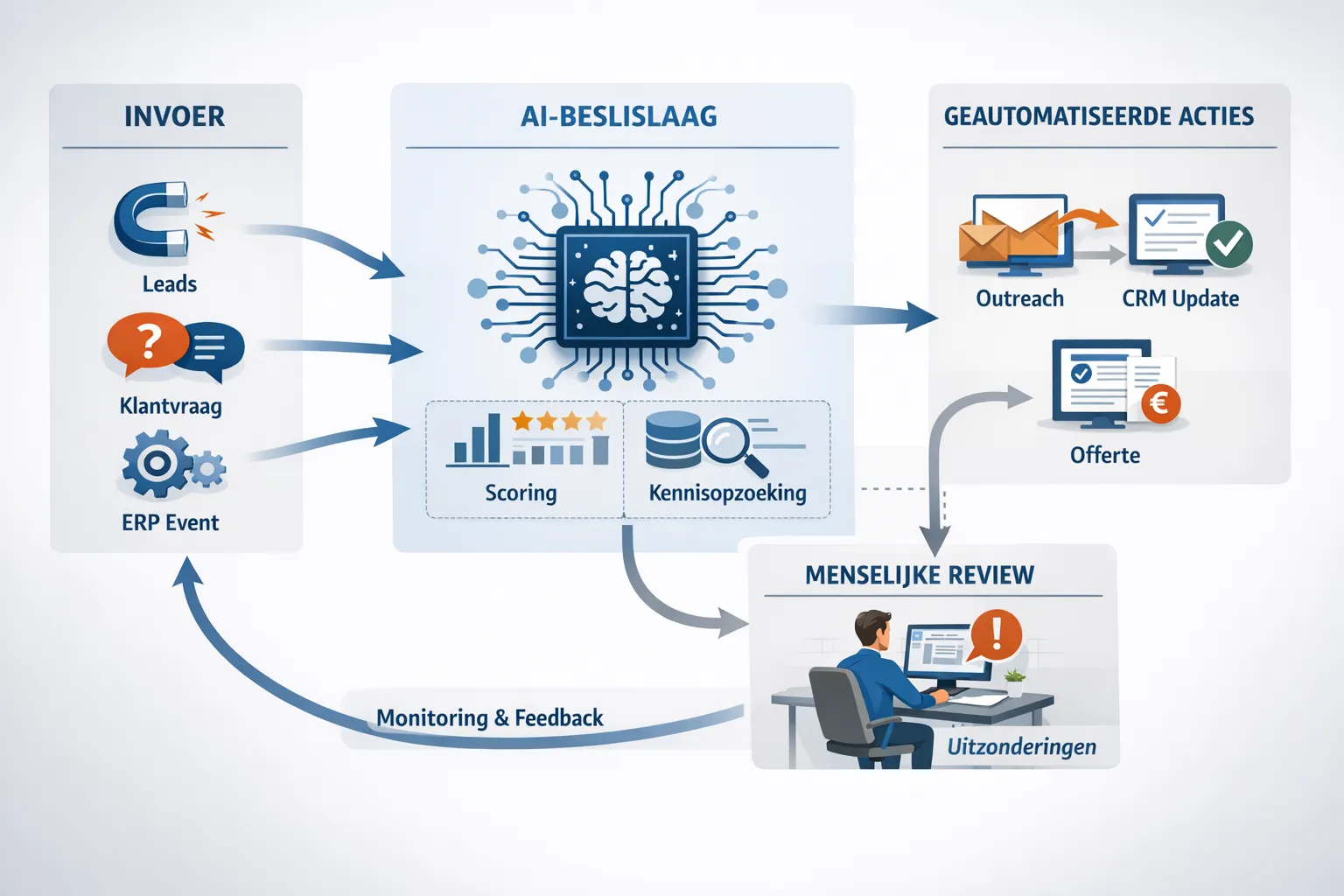
Growth without extra FTE: the five levers
Intelligent automation drives growth especially when you remove bottlenecks in your commercial and operational chain. These five levers usually create the biggest impact for SMB teams.
1) Respond faster to demand
In B2B, response time can kill conversion. Automate intake and triage, send an immediate first reply that is personally formatted, and proactively schedule a meeting. Let AI pull context from your CRM and website activity, fill missing data, and hand off to the right employee. You increase qualification rates without anyone chasing the inbox manually.
2) Convert more pipeline
Intelligent follow-up sequences combine data enrichment, relevant messaging, and a channel mix. Think of AI that selects value props, pain points, and reference cases per lead, and writes an appropriate follow-up, including reminders and automatic task creation for sales. Human review is only needed for top accounts or strategic proposals.
3) Higher order value and healthy margins
Automations that generate cross-sell and upsell suggestions during quoting or reordering can increase order value, as long as they are fed with up-to-date inventory, pricing agreements, and history. Add a margin threshold to the decision rules. Below that threshold, the system explicitly requests approval, above it, it can send automatically.
4) Retention and expansion with existing customers
Proactive updates, timely contract reminders, usage alerts, and onboarding flows reduce churn and increase expansion. AI summarizes changes, proposes a clear call-to-action, and sends it through the customer’s preferred channel. Your team focuses on the conversations that matter.
5) Fewer errors and less rework
By automating intake, validation, and system orchestration, many manual errors disappear. Think automatic address or item validation, enrichment of missing fields, or syncing ERP and CRM. Less rework shortens lead times and protects margins.
Sector mini playbooks that deliver value today
For wholesalers and distributors: automate quote preparation. AI retrieves pricing agreements, lead times, and alternative items, drafts an accurate quote, and schedules follow-up actions. Straight-through where all data is complete, otherwise a quick human check.
For B2B suppliers and manufacturing companies: trigger reorders based on usage, lead time, and seasonal patterns. Combine this with automated, personalized outreach including availability updates and suitable alternatives.
For accounting and legal boutiques: speed up intake and document triage. AI classifies documents, fills checklists, flags missing items, and creates a first draft advisory with references to internal knowledge. Employees validate and sign off.
For installation companies serving B2B: automate work preparation and scheduling. Based on location, certification, and availability, AI proposes a schedule, assembles material packages, and sends updates to the client.
For B2B real estate brokers: let AI qualify leads based on requirements and portfolio, immediately send relevant properties, and schedule viewings. Provide automatic progress reports to owners.
Why this works: capacity without headcount
Capacity increases when three things improve at the same time: less waiting time between steps, less variation in output, and less repeated work. Smart automation tackles exactly these three. The decision layer removes uncertainty, the action layer prevents queues, and the human check remains available for the 10 percent of cases that are complex or high risk. That increases throughput without hiring more people.
We see the same movement outside B2B. In travel, for example, it is already clear how AI speeds up processes at scale while also making them more personal. See this analysis on how AI makes customer journeys more personalized and efficient, including attention to privacy, bias, and the balance between humans and machines: how AI makes customer journeys more personalized and efficient. The principles apply broadly to your sales and service.
The 10-10-10 capacity method to find opportunities
Use a fast, disciplined way to find the best automation opportunities.
Write down the 10 most recurring tasks per role.
Select the tasks that happen more than 10 times per week or take more than 10 minutes each time.
Assess per task whether the input is digital, the rules are clear, and integrations exist.
Tasks that meet all three criteria are prime targets. Start with a maximum of three tasks, so you can see results within 30 days.
The technical building blocks, small and large
Start no-code where possible, API where necessary. That keeps you fast without sacrificing reliability later.
Triggers and data, from CRM, ERP, mailbox, forms, or webhooks.
Knowledge injection, for example RAG on contracts, product information, and price lists.
Decision logic, a combination of scoring models, business rules, and thresholds.
Actions and orchestration, email, WhatsApp, CRM updates, task creation, document generation, scheduling.
Human in the loop, clear review steps for high risk or uncertain cases.
Observability, logging, metrics, and feedback to improve continuously.
Measuring what really matters
Automation only succeeds when it measurably contributes to growth and cost reduction. Set up the right measurement points per chain.
Commercial: first response time, time to qualify, time to quote, follow-up meeting rate, conversion per stage, order value, and margin.
Operational: lead time per task, error rates, rework, SLA compliance, backlog length.
Team: time spent per role, number of handoffs, and employee satisfaction.
Work with a baseline, run a 2-week pilot, and compare like with like. Keep improvements by incorporating them into dashboards and operating rhythms.
A realistic 30-day plan without extra hiring
Week 1, scoping and baseline. Choose one process closely tied to revenue or margin. Capture current lead times, errors, and volumes. Collect the minimum data and define decision rules.
Week 2, prototype with human in the loop. Build the first workflow with triggers, a simple decision layer, and actions. Let employees review uncertain cases. Log everything.
Week 3, harden and integrate. Enrich with knowledge retrieval, stricter exception policies, and reliable CRM and ERP integrations. Add monitoring and automatic fallback when something fails.
Week 4, roll out and scale. Turn on straight-through processing for low risk cases, expand channel coverage, and establish a continuous improvement cadence. Immediately start on the next 10-10-10 opportunity.
Quality, privacy, and assurance as prerequisites
Data minimization and source management: use only the data needed, track source versions, label confidentiality.
Limit the action space of AI agents: explicitly define what they can and cannot do, and add thresholds per risk class.
Human escalation: mandatory review for legal, price-sensitive, or exceptional situations.
Logging and audit: record decisions, context, and actions so you can explain what happened and why.
EU frameworks: work in line with applicable privacy rules and sector standards, and manage vendor risk and lock-in.
What you can concretely expect from intelligent automation
More selling activity without extra hands: automatic follow-up, faster qualification, more and better quotes in the same time.
Lower operational costs: less copy-pasting and fewer errors, shorter lead times, and less rework.
Better customer experience: faster, more personal, and more consistent communication across channels.
Scalability by design: processes that handle peaks without extra FTEs.
How B2B GrowthMachine delivers this
B2B GrowthMachine is built for SMB teams that want to grow faster without extra hiring. We deliver, among other things:
Sales workflow automation: follow-up, outreach, CRM updates, quoting, and pipeline management.
An AI assistant for daily tasks: admin, scheduling, reporting, and research.
Sales and marketing automation: campaigns, sequences, lead nurturing, content, and customer interactions.
Lead generation: multichannel prospecting, data enrichment, and AI lead scoring.
Custom development: AI agents and automations tailored to your processes and systems.
Integrations: connects with CRM, ERP, email, WhatsApp, Slack, accounting, or any API.
Continuous optimization and 24/7 AI support: we monitor, improve, and keep everything up to date.
Data-driven insight: automatic reports and dashboards for better decisions.
Cost reduction: less manual work and fewer errors through smart workflows.
If you want measurable output within 30 days without adding FTEs, start with one process, one clear KPI, and a pilot with human in the loop. We help you find the 10-10-10 opportunities, build the prototype, and scale safely. Schedule a conversation and discover where your biggest growth without extra hiring is.