
Automation and AI: Build a Reliable Sales System
Jan 12, 2026
Most B2B sales teams don’t have a “lead problem”. They have a reliability problem.
Leads come in from email, referrals, forms, events, partner portals, and reps’ inboxes. Quotes get requested. Follow-ups get promised. Then reality happens: a busy day, a missing CRM field, a rep who forgets to log the call, or a handover that lives in someone’s head. Revenue becomes unpredictable, not because the market is random, but because your sales process is.
Automation and AI can fix this, but only if you build a system, not a pile of tools.
Below is a practical blueprint to build a reliable sales system using automation and AI, designed for SMEs in wholesale, distribution, B2B supply, accounting and legal boutiques, installation companies, and B2B real estate.
What a “reliable sales system” actually means
A reliable sales system is not “we send more emails” or “we use AI for copy.” It’s a set of operational behaviors that happen consistently even when people are busy.
Reliability looks like this:
Every lead is captured, enriched, routed, and worked within a defined time window.
Every opportunity has next steps, owners, and deadlines.
Every quote request has a predictable response path and quality checks.
Every pipeline stage means the same thing to everyone.
Every handoff from sales to operations happens with the right context.
AI makes this easier because it can:
Turn messy inputs (emails, PDFs, free-text requests) into structured data.
Draft first responses, summaries, and proposals faster.
Recommend next-best actions based on signals.
Execute workflows across tools (CRM, email, ERP, WhatsApp, Slack) when rules are met.
Automation makes it reliable because it enforces consistency.
Why “AI for sales” often fails in SMEs
Most AI projects in sales fail for boring reasons, not technical ones.
Failure mode 1: You automate the wrong bottleneck
If your real constraint is slow quoting, but you invest in outbound automation, you will create more leads you cannot serve well. Reliability gets worse.
Failure mode 2: You add AI without process definitions
AI can draft messages, but it cannot guess your qualification rules, margin constraints, delivery promises, compliance requirements, or brand boundaries.
Failure mode 3: Your CRM is not the source of truth
If the CRM is optional, any automation that depends on it becomes unreliable. AI amplifies the mess faster.
Failure mode 4: No controls, no monitoring
If you cannot answer “what did the AI do, when, and why?”, people stop trusting it. Then adoption collapses.
This is why you should design for reliability first, and AI second.
The reliability blueprint: 6 building blocks
Think of your sales system like a production line. AI can be a powerful worker, but you still need conveyor belts, quality checks, and clear ownership.
1) A single definition of “qualified” (and it must be operational)
You need a shared, written definition of what qualifies as:
A lead worth working
A sales accepted opportunity
A quote-ready request
A handover-ready deal
Keep it grounded in reality: industry fit, buying role, urgency signals, minimum order size, serviceability, and margin constraints.
This is where many wholesale and distribution teams win fast: qualification is often less about “pain points” and more about logistical fit (delivery region, credit terms, product match, lead time tolerance).
2) A clean intake layer (capture everything, automatically)
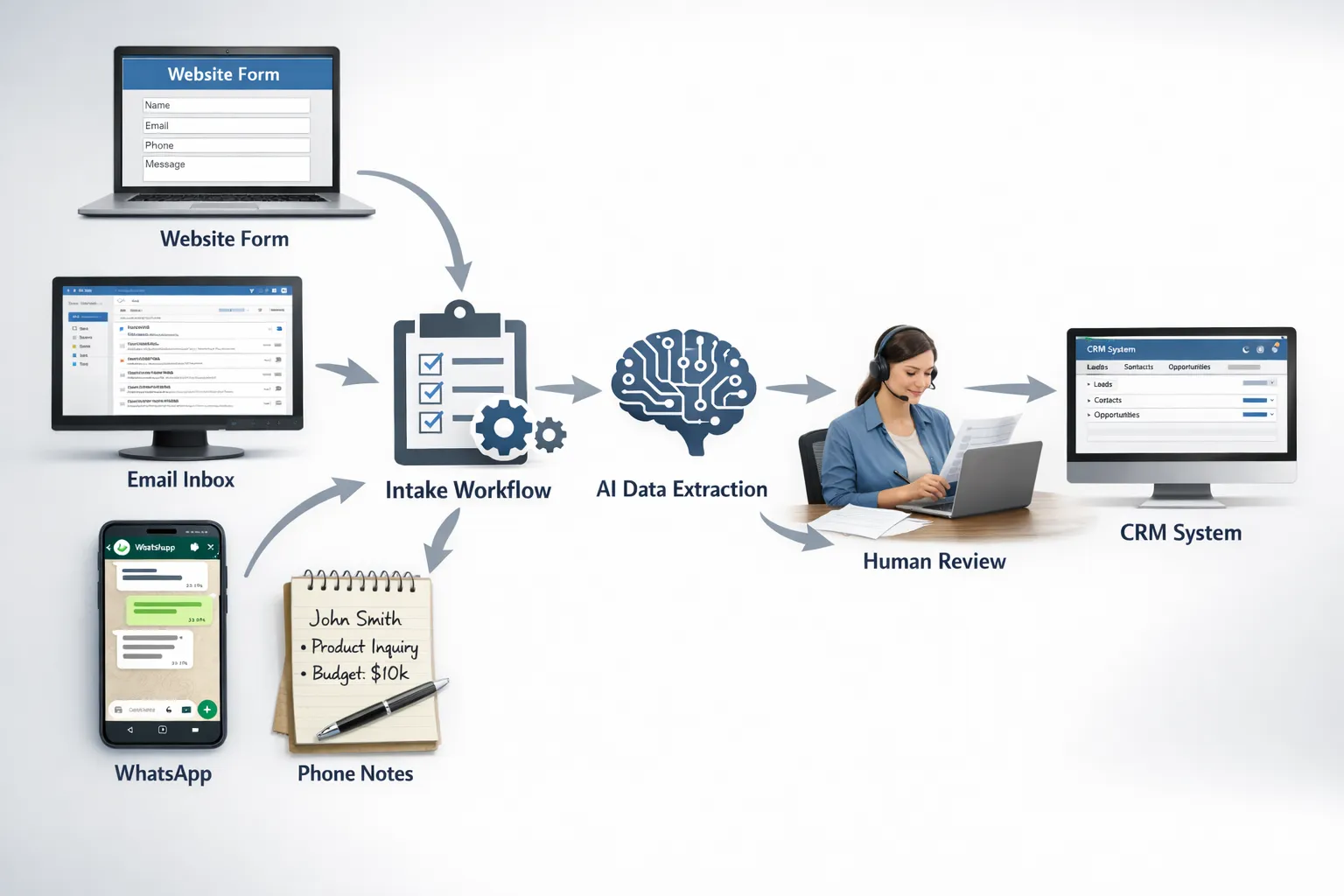
Reliability starts with intake. If requests arrive in ten places, you need one system that captures them consistently.
Common intake sources in B2B SMEs:
Website forms and chat
Shared inboxes like sales@ and support@
WhatsApp and phone callbacks
Partner inquiries
PDF quote requests
Referrals forwarded by internal teams
AI is especially useful here because it can extract structured fields from unstructured text and documents.
Practical approach:
Route all inbound requests into a single intake workflow.
Use AI to extract key fields (company, request type, products, urgency, location, budget range when available).
Create a “confidence + missing fields” check so humans can quickly validate before the record becomes official.
If you skip the validation step, you risk polluting CRM with hallucinated or misread data.
3) A routing engine that respects capacity
Routing is where most sales systems break.
A reliable routing engine does three things:
Assigns ownership based on rules (region, product line, account tier, language).
Enforces time-to-first-action targets.
Protects capacity by throttling, scheduling, or redirecting work.
AI can help by classifying lead intent and matching it to the right playbook, but the routing logic should remain explainable. If a rep asks why they received a lead, the answer should not be “the model decided.”
4) Follow-up that is scheduled, not remembered
Most revenue leakage is follow-up leakage.
Automation should ensure that when an opportunity hits a stage, follow-ups happen by default:
After a quote is sent, follow-up tasks are created automatically.
If no reply after X days, the sequence changes (email, call task, WhatsApp message, partner ping).
If a decision date passes, an escalation rule triggers.
AI’s role here is not just writing. It’s maintaining context:
Summarizing the thread so any team member can take over.
Suggesting next steps based on objections, product constraints, or delivery issues.
Generating a tailored “reason to follow up” that is grounded in the account’s reality (not generic nudges).
If you want to go deeper on designing multi-step nurturing and conversion rules, you can build on the full-funnel approach described in your own ecosystem, for example in the lead warming system guide: Convert Cold Leads to Hot Leads.
5) Quote and proposal workflows with quality gates
For many B2B suppliers, distributors, and installation companies, quoting is the heartbeat of sales reliability.
A reliable quote workflow is:
Fast enough to beat competitors
Accurate enough to protect margin
Consistent enough to scale across the team
Where AI helps most:
Turning request emails into a quote “brief” (products, quantities, delivery, constraints).
Drafting a quote cover email that reflects lead time and assumptions.
Checking for missing information before finance or operations gets involved.
Where humans must remain in control:
Final pricing, discount exceptions, and unusual contract terms.
Commitments about delivery time, scope, and liability.
If quote speed is a bottleneck in your business, it’s worth treating it as a system design problem, not just a template problem. (You already have a dedicated piece on this topic, so you can link operationally from here when relevant.)
6) Closed-loop reporting (so the system improves)
A system is only reliable if it gets better over time.
Closed-loop reporting means:
Every automated action is logged.
Every outcome is measurable.
Every failure has a feedback path.
Examples of measurable outcomes that matter across B2B SMEs:
Time to first response
Time to quote
Stage-to-stage conversion
No-response rate after quote
Lost reasons that are actually categorized (not “price” for everything)
When you build this loop, AI becomes more valuable because it gets better context and your workflows get tuned to reality.
The minimum tech approach (so you don’t overbuild)
You do not need a complicated stack to become reliable. You need a consistent architecture.
A practical “minimum” setup usually looks like:
A CRM as system of record
An orchestration layer (workflows that connect tools)
An AI layer (prompting, extraction, drafting, classification)
Integrations with email, calendar, and optionally ERP
A human-in-the-loop step for risk and exceptions
If you are integrating automation and AI into CRM and ERP, follow modern risk-aware guidance. The NIST AI Risk Management Framework is a useful reference because it pushes teams to define controls, monitoring, and accountability instead of relying on model optimism.
A 30-day build plan (realistic for SMEs)
You can build a reliable sales system in small, controlled steps.
Week 1: Map the sales workflow you actually run
Do this with the people doing the work.
Define:
Your real stages (not aspirational ones)
Required fields per stage
The top 3 leakage points (where deals die or stall)
Week 2: Fix intake and CRM hygiene first
Start with the boring foundation:
Ensure every lead source ends up in CRM.
Standardize required fields.
Add lightweight validation rules.
Week 3: Automate one high-impact follow-up loop
Pick one:
Quote sent to follow-up system
Demo booked to post-demo recap + next steps
“No response” to escalation workflow
This is where you get your first measurable win.
Week 4: Add AI where it removes friction (not where it adds risk)
Good first AI inserts:
Inbox triage and summarization
Data extraction from requests
Drafting first responses and follow-ups
Add guardrails:
Confidence thresholds
Required human approval for risky actions
Logging of inputs and outputs
Industry examples (how reliability looks in the real world)
Wholesale and distribution: speed + accuracy beats “more outreach”
A reliable sales system here often focuses on:
Fast quote turnaround for repeatable SKUs
Automated enrichment (account size, location, segment)
Clear handoffs to operations (availability, lead times)
The win is usually reduced cycle time and fewer quote errors, not just more leads.
Accountancy and legal boutiques: intake quality and scope control
Reliability problems often show up as:
Low-quality leads consuming senior time
Unclear scope in the first conversation
Missing documents and repeated follow-ups
AI + automation helps by:
Structuring intake (what service, deadlines, documents needed)
Summarizing calls and generating next-step checklists
Creating consistent follow-up requests for missing items
Installation companies selling to businesses: fewer handover failures
If your sales-to-operations handoff is weak, you get:
Missed site constraints
Scheduling chaos
Margin leaks due to rework
A reliable system focuses on:
Capturing job requirements at intake
Validating constraints before quoting
Automating the handover pack (scope summary, assumptions, contact details)
B2B real estate brokers: activity consistency and decision timelines
Reliability issues usually come from:
Leads not getting touched quickly
Viewing follow-ups not being consistent
Stakeholders changing mid-deal
Automation ensures every viewing triggers the same sequence, while AI can keep context and suggest next steps based on objections and timeline shifts.
Controls you need for “reliable”, not just “automated”
Sales automation without controls creates brand and compliance risk.
At minimum, build these controls:
Permissioning: who can trigger what action (especially outreach and CRM writes).
Audit logs: what the AI saw, what it produced, and what was executed.
Human approval gates: pricing changes, contractual claims, sensitive data.
Monitoring: error rates, fallback rates, and workflow failures.
Data minimization: do not feed unnecessary personal data into tools.
For EU-based SMEs, keep an eye on obligations under the EU AI Act, especially for transparency and governance when AI influences decisions that affect people. Even when your use case is not “high-risk,” good governance is what keeps the system trusted and stable.
Where B2B GrowthMachine fits (if you want this built, not just planned)
Building a reliable sales system with automation and AI typically requires more than prompts. You need workflows, integrations, guardrails, and continuous optimization so the system keeps working as your team, offer, and market change.
B2B GrowthMachine helps SMEs implement AI-powered sales and operations automation with:
Sales workflow automation (follow-ups, outreach operations, CRM updates)
AI assistants for daily tasks (research, reporting, admin)
Lead generation tooling and automation
Custom AI projects tailored to your workflows
Integrations with CRM, ERP, email, WhatsApp, Slack, and APIs
Continuous optimization and 24/7 AI support
If your goal is a sales engine you can trust, start with one workflow that currently leaks revenue (intake, routing, follow-up, or quoting), and make it measurable.
Learn more about the platform and approach at B2B GrowthMachine.