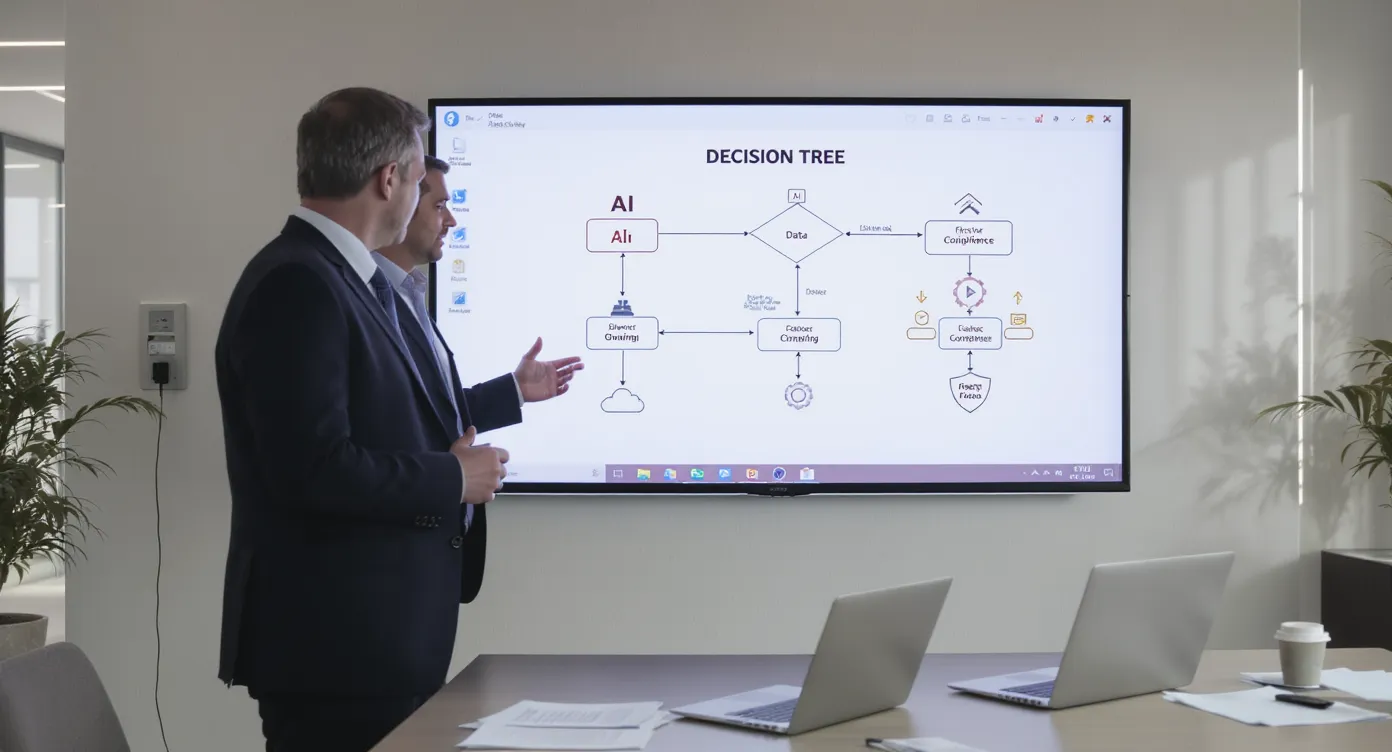
Choose the right AI engine for growth
Dec 6, 2025
Choosing your AI engine determines whether AI stays a fun experiment or becomes a measurable growth engine. For many SMBs, the landscape is confusing, with dozens of models, pricing schemes, and promises. In this article, you get a practical decision guide to choose the right AI engine that accelerates growth, reduces costs, and fits your processes and compliance requirements.
What is an AI engine, really?
By “AI engine” we mean more than just a language model. It is the combination of a core model and the orchestration around it that creates value in your workflows.
The core model, for example a general-purpose language model or a domain-specific model.
Orchestration, such as prompt templates, tool calling, integrations with CRM and ERP, and human-in-the-loop.
Knowledge injection, often via retrieval augmented generation, so the model can use up-to-date and company-specific information.
Security and governance, logging, versioning, access rights, and quality control.
So the right choice is a stack decision, not just a model decision.
Start with the growth goal, not the model
The best AI engine follows your growth strategy. Tie your choice to 1 or 2 concrete breakthroughs you want to deliver within 90 days.
Wholesale and distribution, shorten time-to-quote and increase conversion through automated pricing and inventory answers, quote creation, and follow-up.
B2B suppliers and manufacturers, automate lead qualification, order intake, BOM or SKU interpretation, and customer status updates.
Accounting and legal boutiques, speed up document intake, summaries, compliance checks, and email drafts with source references.
Installation companies, plan and replan automatically, pre-triage tickets, generate work orders and safety checklists.
Commercial real estate brokers, enrich listings, match properties to search profiles, and automate investor outreach with personalized emails.
Then choose the AI engine that serves these goals reliably, quickly, and cost-effectively.

Selection criteria that actually matter
Accuracy and consistency. Measure on your own tasks, with 30 to 100 realistic cases and clear evaluation rules. Watch factuality, source referencing, and consistency across multiple runs.
Latency and scale. For sales chat and support, response time is crucial; for batch processing, throughput and stability matter. Check p95 latency and supplier commitments on rate limits and uptime.
Total cost. Calculate per task, not per month. Look at tokens in and out, reuse through caching and summarization, and whether a smaller model with good instructions can reach the same quality.
Data and compliance. Confirm whether your data is not used to train public models, arrange processing within the EU where needed, and check certifications such as ISO 27001. Include EU AI Act and GDPR implications.
Integrations and orchestration. Connect to CRM, ERP, email, WhatsApp, Slack, and accounting. Test function calling and structured output for error-free API calls and correct CRM updates.
Control and governance. Version control of prompts and workflows, separation of sandbox and production, human review where needed, audit trail.
Vendor lock-in and portability. Avoid dependence with an abstraction layer and the ability to switch models, including open-source alternatives where appropriate.
Maintainability. Monitoring, automated regression tests, A/B tests, and a process for continuous optimization.
Architecture choice: RAG often works better than fine-tuning
For SMB use cases, retrieval augmented generation is usually the best first step. You index your knowledge sources, like product sheets, price lists, service manuals, contract templates, and CRM notes. The AI engine retrieves relevant passages and uses them as context for an answer or document. Benefits include fast implementation, higher factuality, simpler governance, and direct control over the sources used.
Fine-tuning is useful when the task is highly repetitive, always requires the same style, and enough labeled examples are available. Think email classification, intent recognition, or very domain-specific terminology. Prefer starting with RAG and collect training data in parallel. Fine-tune only if it clearly adds value.
PoC in 10 days: how to keep decision-making moving
Day 1 to 2, define a sharp use case with a target KPI, for example time-to-quote minus 40 percent, or 20 percent more meetings from cold outreach.
Day 3 to 4, collect data and build an evaluation set, 50 to 100 real cases with desired output and evaluation criteria.
Day 5 to 6, test 2 to 3 model options with the same prompts, RAG on a limited knowledge base, and basic integrations like CRM logging.
Day 7, measure quality, speed, and cost per task. Document errors and edge cases.
Day 8 to 10, decide, lock in governance, create a rollout plan, and define a maintenance cadence.
If you want more background on when AI delivers more value than manual work, read our article AI versus manual work.
Industry-specific rules of thumb for choosing an engine
Wholesale, distributors, B2B suppliers
Outputs with numbers must be traceable. Choose an engine that produces structured output, for example JSON, so prices, margins, and lead times land exactly in your systems.
Combine with RAG on price lists and policy documents, and let the engine call tools for real-time inventory and lead times.
For bulk classification or deduplication of product data, a smaller, cheaper model is often sufficient.
Accounting and legal boutiques
Choose models that are strong with long contexts and source referencing. Add RAG on standards, legislation, and internal templates.
Enforce citations and numbering via strict prompt templates and structured output. Enable human-in-the-loop for high-risk steps.
Check data retention, logging, and data location for GDPR and professional confidentiality.
Installation companies and technical services
Latency matters for planning and support. Combine a fast engine with tool calling to planning, warehouse, and ticketing.
Use a smaller model for triage and routing, and a more powerful model for complex diagnosis or safety checklists.
Commercial real estate brokers
Multimodal capabilities can be useful for photo or floor plan descriptions. Add RAG on property data and market statistics.
For outreach at scale, a high-quality model with tight persona and product context works better than random templates.
More inspiration on workflow automation can be found in How AI transforms workflow automation and in 5 essential AI tools.
Measure what matters, from pilot to production-ready
Business KPIs, time-to-quote, lead response time, meetings per 100 leads, conversion per funnel stage, first contact resolution, cost per case.
Quality, factuality and source references, precision and recall for classification, style consistency, tone of voice.
Operations, p95 latency, throughput, timeouts and error codes, token usage per task, rework and human correction.
Risk and compliance, PII incidents, red-teaming findings, audit trail coverage, model versions and prompt versions.
Use a lightweight scorecard per release and automate regression tests on your own evaluation set. The NIST AI Risk Management Framework provides a useful structure for risk and quality thinking.
Common mistakes and how to avoid them
Falling in love with a demo video. Always evaluate using your own data and tasks.
Fine-tuning too quickly. Start with RAG and strict prompts, fine-tune only after proof of added value.
No human-in-the-loop. Let people decide for risky or legal steps.
Prompt chaos. Manage prompts and workflows as code, with versions and tests.
Forgetting operational reality. Test under peak load and with real integrations.
No exit strategy. Build in portability so you can switch models without rebuilding everything.
Not enough attention to GDPR and the EU AI Act. Bake in data processing, explainability requirements, and risk controls early.
A 90-day roadmap to production value
Weeks 1 to 3, PoC on 1 priority use case, evaluation set, model comparison, RAG on a limited knowledge base, basic governance.
Weeks 4 to 6, expand to real integrations, CRM, ERP, email, human-in-the-loop, monitoring and KPI dashboard.
Weeks 7 to 10, pilot with real users, A/B variants, fail-safes, legal and security review.
Weeks 11 to 13, production rollout, support process, continuous optimization, backlog for additional use cases.
How B2B GrowthMachine helps you choose and scale
B2B GrowthMachine delivers AI-driven automation for sales and operations. We help you move pragmatically from strategy to results with:
Sales workflow automation, follow-ups, outreach, CRM updates, quotes, and pipeline management.
AI assistant for daily tasks, administration, planning, reporting, and research.
Sales and marketing automation, outbound, email sequences, lead nurturing, content, and customer engagement.
Lead generation, multichannel prospecting, data enrichment, and AI lead scoring.
Custom AI projects, agents, and automations for your specific processes.
Integrations with CRM, ERP, email, WhatsApp, Slack, accounting, and other APIs.
Continuous optimization, monitoring, and keeping automations up to date.
24/7 AI support and data-driven insights via reports and dashboards.
We advise vendor-neutral on model selection, set up RAG and orchestration, connect your systems, and ensure governance. The result is less manual work, faster sales cycles, lower costs, and scalable systems. To learn more about the strategic side of adoption, also see The future of AI automation.
Frequently asked questions
What is the difference between an AI engine and an AI tool? An AI engine is the combination of the model, orchestration, knowledge injection, and governance. A tool is an application on top of that engine, for example a chatbot or a quote module.
Should I fine-tune, or is RAG enough? Start with RAG in most cases. Fine-tuning only makes sense if you have many labeled examples and a repetitive task that demonstrably improves with training.
Can we keep data within the EU and comply with GDPR and the EU AI Act? Yes, choose vendors with EU data processing or EU regions and contractually confirm data is not used for model training. Consult EU AI Act and GDPR guidance if in doubt.
How do I estimate costs upfront? Calculate per task. Determine tokens in and out for a representative set, include RAG costs, and compare two model options, a premium and a compact model. Optimize prompts and apply caching.
Are open-source models a good idea for SMBs? Often yes, especially for classification, routing, and lower-risk tasks. For tasks with high accuracy requirements, a premium model may score better. A hybrid approach is common.
How fast can we go to production? With a sharp use case, limited scope, and reusable components, 6 to 12 weeks is realistic, including PoC, pilot, and the first rollout.
Which KPIs prove impact? Time-to-quote, lead response time, meetings per 100 leads, error reduction, hours of manual work saved, and cost per case. Combine these with quality measurements and latency.
Ready to choose the right AI engine and deliver measurable growth within 90 days? Schedule an introductory call with B2B GrowthMachine. We will help you sharpen the business case, select the best engine, and implement automation that keeps performing.