Most B2B teams don’t lose deals because their offer is bad. They lose them because the right prospect never replies, the follow-up happens too late, or the message feels generic.
Emails AI can fix that, but only if you treat it as an operational system, not a copywriting shortcut.
This guide shows how to use AI for better follow-ups and higher reply rates without turning your outreach into spam. It is written for real B2B operators (wholesale, distribution, accounting/legal boutiques, installation companies, and B2B brokers) who need predictable pipeline, not “clever” emails.
Why follow-ups fail in B2B (and why AI changes the game)
Follow-ups usually break for a few boring reasons:
No consistent next step after “sent”. Reps decide manually, and manual always loses to urgent work.
No context in the inbox. The person writing the follow-up does not see quotes, open tickets, delivery issues, contract terms, or the last call.
One-size-fits-all sequences that ignore role, industry, and timing.
Misaligned timing. Some leads need a follow-up 20 minutes later, others 7 days later with a different angle.
CRM drift (missing notes, wrong stage). You follow up as if it is a first touch.
AI helps because it can do three things at once:
Generate a draft quickly.
Pull relevant context (from CRM, email threads, ERP, proposals, call notes) if integrated.
Execute follow-up rules consistently (when to send, what to send, when to stop, when to escalate).
The big shift is this: reply rates rise when follow-up becomes a controlled workflow, not an individual habit.
What “Emails AI” should do (and what it should never do)
The best mental model is “copilot plus autopilot”.
What to automate with Emails AI
Use AI to remove repetitive work and enforce consistency:
Draft follow-ups that reference the last interaction accurately
Personalize by role and industry using a controlled set of facts
Route replies (positive, neutral, objection, unsubscribe, wrong person)
Trigger follow-ups based on signals (quote sent, quote viewed, meeting no-show, pricing question, ticket closed)
Update CRM fields (stage, next step, reason lost) based on observed intent, with human approval for sensitive changes
What not to automate (at least not fully)
Avoid giving AI full control over high-risk actions:
Sending emails that include legal commitments, discounts, delivery promises, or contractual language
Messaging regulated topics without review (finance, legal, medical)
Aggressive cold outreach without deliverability and compliance guardrails
A practical rule: AI can draft and propose. Humans approve anything that changes risk.
The follow-up system that increases reply rates (a practical blueprint)
If you want higher replies, you need three layers: timing, relevance, and trust.
Layer 1: Timing that matches the buyer’s reality
Most sequences are scheduled by habit (Day 2, Day 5, Day 9). Better sequences are scheduled by signals.
Examples of strong follow-up triggers:
A prospect replies with “send info” (this is not a no, it is a request for structure)
A quote is sent but not acknowledged within X business hours
A quote is viewed (or re-opened) and no reply follows
A meeting is booked, then rescheduled or no-show
A prospect asks a technical question (high intent) and the answer is delivered (perfect moment to move to next step)
AI is useful here because it can classify events and decide which playbook to run next.
Layer 2: Relevance built from controlled context
“Personalization” is not adding the company name.
In B2B, relevance usually comes from:
The job to be done (what they are trying to achieve)
Constraints (lead times, compliance, budget windows, approvals)
Risks (downtime, stockouts, errors, audits)
Their role (finance cares about cash and risk, ops cares about throughput, sales cares about speed)
Emails AI can produce relevance only if you provide it with a clean context package.
A simple context package for follow-ups:
Company: industry, size band, country
Contact: role, department, seniority
Reason for outreach: trigger, problem hypothesis
Prior thread summary: last 3 interactions in one paragraph
Offer element: what you proposed (one sentence)
Proof: one relevant case point or outcome (no exaggeration)
CTA: single next step
If you do not have these inputs, AI will “fill the gap” with generic text. That is where reply rates die.
Layer 3: Trust through deliverability, compliance, and tone consistency
Even great copy fails if your email never reaches the inbox, or if the prospect does not trust it.
Trust is built when:
Your domain is authenticated (SPF, DKIM, DMARC)
Your sending behavior is consistent (no sudden spikes)
Your emails are specific and non-pushy
Unsubscribe and consent are handled correctly
For deliverability basics and monitoring, Google and Microsoft provide official tools and guidance:
Google Postmaster Tools for domain reputation signals
Microsoft SNDS for Outlook sending reputation
DMARC overview to understand policy and alignment
(These are not “growth hacks”, they are the plumbing that keeps reply rates possible.)
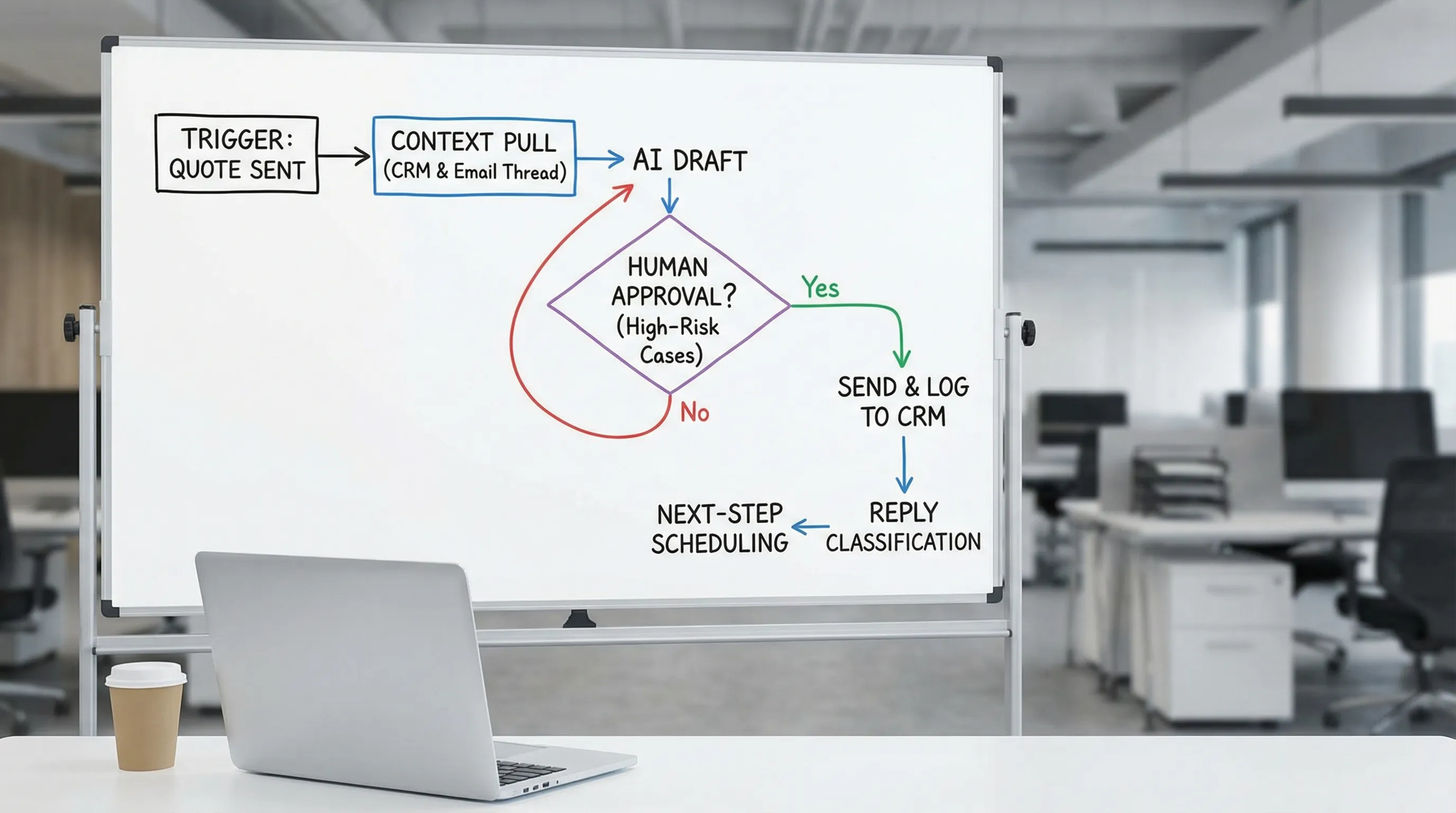
The 5 follow-up emails that Emails AI should generate (with intent-based goals)
Good follow-ups have different jobs. If every follow-up tries to “close”, prospects stop replying.
Below are five practical follow-up types you can generate with AI, each tied to a clear goal.
1) The clarification follow-up (goal: reduce friction)
Use when the prospect is silent after a clear proposal.
Key idea: remove decision friction.
Example prompt:
Write a short follow-up email.
Context: We sent a quote for [product/service] to [company]. They have not replied in 3 business days.
Role: [operations manager / finance manager].
Include: 1 sentence summary of what we proposed, 2 yes/no clarification questions, and a low-pressure CTA.
Tone: direct, professional, no hype.
Length: under 90 words.
```text

### 2) The value reminder (goal: reconnect to the buyer’s KPI)

Use when they went quiet after initial interest.

Key idea: tie the proposal to one metric they care about (speed, errors, uptime, cash).

Important: do not invent numbers. Use ranges only if your company can defend them.

### 3) The “right person” follow-up (goal: reroute fast)

Use when you suspect you contacted the wrong role.

AI can do this well because it can keep tone polite while being explicit.

### 4) The objection follow-up (goal: progress the conversation)

Use when they said:

- “Too expensive”
- “Not now”
- “We already have a supplier”

AI can draft structured objection handling, but you should provide allowed moves:

- Offer a smaller scope
- Offer a comparison call
- Offer an implementation timeline
- Offer a single case example

Do not let AI improvise discounts or terms.

### 5) The close-the-loop follow-up (goal: stop chasing and preserve brand)

Paradoxically, this often gets replies.

A well-written “I’ll close your file unless…” email works because it is respectful and clear.

AI drafts for this should be conservative. No guilt language.

## Use Emails AI to personalize by industry (without rewriting everything)

You do not need 200 sequences. You need a small set of playbooks with controlled variation.

Here are examples of what “real personalization” looks like by audience.

### Wholesale and distribution

Relevant follow-up angles:

- Stock availability and lead times
- Backorders and substitution handling
- Order accuracy and fewer exceptions
- Quote speed for repeat orders

High-performing follow-ups often reference operational reality:

- “If lead time is the blocker, we can propose a phased delivery schedule.”
- “If substitution approvals slow orders, we can align a pre-approved list.”

### Installation companies selling to businesses

Relevant follow-up angles:

- Planning and dispatch constraints
- Site readiness and dependencies
- SLA expectations and downtime risk

Good follow-ups focus on “next step clarity”:

- “To confirm feasibility, can you share site access windows and preferred install dates?”

### Accountancy and legal boutiques

Relevant follow-up angles:

- Intake quality (documents, completeness)
- Risk and compliance boundaries
- Response times and client expectations

Best follow-ups are calm and structured:

- “If timing is the issue, we can start with a narrow scope (only X) and expand later.”

### B2B real estate brokers

Relevant follow-up angles:

- Buyer criteria and decision committee
- Timeline, financing readiness
- Comparable availability

Follow-ups that work are specific:

- “Are you optimizing for location, cap rate, or time-to-occupancy? I’ll send only relevant options.”

## The metric stack: what to measure if you want higher reply rates

If you only track “reply rate”, you cannot diagnose what is broken.

Track a small set of operational metrics:

- **Speed-to-first-follow-up** (especially after inbound interest or quote requests)
- **Reply rate by follow-up number** (Follow-up 1 vs 2 vs 3)
- **Positive reply rate** (meetings, requests, clear next step)
- **Time-to-reply** (how quickly prospects respond after certain triggers)
- **Conversion to meeting or quote acceptance** (reply is not the end goal)

If deliverability is a concern, also monitor:

- Bounce rate
- Spam complaints
- Unsubscribe rate

For US compliance basics, reference the FTC’s [CAN-SPAM compliance guide](https://www.ftc.gov/business-guidance/resources/can-spam-act-compliance-guide-business).

If you operate in the EU, align with GDPR and local guidance. The safest approach is to design follow-up workflows with data minimization, clear legal basis, and a consistent opt-out process.

## The guardrails that keep Emails AI from damaging your brand

Most teams adopting AI for email make one mistake: they automate sending before they standardize quality.

Use these guardrails:

### Guardrail 1: Approved facts only

Create an “approved facts” block the AI may reference:

- Product/service scope
- Delivery promises you can keep
- Proof points you can defend
- Allowed CTAs

If a fact is not in the approved block, the AI cannot use it.

### Guardrail 2: Tone and length constraints

Reply rates drop when AI writes like marketing.

Set constraints such as:

- Under 120 words
- One CTA
- No hype words (revolutionary, game-changing)
- No false urgency

### Guardrail 3: Human approval rules

Require approval when:

- The email contains pricing, discounts, contract language, or delivery commitments
- The lead is strategic (high ACV, key account)
- The AI’s confidence is low (missing context)

### Guardrail 4: Stop rules

Your system should know when to stop.

Define stop conditions:

- Unsubscribe or explicit “no”
- No engagement after X touches
- Wrong person confirmed

This protects deliverability and brand trust.

## A practical 14-day rollout plan (lightweight, production-minded)

You can implement Emails AI for follow-ups without a long project, if you keep scope tight.

### Days 1 to 3: Pick one trigger and one sequence

Pick the trigger closest to revenue, for example:

- Quote sent
- Inbound lead form
- Meeting no-show

Write a “good enough” sequence of 3 follow-ups with human-written baselines.

### Days 4 to 7: Add AI drafting with context packaging

Connect the AI to the minimum context needed (CRM fields and email thread summary).

Implement “approved facts” and tone constraints.

### Days 8 to 10: Add routing and classification

Have AI classify replies into a small set of buckets:

- Interested
- Not now
- Not a fit
- Wrong person
- Admin request

Then route accordingly (create task, notify owner, update stage).

### Days 11 to 14: Add measurement and weekly QA

Set up a weekly review ritual:

- Read 20 random sent follow-ups
- Check for factual errors, tone drift, missing context
- Track reply rate by follow-up number
- Adjust prompts and rules

This is where the real gains compound.

## How B2B GrowthMachine can help

If you want higher reply rates, the biggest lever is not “better writing”. It’s **reliable follow-up execution with real context and integrations**.

B2B GrowthMachine helps SMEs implement AI-powered sales automation, including:

- Follow-up and outreach automation
- CRM updates and pipeline hygiene
- AI assistants for day-to-day sales admin
- Integrations with your existing systems (CRM, ERP, email, Slack/WhatsApp via APIs)
- Continuous optimization so performance improves over time

If you want to turn follow-ups into a system (not a manual habit), start with a small, measurable pilot around one trigger and one sequence.

Learn more at [B2B GrowthMachine](https://www.b2bgroeimachine.nl).