
AI Strategy Consulting: What You Get in 30 Days
Jan 19, 2026
Most AI initiatives fail for a boring reason: nobody turns “we should use AI” into a specific workflow, with owners, data access, guardrails, and a measurable outcome.
A good AI strategy consulting engagement fixes that. And for SMEs, it should not take a quarter just to produce slides.
If you are a wholesaler, distributor, B2B supplier, accountancy firm, installation company, or B2B real estate broker, a 30-day strategy sprint is enough time to get to a decision and a build-ready plan, as long as the scope stays tight.
Below is what you should realistically expect to “get” in 30 days, what it means in practical terms, and what you should not accept.
What a 30-day AI strategy sprint is (and is not)
A 30-day AI strategy sprint is a short, execution-oriented engagement that answers four questions:
Where will AI create measurable value first? (Revenue, margin, cycle time, or cost-to-serve)
What exact workflow will change? (Triggers, inputs, decisions, actions, approvals)
What data and integrations are required? (CRM, ERP, inbox, quoting, ticketing, spreadsheets)
How will you control quality and risk? (Privacy, security, EU AI Act awareness, audit trail)
It is not an “AI transformation program,” a tool shopping expedition, or a generic maturity assessment that ends with “it depends.”
The goal is to leave the month with a pilot you can actually ship (or a clear “do not proceed”).
The outputs you should expect after 30 days
Different consultants label deliverables differently, but the substance should be consistent. By the end of the month, you should have:
A single prioritised use case (or two tightly related ones) tied to a business KPI
A baseline and target (how you measure improvement and what “good” looks like)
A workflow specification that your team can implement (or hand to an implementation partner)
A data and integration blueprint (what systems, what fields, what access method)
A risk and controls plan (privacy-by-design, human-in-the-loop, logging, safe rollout)
A 30–60 day pilot plan (tasks, owners, timeline, acceptance criteria)
If a consultant cannot name these deliverables up front, you are buying uncertainty.
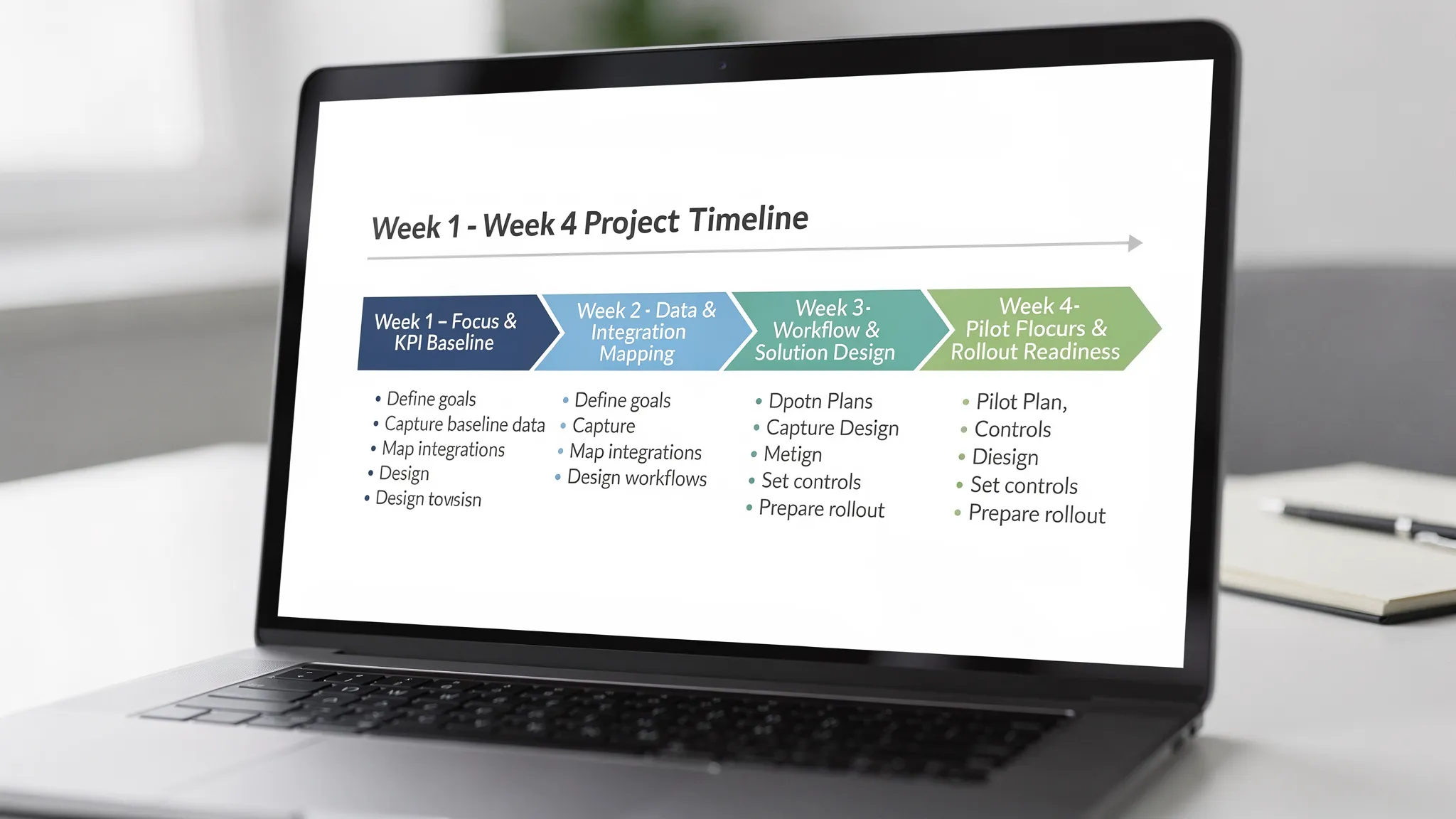
Week 1: Focus, value, and KPI baseline
Week 1 is about narrowing down. SMEs do not win by picking 12 “AI opportunities.” They win by choosing one workflow with high frequency and clear business impact.
What happens in practice
You should expect working sessions that look less like brainstorming and more like operational diagnosis:
Identify the top 3 to 5 workflows that consume the most hours or delay revenue (quotes, follow-ups, CRM hygiene, ticket intake, invoice processing, scheduling).
Separate symptoms from root cause (for example, slow quoting is often a data and approval problem, not a “writing” problem).
Define a KPI baseline using real numbers you can trust.
What you should have by end of Week 1
A strong Week 1 output is a one to two page “focus brief” that includes:
The chosen workflow and where it starts and ends
Current performance baseline (cycle time, hours, error rate, conversion, cost-to-serve)
The economic model (why improving this KPI matters)
Constraints (systems, compliance, language, channels, required approvals)
Example focus picks by sector
For context, here are common “first sprint” candidates:
Wholesale and distribution: quote turnaround time, order status updates, returns and claims intake
B2B product suppliers: lead triage and follow-up, product and pricing Q&A grounded in catalog data
Accountancy firms: client intake, document classification, draft responses with audit-ready traceability
Installation companies: scheduling exceptions, job intake validation, proactive customer updates
B2B real estate brokers: lead qualification, property matching, automated follow-up and meeting prep
The emphasis is always the same: pick something you can measure weekly.
Week 2: Data readiness and integration blueprint
Most AI projects stall because “the model” is not the problem. Access to the right context is.
Week 2 should turn “we have data” into a precise map of what the workflow needs, where it lives, and how you will access it safely.
What happens in practice
Expect a lightweight but rigorous inventory:
Systems of record: CRM, ERP, accounting, ticketing/helpdesk, file storage, email, WhatsApp/Slack
Data objects: accounts, contacts, products, price lists, deal stages, tickets, invoices, service jobs
Data quality issues that will break automation (missing fields, inconsistent naming, duplicate accounts)
Integration constraints (API availability, rate limits, permissioning, manual steps)
A good sprint also makes a clear call on knowledge approach:
When you can use retrieval (RAG) to ground answers in your documents
When you should rely on structured fields and rules
When you should not use generative AI at all (high-risk writes to master data, uncontrolled messaging)
What you should have by end of Week 2
You should walk away with:
A “minimum viable context” list (the smallest set of fields/documents needed to perform well)
A simple integration plan (what connects to what, and what is read-only vs write)
A shortlist of known blockers (and whether they are fixable inside the pilot window)
This is where strategy becomes real engineering.
Week 3: Workflow design, controls, and build/buy decisions
Week 3 translates your chosen use case into an implementable system. Not a diagram for its own sake, but a decision-ready design.
What happens in practice
You define the operational backbone:
Trigger events (new inbound lead, quote request, overdue follow-up, new ticket, low stock exception)
Required context (CRM fields, ERP pricing rules, customer history, product catalog, policy docs)
Decision logic (rules, thresholds, confidence gates)
Actions (draft email, create task, update CRM, request approval, send internal alert)
Human checkpoints for riskier steps (approval before sending, review before posting updates)
You also choose the implementation approach:
Plug-and-play workflows vs custom AI agents
Which automations must be integrated (CRM, ERP, inbox) to create real ROI
What needs monitoring from day 1 (quality, fallbacks, escalation rate)
Governance and compliance are not optional
Even in a 30-day sprint, you should see explicit decisions on:
Data minimization and retention (what the AI can access, what it must never store)
Logging and audit trail (what decisions were made, by whom, and based on what inputs)
Vendor and third-party risk (DPAs, sub-processors, access control)
If you need support on privacy, data protection, or broader governance and risk topics, it can be useful to involve a specialist GRC partner such as Privacy & Legal Management Consultants Ltd. alongside your AI implementation team.
What you should have by end of Week 3
A solid Week 3 outcome is a “pilot design pack” containing:
The workflow specification (step-by-step)
Acceptance criteria (what outputs are considered correct, safe, and usable)
Control points (human review, escalation paths, prohibited actions)
A clear build/buy/partner recommendation for the pilot
Week 4: Pilot plan, measurement, and rollout readiness
Week 4 is where many consultants stop short. You should not.
You are not buying a concept. You are buying a plan that can go live without turning into chaos.
What happens in practice
You finalize:
Pilot scope (which teams, which segment, which channels)
A measurement plan that includes both outcome metrics and leading indicators
Rollout mechanics (staged launch, shadow mode, human approvals, rollback plan)
Ownership and operating rhythm (who reviews results weekly, who fixes issues)
What you should have by end of Week 4
A practical sprint ends with:
A pilot backlog with tasks your team can execute immediately
A timeline for the next 30 to 60 days
Clear responsibilities (business owner, ops owner, technical owner)
A go/no-go checkpoint definition
This is also where you should confirm the “next constraint.” If the pilot depends on cleaning thousands of CRM records, you need that work scoped and owned, not hand-waved.
What “good” looks like: measurable outcomes, not activity
In a 30-day strategy sprint, you usually do not claim business results yet (because you have not deployed). But you can and should lock in measurable targets.
Examples of strong targets include:
Reduce time-to-first-response for inbound leads
Reduce quote cycle time from request to sent quote
Increase follow-up completion rate without adding headcount
Reduce rework from incomplete intake (missing data, wrong product, wrong company info)
Avoid vague goals like “use AI to improve productivity.” That is how strategy decks become shelfware.
Red flags: what you should not accept in a 30-day engagement
A short sprint has no time for fluff. Be cautious if you see any of the following:
Tool-first thinking (“let’s implement a chatbot”) without a defined workflow and baseline
No data access plan by week 2
No controls plan (human-in-the-loop, logging, privacy) by week 3
A roadmap that depends on perfect data before you can start
“ROI” presented without linking to hours recovered, cycle time, error reduction, or conversion
In B2B settings, especially where pricing, contracts, and customer commitments matter, lack of controls is not just risky. It is expensive.
Where B2B GrowthMachine fits
If you want the 30-day sprint to lead into implementation quickly, pick a partner that can design and deploy workflows, not just advise.
B2B GrowthMachine focuses on AI-powered sales and operations automation for SMEs, including workflow automation, integrations across core systems, and continuous optimization. That makes it easier to move from strategy to a working pilot without losing momentum.
If you want the broader picture of how AI strategy consulting translates into ROI for SMEs, this companion piece provides additional context: AI strategy consulting for SMEs: what’s the ROI.
A practical next step
If you are considering AI strategy consulting, go into the first call with one simple requirement: by day 30, you want a pilot plan that names the workflow, the data, the controls, and the KPI target.
That is the difference between “talking about AI” and installing an AI growth engine in your day-to-day operation.